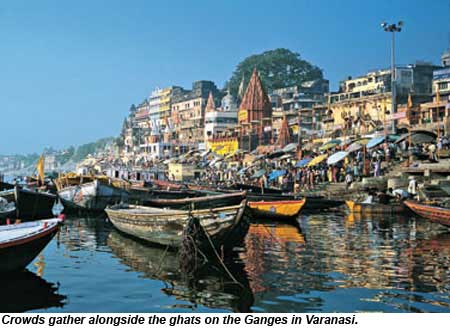
 The first rays of sun are just breaking through the early morning mist, but already the narrow streets leading down to the Ganges River in Varanasi are thronged with people.
Food stalls are doing a roaring trade, but the busiest people are the barbers, both inside tiny roadside shops or on the flight of steps (called a ghat) leading down to the river.
It is the last day of one of the major festivals of the Hindu calendar, and for the male devotees, many of whom have come long distances to be part of the celebrations, having one's head completely shaved is part of the ritual.
By the time the sun has risen, the banks of the Ganges are a hive of activity. The devotees, as well as many locals, use the river for their ablutions. The river is full of soap, shampoo and the many flowers used as part of the ceremony.
The largest crowds have gathered at the Dr. Rajendra Prasad ghat, named after the first president of India, but all along the river other ghats are being used.
I board a small punt and am rowed up and down the Ganges, surveying the colorful scene and watching the sun's increasingly powerful rays change the hues of the pinkish-red buildings along the water's edge. Only a short distance upstream is the place where many burials are carried out during each day (and into the night), the bodies being cremated on huge bonfires stoked by large hunks of wood. For the Hindi faithful, being cremated at the Ganges is a very desirable departure.
 I glimpse the Vishwanath (Golden) Temple, its gold plating — a gift of Maharaja Ranjit Singh in 1835 — a stark contrast to the overwhelming sense of poverty of many of the devotees. Security is tight around the temple and the adjacent Gyanvapi Mosque, and I have to hand over my backpack, as cameras are not allowed inside. Fortunately, my guide has an arrangement with a shopkeeper to take cameras to the other end of the alleyway, where they are returned to me.
At dusk I go back to the river and watch the faithful, led by priests waving fiery torches, chant passages from the sacred texts. Afterward the narrow streets become a lively, crowded market selling everything from fragrant flowers and other objects used in the rituals; lovely saris and jewelry as well as foodstuffs. Sacred cows wander about quite unconcerned by the press of people; I watch a small calf suckle its mother in the middle of the road. Varanasi is famous for its silk brocade and other fabrics, and some excellent carpets are made in the homes of villages close to the city.
Other Varanasi temples worth visiting include Bharat Mata, Durga (lots of monkeys there) and Vishwanath Temple.
Varanasi is a thriving city and educational center. Its major university, the Benaras Hindu University, boasts a leafy campus that contrasts dramatically to the dry and dusty streets of the rest of the city.
The Ganges at Varanasi is among the great spiritual places for Hindus. Only six miles from the city, an area called Sarnath is revered by Buddhists as the place Buddha preached his sermon enshrining the principles of his teaching into laws. Among the archaeological remains are two stupas; the best preserved is the Dhamekh stupa. The nearby Archaeological Museum contains wonderful sandstone carvings, some dating back more than 2,000 years.