South Jeolla Province. Not a name that rolls trippingly off the tongue.
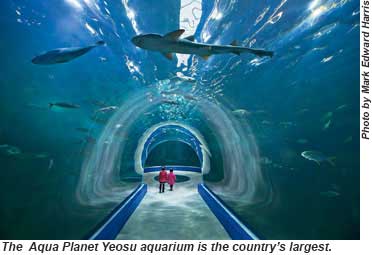 But what this southeastern section of South Korea lacks in cool nomenclature it more than makes up for in natural beauty and off-the-beaten-path travel opportunities. Tea fields, bamboo forests, wetlands and 500 miles of dramatic coastline are connected by a well-maintained highway and road network, most with bilingual signs. Just off the coast are more than 300 islands, many of which are part of Korea's national park system.
The city of Yeosu made significant investments in tourism infrastructure as it prepared to host the 2012 World Expo. While many of the expo-specific installations are now just a memory, buildings such as the magnificent Aqua Planet Yeosu aquarium were designed for the long term. The aquarium's 6,030-ton tank, the country's largest, contains not only abundant sea life but hosts synchronized swimming performances throughout the day.
Near the aquarium and accessible via a breakwater walkway is picturesque Odong Island, famous for its camellia trees that produce beautiful red blossoms in spring. Odong is known to the young couples who stroll its walking trails arm in arm as the "Island of Love." Also in the area is Dolsan Island, connected to Yeosu by Dolsan Bridge, Korea's largest cable-stayed bridge.
Hyangiram Hermitage is among Yeosu's most popular tourist attractions. Perched high above the South Sea, the temple, founded by the Silla monk Wonhyo in 644, offers some of the most beautiful sunrises and sunsets in the country. The hike to the temple takes visitors up a steep flight of steps and through narrow rock gorges. The hermitage itself is built into the rocky face of Mount Geumosan and offers spectacular views of the sea and coastline.
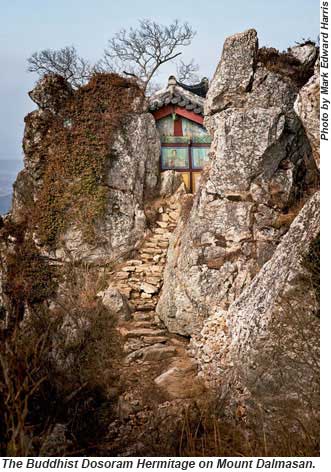 Much farther off the beaten path, perched on the west side of Mount Dalmasan, is the Buddhist Dosoram Hermitage, part of the Mihwangsa Buddhist temple that was established in 749 during the Silla Dynasty.
Along the coast west of Yeosu is the Suncheon Bay Ecological Park, the world's fifth-largest wetland, composed of a two-mile-long stream running through a 5,490-acre tideland and a 570-acre field of reeds that is home to the many species of plants that thrive in damp conditions.
Among all of the world's wetlands, Suncheon Bay is known for attracting the largest number of rare birds, including the hooded crane, the white-naped crane, the white stork, the black-faced spoonbill and the Eurasian oystercatcher. In all, approximately 140 species of birds either live in or migrate through the area. Independent travelers can reach Suncheon from Yeosu Airport by airport bus. For those with particular interest in flora and fauna, this year presents a unique opportunity, with the International Garden Expo Suncheon Bay Korea 2013 taking place through Oct. 20.
A seven-day regional tour designed for FITs as well as groups who want to visit the Garden Expo in Suncheon Bay and experience the southwestern part of Korea has been put together by Seoul-based Hanjin Travel.
Its six-night, seven-day Eastern Korea & International Garden Expo Suncheon Bay Korea 2013 tour takes advantage of South Jeolla's greatest hits for approximately $1,100 based on double occupancy. Accommodations; daily breakfasts; four local lunches; all transfers via private vehicle, including to and from Incheon Airport; admissions to all sites; and an English-speaking guide are included.
In addition to exploring Yeosu and the wetlands, the tour includes a night in Seoul, an exploration of Jeonju Hanok Village with an overnight stay in an ondol (a traditional Korean house with under-floor heating), the magnificent terraced Boseong Green Tea Plantation and nearby Bamboo Garden, the Seonamsa Temple and Naganeupseong Folk Village.
The sprawling Seonamsa Temple complex on the west end of Mount Jogyesan is often used as shooting location for period films and TV shows. Naganeupseong Folk Village is a well-preserved castle town that is over three square miles, where approximately 100 families still reside within its walls. Visitors can observe the dwellings and traditional craftmaking indigenous to this southern provincial area as well as sample traditional foods. Nine houses within the compound are designated as important cultural resources, and numerous straw-roof houses dot the landscape.
Wook Kyun Kim, president of Aju Incentive Tours, feels that South Jeolla is full of treasures yet to be discovered by overseas visitors. His company, named as one of the top tour operators in Korea by the country's Ministry of Culture, Transportation and Tourism, specializes in creating itineraries to fit a client's specific interests, from cooking classes and temple stays to adventure travel and art exploration. Aju works with U.S. travel agents by offering net prices that the U.S. agents can then put a margin on.
Yeosu is the usual starting point for exploring South Jeolla Province. Flights from Seoul's Gimpo Airport take about an hour to Yeosu Airport, while trains from the capital's Yongsan Station and buses from the Seoul Express Bus Terminal take approximately six hours.
Visit http://english.visitkorea.or.kr.