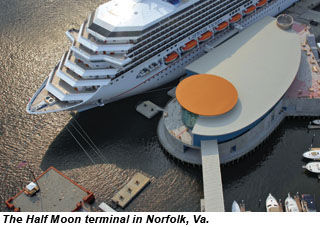
In 2007, Norfolk, Va.'s glassy, modern, $36 million Half Moon cruise terminal opened to great fanfare.
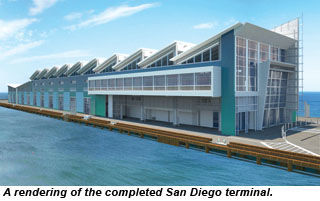
In December, San Diego is scheduled to open a $21 million cruise terminal.
About 120 miles north, the Port of Los Angeles is investing $10 million in improvements to its cruise facility.
The only thing lacking at these world-class facilities will be cruise ships.
Despite making significant investments, each of these ports will host its lowest number of cruise vessels and passengers in more than five years.
 San Diego will see a 45% reduction in cruise ship traffic this year. Los Angeles will greet 144 cruise ships in 2011, down from 265 in 2008. And those numbers are the envy of Norfolk's Half Moon terminal, where a total of 11 ships will call this year, with only six calls on the books for 2011.
Such is the plight of U.S. ports trying to be players in an industry as fickle as cruising at a time when European and other faraway ports are again beacons for cruise lines. (Click on chart at right for a larger view of cruise passenger counts at three U.S. ports.)
Cruising Down Under
Consider this: Celebrity Cruises earlier this summer said it was canceling its departures out of Baltimore and would instead return to Australia and New Zealand next year, reversing a 2008 decision to leave the Down Under market and put a ship in Baltimore.
 That kind of mobility enables cruise lines to tap new markets and create new itineraries with relative ease, while the U.S. ports they serve enjoy no such flexibility.
Besides Celebrity, Royal Caribbean International, Holland America and Princess have all committed additional capacity to Australia over the next few years. According to Cruise Down Under, a regional, cooperative cruise marketing organization, that could mean an increase of as much as 20% in the number of cruise ships visiting the area during the winter 2011-12 season (the austral summer).
Princess recently said it was putting an unprecedented four ships in Australia in 2011; citing increased demand from Australians, Princess' sister company, Cunard Line, recently said that the Queen Mary 2 would be based in Australia in 2012 for a circumnavigation of the continent, a first for Cunard; Royal Caribbean will deploy two ships to Australia in 2011, adding the Radiance of the Seas out of Sydney. The Radiance will join the Rhapsody of the Seas, currently sailing its third Australian summer season.
Dubai has also seen a major increase in cruise traffic; citing strong demand, Royal Caribbean will lengthen the Brilliance of the Seas' Dubai season during winter 2011-12.
The 2,501-passenger ship will return to Dubai in November 2011, two months earlier than previously planned, and will offer more itineraries, including longer cruises of 12 to 18 days.
Costa Cruises signaled its dedication to Dubai in February by holding the naming ceremony there for its newest ship, the 2,286-passenger Costa Deliziosa.
Costa, Carnival Corp.'s Italian cruise brand, will carry 140,000 passengers on three ships from Dubai this year, triple the number when it began in 2006. As this growth continues, Costa decided to reduce its ships out of Florida next year from two to one.
The hardest-hit of U.S. cruise markets are on the West Coast, where Royal Caribbean pulled the Mariner of the Seas from the Mexican Riviera in favor of a move to the Mediterranean beginning in January; Norwegian Cruise Line pulled the Norwegian Sun from the Mexican Riviera in 2011, at the same time that it will be homeporting a ship in Copenhagen, Denmark, for the first time.
Carnival Cruise Lines took the 2,052-passenger Carnival Elation from its year-round perch in San Diego this past spring and instead is sailing the ship out of Mobile, Ala.; its newest ship, the 3,690-passenger Carnival Magic, will mark the line's return to Europe next year after a two-year hiatus, sailing the Mediterranean from Barcelona.
 Princess Cruises and Holland America Line, Alaska's two largest cruise operators, have significantly reduced their Alaska capacity: Princess by 16% this year and HAL by 7% in 2011.
Much of the loss for U.S. ports is Europe's gain. Holland America will base seven ships in Europe this summer, including its newest vessel, the Nieuw Amsterdam, while Princess will have its largest-ever Europe deployment this year and next.
In explaining these moves, those lines' parent company, Carnival Corp., cited the "astronomical" costs Alaska puts on the cruise industry in taxes and fees.
"If it pays to pull a ship from Alaska and put it in Europe ... they will do that," Carnival CEO Micky Arison said of the company's brands. "That is exactly what they did in 2010, and we are going through those reviews right now, and it is likely we are going to do more of it in 2011."
California's ports have been hit by problems on three fronts: the cumulative impact of Alaska's problems, because ships that summer in Alaska often winter in Los Angeles or San Diego; the breakout of H1N1 swine flu in Mexico coupled with drug cartel violence in Mexican border areas, because Southern California is where most Mexico cruises begin; and a slow source market, because the area's economy was among the hardest hit by the recession.
Those factors have contributed to a dip in cruise fares that the lines say is not sustainable.
"We truly wish we could justify the ship remaining in L.A., but we are unable to do so," Royal Caribbean CEO Adam Goldstein said about redeploying the Mariner. "Yes, she does normally go out full ... yet the ship does not perform at an acceptable level to be able to remain in California. Throughout the industry, ships normally go out full. The critical question is, at what price? ... We are obligated to our shareholders to deploy her where she can earn superior returns."
West Coast ports can only hope that the cycle will turn around soon.
"It's our turn," Chris Chase, the marketing manager for the Port of Los Angeles, said of the area's downturn after years of growth. "The Mexico market is tough. There was H1N1 last year, perceived security issues and the economy of Southern California. ... They can make more money elsewhere, especially in Europe.
"There are always ebbs and flows. Fortunately we've been on the positive slope for a while."
And the winners are ...
U.S. homeports are by no means out of the game; in fact, several are doing well and some are doing better than ever.
It helps that the world's largest cruise line, Carnival, has expressed publicly its faith in homeport cruising and the most new ships begin life in a Florida port.
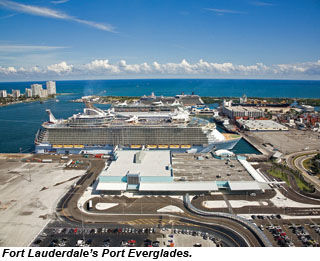 Fort Lauderdale's Port Everglades is homeport to the world's largest cruise ship, the Oasis of the Seas; Miami is home base for the Norwegian Epic; Baltimore will host 91 cruise ship visits this year, up from 27 in 2008; and Galveston, Texas, will become the U.S. homeport for the Carnival Magic, contributing to a 28% increase in Carnival capacity at the port in 2011.
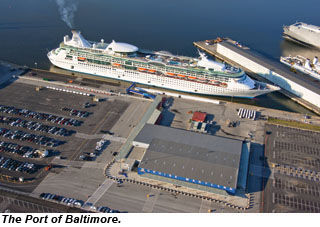
Baltimore will see a record 190,00 cruise passengers come through its port this year, only four years after opening its first-ever terminal dedicated to cruising and one year after welcoming the Carnival Pride, its first year-round cruise ship.
"It's been fantastic," said Richard Scher, spokesman for the Maryland Port Administration. "The remarkable growth that this port has had in its cruise business has been stunning."
Even so, Scher knows that a port's fortune can change quickly. "We'd love to be able to say we look forward to 30 years in a row of a relationship with a given cruise line," he said. "There are a number of factors why a cruise line repositions a ship. Some factors are out of our hands."
While the current trend is of concern for the U.S. homeports on the losing end, they, too, are used to the cruise ship traffic coming in waves that fluctuate with the state of the U.S. economy and world affairs.
After the terrorist attacks of 9/11 and following the economic meltdown in 2008, cruise ships began moving to U.S. homeports so Americans could embark close to home.
The latest shift is attributable to improved consumer confidence -- Americans are traveling abroad again -- and because some nations' economies, such as Australia's, did not suffer as much as that of the U.S.
Among other factors at work is the lull in shipbuilding, which means there are fewer new vessels to go around.
In addition, as new cruise ships have gotten larger, and as the older, smaller ships are increasingly sold to European brands, there are fewer U.S. ports with the market size required to fill them.
"We target the biggest markets," said Crane Gladding, Norwegian Cruise Line's senior vice president for revenue management and passenger services. "There is a tough balance between the size of the ships, the age of the ship and the size of the markets. Our fleet is primarily new ships, and they are fairly sizable.
"Some other brands tend to have smaller ships that they can deploy into more speculative markets and can balance supply and demand better. A ship half the size of one of our ships today might be easier to deploy into a secondary market like Charleston [S.C.], Norfolk or Baltimore."
 Terry Thornton, Carnival's senior vice president of marketing and planning, agreed.
"There are only a few 2,000-passenger ships out there that can put capacity in a market like Norfolk," he said.
Carnival operates a few cruises from Norfolk per year but has stated that the market can't sustain much more capacity than that.
"We found that the sourcing is a little light in terms of market size," Thornton said. "It just doesn't seem to have the draw of the drive market. ... The market is just a little too small. The few cruises we do perform very well."
Frustrating to both the cruise industry and to its ports is the unpredictable nature of a given port's success.
"The interesting thing about the strategy of having homeports is that they don't necessarily perform the same, even in the same year," Thornton said. "And differences in the local economy can impact the same region from one year to another."
Thornton said that is why Carnival is so bullish on Galveston and New Orleans right now.
"Those economies have held up much better overall than the rest of the country," he said. "The population there is actually growing. Pricing has held up much better in Galveston than other markets."
While some homeports are reeling from the current cycle, others say they are waiting out the inevitable.
"The Caribbean lost a lot of business and came back; we've lost business and come back," said the Port of Los Angeles' Chase.
At the Port of San Diego, marketing director Rita Vandergaw does not sugarcoat the situation.
"It's a tough pill for us, because we are in the midst of expanding our facilities and making improvements," she said. "I need those customers. I need them here.
"The business is cyclical. We have an awesome destination. I'm confident it will come back and the cruise lines will be back on a year-round basis."
This report appeared in the Aug. 23 issue of Travel Weekly.