 My suite at the Waldorf-Astoria had about the same square footage as my house. My room at the Pod three short blocks away was about the size of my bathroom at the Waldorf.
Earlier this month, I had the rare occasion of staying at both hotels on successive nights, and now that we've pushed the obvious out of the way, the age-old question needs to be asked: Does size really matter?
Everything about the Waldorf-Astoria is staggering. The hotel, whose history dates to the 19th century and which takes up a city block, is gorgeous, ornate, massive and synonymous with indulgence. When the "current" Waldorf was built along Park Avenue in 1931, the old hotel was cleared to make way for the Empire State Building. Its Presidential Suite's rack rate is $10,000 a night.
Walk into the main lobby on a Sunday afternoon most weekends of the year, and you can witness a brunch setup that's larger than most New York restaurants and comes complete with egg stations, chocolate fountains and pomp and circumstance fit for an Ivy League graduation ceremony.
Head up to a suite in the Waldorf Towers, and the experience loses none of its luster. A classical fugue plays on the room's radio, a pair of robes are perched up on the suite's two queen beds like a couple of obedient dogs, fixtures and furniture pieces are spotless and classic without feeling stodgy, and a row of south-facing windows offer river-to-river views. I could get used to this if I had the time.
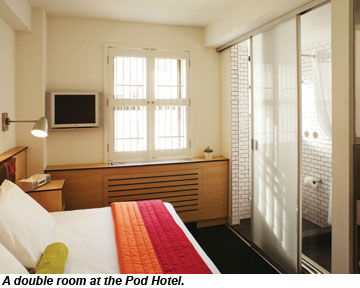 Where the Waldorf is a giant, welcoming slap on the back, the Pod is a gentle nudge to the ribs. Everything about it says clever, from the unassuming entrance off of a neighborhood stretch of East 51st Street to the mod lobby complete with little touchscreen wall monitors for immediate Internet access for guests, to a modest lounge area that has a walk-up station for a limited menu of locally sourced snacks and beers. It opens to a low-key outdoor patio and garden area (there's also a roof deck atop the 14-floor building that offers great midtown views).
To say the rooms are small is to say In-N-Out burgers are unhealthy, in that you'd almost be disappointed if that were not the case. (Some of the Pod's "larger" rooms are actually called "Double Doubles" in what might or might not be a nod to the beloved California-based burger chain.)
Blond wood finishes and a red color scheme on the bed emit an Ikea-plus vibe, while luggage cubicles and under-the-bed drawers in a double-bed room ensure that most couples have enough storage space at least for a short stay.
The chrome in-room vanity is like a slightly larger version of those in airplane bathrooms, only without the turbulence. Meanwhile, white subway tiles, fogged glass and a rainfall showerhead demonstrate the Pod's effort to provide far more than merely a Spartan lodging experience.
And the desk provides just enough room for a laptop-toting traveler to log in to the free (and pretty fast) wireless Internet and get some work done.
Take a look at occupancy numbers and you'll realize that both the Waldorf-Astoria and the Pod are taking care of their respective clienteles. At about 84%, Manhattan's occupancy rate is some 25 percentage points above the national average. Meanwhile, the Waldorf runs an astonishing 94% occupancy rate, while the Pod checks in at about 93%.
That means that the 1,413-room Waldorf sells almost a half-million guestrooms a year, while just 26 out of the 5-year-old Pod's 370 rooms will sit dark on a typical night (a second Pod, on East 39th Street, opened this month).
Were there glitches? Of course. The alt-rock music blaring out of the Pod's elevator speaker can be a little jarring before the morning coffee kicks in, while the flat-screen TV is off-center relative to the bed (which in my room sat in line with the window) and isn't adjustable, meaning that the 15-inch picture becomes closer to an even foot when you're watching it from your bed.
And in rooms that are otherwise so well designed, finding electrical outlets under the desks instead of on them is a little annoying.
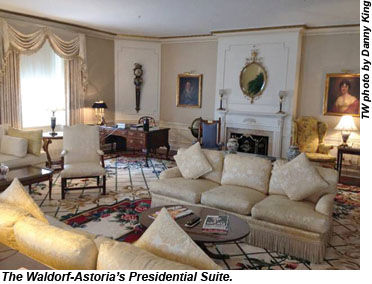 As for the Hilton Worldwide-operated Waldorf, its sheer volume can make a Sunday-afternoon check-in a lengthy one even with the front desk fully staffed. Moreover, the wired generation will quibble not only with the challenge of finding an open electrical outlet anywhere near the suite's working desk but also with the fact that WiFi runs $16 a day.
Like a country club's golf pro going up against a weekend warrior, one has to handicap the hotels in order to truly compare them.
A quick look at rates reveals that a Waldorf-Astoria queen-bed room starts at $299 a night for a mid-July weekend stay, while a one-bedroom suite in the Waldorf Towers will run about double that.
Meanwhile, rooms at the Pod go for about $185 a night, or about $60 less than the city average.
That said, if you factor in room size, you can have the Waldorf Towers suite for about 75 cents per square foot per night, while you'll pay $1.25 per square foot at the Pod.
All of which goes to show that, while size does matter when it comes to the wallet, it's not as big an issue when it comes to hotel-room space if the operator is doing a decent job of appealing to the right target demographic's sense of value.
Contact Danny King at [email protected] and follow him on Twitter @dktravelweekly.