What is hip? Tell me, tell me, if you think you know.
What is hip? If you're really hip, the passing years will show you in a hip trip.
 The aforementioned lyrics from Tower of Power's 1973 monster-funk-jam "What Is Hip?" came to mind upon reading a recent press release from Expedia.
The online travel agency was touting its Hotels.com unit and its listings for lodging accommodations within what it called "a selection of hip, culturally diverse neighborhoods," one of which was a Comfort Inn about a mile from my home in Los Angeles' Silver Lake district.
And while I have nothing against Comfort Inn, its Sunset Boulevard locale in this case was what some (OK, I) would consider more gritty and borderline slummy than cutting-edge, plus pretty dicey after dark. Not exactly a place I'd send a relative visiting from out of town. Well, maybe some relatives.
Go to a hotel conference like last week's New York University International Hospitality Industry Investment Conference and the buzzwords (in addition to "RevPAR," "pipeline" and "the OTAs and U.S. Customs are killing the travel industry") will invariably include terms like "hip" and "edgy" to describe either a recently launched brand or a badge looking for some new life.
With hoteliers continually looking to cut costs while raising rates, operators that might have shunned the idea of "edginess" in the past are now looking to go lighter on labor and space needs and go heavier on public-space ambience, tech-informed services and that elusive "vibe."
Credit (or, in some cases blame) for introducing the hipness quotient to hotels often goes to former nightclub impresario Ian Schrager, who first brought his velvet-rope sensibilities from his experience as the co-founder of New York's famed Studio 54 to the first Morgans Hotel in 1984. Art gallery-inspired lighting, minimalist decor and toned-down hues were in, making what were hotel public-space staples like the piano bar and glass elevator seem out of date pretty much immediately.
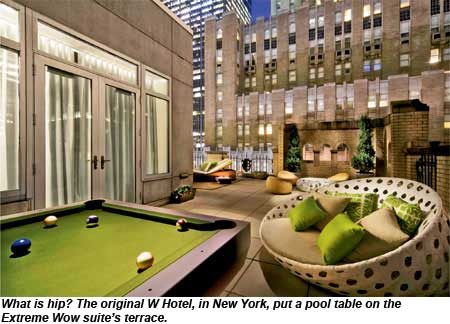 By 1998, hipness was taken to another level -- again in New York -- with Starwood Hotels & Resorts' first W Hotel, which was launched as an always-tough-to-quantify "lifestyle" hotel with its color splashes and lively lounge scene. W quickly rocketed into the luxury hotel sector as high demand boosted room rates.
Since then, hotel "hipness" has become a lot of things to a lot of income brackets. Run a Google search for "New York+Hip+Hotel" and its nearly 52 million results will be topped by places like Thompson LES, Ace Hotel and the budget-friendly (and tiny-roomed) Jane.
Do the same for Los Angeles, and you'll get references ranging from the edgy (the Standard, the Redbury) to iconic (Chateau Marmont).
More elusive than the definition of hip is any pricing pattern. For New York hipness, Hotels.com lists the Condor Hotel (in Brooklyn's Williamsburg section, of course) with nightly rates starting at a spartan (by New York standards) $179 a night, while Thompson LES rates begin in the $400 range and work their way up from there. And while it's less than a five-mile drive between Silver Lake's Comfort Inn and the aggressively hip W Hollywood, the two vibes couldn't be any more different.
Regardless, hip is increasingly regarded as a good thing. While hipness has generally been associated with the growing number of independent, upscale boutique hotels throughout the U.S. -- Smith Travel Research says the number of boutique hotels in the country has jumped about 30% during the past three years, to about 800 properties -- the chains certainly don't want to be left out. At the NYU conference, panelists from companies ranging from larger hoteliers such as Starwood to the more moderate-sized companies like Commune Hotels (the parent of the recently merged Thompson and Joie de Vivre) used terms like "local flavor" and "individuality" and dismissed anything that appears "cookie-cutter" as out of step with current lodging tastes.
Of course, hipness can backfire. Schrager in 2007 memorably teamed with Marriott International to announce its Edition brand, with hotels set for locales such as Istanbul and Honolulu. It turned out that "edgy" and "aloha" mixed like oil and water, at least upon launch, and the Waikiki Edition's owners took back management of that hotel within a year of its 2010 debut and banished the name.
Meanwhile, Chesapeake Lodging Trust, which in April bought the W New Orleans, apparently thought two W's in the Big Easy was one too many, and it will switch the 410-room hotel over to Starwood's decidedly less fashionable (but just as posh) Le Meridien brand following a $29 million renovation next year.
And while Hotels.com touts the Inn San Francisco's location near "quirky" shops as a badge of hipness, let's just say the always fashionable Tony Bennett isn't likely to be leaving his heart in the Mission District anytime soon.
At the end of the day, this dog-chasing-its-tale quest for hipness might best be illustrated by a story from a hospitality consultant (who preferred to remain anonymous) about a couple of friends who recently visited New York's Royalton Hotel, which Schrager opened in 1988 when he was still running Morgans Hotel Group. While the friends were longtime fans of the hotel, their most recent visit was slightly marred by the fact that their eyesight wasn't what it used to be and that the sexy lighting in the elevator prevented them from being able to make out the floor numbers on the elevator buttons.
All of which gets us no closer to an answer for how to define hipness within the hospitality industry. Nonetheless, it leads us to a brilliant conclusion from Tower of Power:
While you're striving to find the right road, there's one thing you should know:
What's hip today might become passe.
Contact Danny King at [email protected] and follow him on Twitter @dktravelweekly.