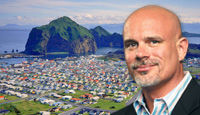
 Travel Weekly's Kenneth Kiesnoski recently visited Iceland. His dispatch follows.
REYKJAVIK — It’s been more than 11 years, and dozens upon dozens of trips elsewhere around the globe, since I last visited Iceland.
It’s a place I remember, fondly, as starkly beautiful, in an otherworldly, almost lunar way, and strikingly under-populated, by a friendly, quirky and hard-partying people said to still believe in “hidden folk,” elves and trolls. I also recall it — not quite as fondly — as terribly draining on the wallet.
With once largely ignored Iceland regularly making headlines over the last three or four years — thanks to its 2008 economic crash and the flight-disrupting 2010 eruption of the (nearly) unpronounceable Eyjafjallajokull volcano — I have been thinking for a while it might be high time to get reacquainted with the destination.
In seeming answer to my musings, I received an invitation late last year from Icelandair to attend this month’s Mid-Atlantic Seminar and Trade Show in Reykjavik.
The annual tourism confab, celebrating its 20th year in 2012, brings together buyers, suppliers, agents and media from the 31 markets in Iceland, Europe and North America that Icelandair serves.
But more on the Mid-Atlantic show another time. Right now I’d just like to share some thoughts on how, in the opinion of an infrequent visitor, Iceland’s changed — and how it hasn’t — over the last decade or so.
First off, it’s still a quick flight from the U.S. East Coast. Despite Mother Nature’s best efforts on the geological front, what with volcanoes, earthquakes and such, Iceland has thoughtfully stayed put and remains a snap to get to from New York. About five-and-a-half hours in either direction, and you’re there or back.
Once you land at Keflavik Airport, you’re still greeted by a moonlike, lava-strewn landscape, softened in spots by coatings of rich, green moss and lichens.
 Although not all of Iceland is so stark in appearance, there is a noticeable lack of forests and large flora nationwide. Back in 2000, when I first visited, there was much talk about reforesting once-verdant Iceland, which had been denuded by firewood-hungry Vikings centuries ago.
There may have been some progress in the 11 years since but I couldn’t tell the difference. But, hey, you can see trees anywhere; what you can’t see everywhere are Iceland’s unique landscapes and sights, such as Gullfoss falls; Geysir, the mother of all geysers and waterspouts worldwide; and huge, easily accessible glaciers such as Vatnajokull. These all still thrill.
What has sprouted up since is Reykjavik itself. While the odd-looking, hilltop Hallgrimskirkja church still dominates the cityscape, other architectural landmarks, and lots of nondescript office buildings, condos and shopping centers have also arisen (some conceived and constructed during Iceland’s short-lived boom years, and many now half empty).
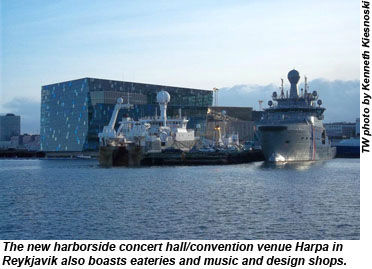
Of particular note: Harpa, a striking harborside concert hall and convention center designed by Icelandic-Danish artist Olaffur Eliasson.
As with the stone facade of the Hallgrimskirkja, the glass sheathing covering Harpa’s exterior is inspired by the polygonal basalt columns typically found throughout Iceland. Worth a visit just for a look or a show, Harpa also boasts a well-regarded cafe/restaurant and music and design shops.
Speaking of shops, let’s talk kronur (Iceland’s currency) and local prices.
Given the spectacular fall of the krona in the wake of the 2008 meltdown, I’d hoped costs would have fallen. With the krona currently trading at around 100 to 120 per U.S. dollar — compared to a peak of only about 50 kronur to $1 a few years back — I expected an Iceland-wide fire sale.
Not so. Word on the street in Reykjavik is that a pint of locally brewed Thule or Eigils Gull lager in the city’s ever-popular pubs and clubs, once as pricey as $14 a glass, could be had for about $3 immediately after the crash but now sets you back about $7.
Prices in shops — running the gamut from souvenir stores and supermarkets to designer clothing and housewares outlets — didn’t seem any lower to me than they did in 2000. Case in point: Buying five postcards and four airmail stamps in the gift shop of my hotel set me back $15 or so.
And pylsur, the lamb-meat hot dogs that are Icelanders’ snack and street food of choice, sell for about $2 to $3 each. Not outrageous but not a steal, either.
Iceland remains as attractive, appealing and intriguing as ever — but don’t travel there expecting the deal of the century. Low prices can be sniffed out here and there, and the country remains competitive pricewise with similar destinations, but the real value in a visit to Iceland is the chance to experience its unique vistas, history and people.
Follow Kenneth Kiesnoski on Twitter @kktravelweekly.