 Although tourism to Hawaii took a hit during the U.S. economic nosedive, the family travel market to the islands has remained more or less steady, a statistic that surprises even some tourism officials.
"Travel costs are higher for four than for two, so you would think family travel would drop notably as travel prices go up," said Jay Talwar, senior vice president of North America marketing for the Hawaii Visitors and Convention Bureau. "But that is not the case at all."
Consider the numbers. In 2008, 21% of arrivals were family travelers, which is about the same as 2004, even though the overall marketplace has seen some dramatic increases and decreases during that period.
Multigenerational travel continues to be an important market, according to Talwar. "We don't have [multigenerational travel] broken out in our data yet, but our sellers tell us that it is a positive trend for us," he said.
Talwar suggested that attitudinal factors might account for these steady numbers. Tough economic times tend to foster a desire for families to spend more time together, he said, while at the same time, parents often have to work longer hours and have less time to see their families at home.
"So when they do take that vacation, it becomes even more important to find one that delivers, and because our visitor satisfaction is high -- in the 90th percentile -- people know they will have the type of experience they are looking for," he said.
Other factors include the fact that Hawaii is part of the U.S., so in these times of worries about the H1N1 flu, parents know they can avail themselves of their own health care system. Security and safety issues also are very positive, which is more important to family travelers than for, say, young couples looking for adventure, he said.
But while the Islands are a proven destination, "Hawaii is not a 'been there, done that' destination, either," Talwar said. "The Islands are unique in that they are both familiar and exotic."
Optimistic prognosis
Looking ahead, overall travel to Hawaii is showing signs of a rebound, according to the latest figures from the Hawaii Tourism Authority.
Visitor spending rose 3.5% among air arrivals in January over the same month last year, to a total of $983.3 million.
HTA statistics also show a 2.9% increase in total visitor days this January over January 2009, for a total of just over a half-million visitors.
The boost represents the second consecutive month of positive growth since airlines ATA and Aloha ceased operations in April 2008.
Travel agents on the West Coast can take heart that in January 2010, arrivals by air from the West Coast rose 2.2% over January 2009, although arrivals from the East Coast dipped by 2.7%.
Interestingly, 24% of arrivals from the West Coast were families, as were 17% from the East Coast, percentages that have also held steady since 2004.
A projected increase in air capacity should move those numbers even higher, according to officials.
"Statewide, we are looking at the addition of a half-million air seats in 2010, which means there will be capacity and seats across the state, including the Neighbor Islands," said Chris Kam, senior director of market insights at the HVCB.
Oahu outpaced the other islands last year because of the lack of air service into the other islands, Kam said, but the commitments made by airlines to serving Neighbor Islands are expected to redress that imbalance in 2010.
Increased air capacity typically drives prices down, Talwar acknowledged, but he noted that even when air has been tight, tour operator packages were usually able to keep prices steady, thanks to corresponding drops in hotel and activity rates.
Multi-island trips continue to be popular, and although data on families vs. the general leisure population is not available, anecdotal evidence suggests that families are somewhat less likely to island-hop than young, unencumbered couples.
Visitor profiles
As to seasonality, Talwar said: "If you look at peak vacation periods, it's always easier to get a better rate in the softer seasons, but it is important for travel agents to realize that there are specials, promotions and other values in peak season, as well, if they look for them."
And while conventional wisdom has it that families are traditionally bound by school vacation calendars, Kam pointed to recent studies that show a shift toward year-round travel, even in this market.
"We don't have hard data to show movement in seasonality of families, but earlier this month we did some travel attitudinal research, and 49% [of respondents] said they would allow their children to miss school so they could be with family," Kam said.
Forty-six percent of those families also said they like to visit the same familiar places with their children and would be likely to revisit a destination that works.
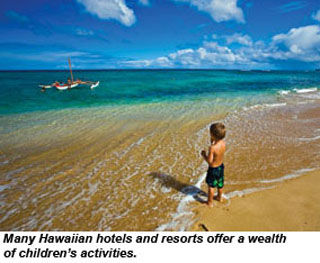
Like general leisure travelers, families visiting Hawaii like outdoor activities, Kam said, but they have the advantage of a wealth of children's programs -- called keiki programs in Hawaiian -- available at most hotels and resorts.
Some of the most popular offerings include snorkel cruises, volcano treks and Hawaiian arts and crafts by the pool. Most major properties have a cultural expert on site who can take families for ecological walks and tell stories about the native Hawaiian population.
"No one wants to make a vacation a science or history field trip, but these activities allow kids to have enriching experiences that are also close to the beach," Talwar said.
Tourism officials expect that the filming of the new movie "Pirates of the Caribbean: On Stranger Tides," which is being shot in Kauai and Oahu, will add fodder to the already robust TV and movie tours business. The TV series "Lost," which has generated buzz this year because it is in its last season, is filmed in Hawaii, as were sci-fi blockbuster "Jurassic Park" and two of the Indiana Jones films.
Where to stay
The much-anticipated Disney destination resort on Oahu, to be situated on the oceanfront 21-acre Ko Olina Resort & Marina development, is expected to be a big draw for families.
The Aulani, a Disney Resort & Spa, Ko Olina, Hawaii, set to open in 2011, will feature 350 hotel rooms and 480 Disney Vacation Club timeshare villas as well as pools, slides, a saltwater snorkel lagoon and other water play areas.
A children's club, two restaurants, 18,000-square-foot spa and convention center will also be included.
Cultural programming, including Hawaiian music, dance and arts and crafts, will be a big part of the resort's activity schedule.
The 858-acre, 443-room hotel Turtle Bay Resort, on Oahu's North Shore, is also in the news, thanks to a nearly $10 million upgrade under new owners.
Condos and timeshares continue to be an important part of Hawaii's menu of accommodations, and that market share is increasing, according to Kam.
In fact, according to the State of Hawaii Department of Business, Economic Development and Tourism's latest data from 2008, condominium hotels make up 22% of Hawaii's statewide room inventory, Kam said.
The big push through the HVCB this year will be to help travel agents and consumers understand the differences among Hawaii's six islands, each of which has its own distinct personality, Talwar said.
"[In the recent attitudinal survey] we saw that the more people understood how each island provides a different experience, the more interesting the destination became to them," Talwar said.
Similarly, the better an agent understands those differences, the better job he or she can do in matching the client to the right experience.
"Our job is to make sure we have well-informed travel agency partners working with us who understand the breadth of this six-island destination."
Visit www.gohawaii.com.
Read more from the 2010 How to Sell Family Vacations to Hawaii special section here.