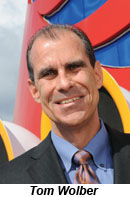
 Tom Wolber has overseen Disney Co. projects in resort and park operations on two continents and, since joining Disney Cruise Line in 1999, the construction and operations of the cruise line's three newest ships. As the line's COO and senior vice president, Wolber is responsible for purchasing, logistics, onboard entertainment, youth activities and marine and technical operations. Travel Weekly contributor Robert N. Jenkins interviewed Wolber after touring the Disney Fantasy, which will be named in New York on March 1.
Q: What is the most difficult part of building a ship?
A: The logistical puzzle of a newbuild is mind-boggling. It is not just getting the ship built and making the designs come to life. It is getting items from sources produced all around the world to the shipyard at the right time.
Q: Twelve years passed between the launch of Disney's second ship and the Disney Dream. Talk about your concern over a loss of institutional knowledge.
A: This is the whole knowledge about how to bring out a ship, how to recruit a crew, how to train them in two weeks [on the initial crossing] to achieve a level of guest satisfaction. All these things are done by leaders of a newbuild team. If you wait too long, some go to do other things. But if you do one ship closely after another, it becomes a bit easier.
Q: There are not many physical changes between the Disney Dream, which launched in January 2011, and the Disney Fantasy, whose first revenue sailing will be March 31. Does that relatively brief window between their launches complicate making changes to the Fantasy?
A: While the Disney Dream was still in the shipyard, we started thinking about what else we might do on the top deck [of the Fantasy]. Then we started sailing the Dream and saw which areas were more popular. Within three months, we knew what sort of changes we needed.
Much comes from guest feedback. A month after bringing a vessel out, we conduct focus groups onboard with passengers ... to find out what is great, what needs some help. We [also] consider the online comments that passengers post. The biggest one is the Disboards [forum]; I have that one on a fast link.
And as the guests disembark, we scan in their comment forms, so by the late afternoon we have the scores and trends. We give that feedback to the department heads onboard.
We try things because they are new, but ultimately the guest is going to decide what is going to be successful.
Q: How quickly can you react to world events such as civil unrest or fuel-price changes?
A: The one big advantage in the cruise industry is that your assets are movable. If you are talking about political unrest, things that would put your passengers and crew and the ship in harm's way, it is a call you can make on the day and change the itinerary.
When it comes to fuel prices, it is a much longer lead-time issue. You must employ longer-term strategies: You must think about itinerary planning, the length of the legs [between ports], the efficiency of plans onboard, what elements of technology can be used.
Q: When do you feel satisfied about a ship's construction?
A: The big sigh of relief, and the pride in the products we deliver to our guests, is probably during the preview cruises and the maiden voyage, when you see the reactions of people who have not been that close to the project. Waiting to see the first passengers reacting, especially with the prototype in a series, is a real nail-biting experience.