On the occasion of the recent Travel Weekly Mexico City Leadership Forum 2010, executives from airlines, hotels, tour operators and the Mexico Tourism Board gathered for a breakfast roundtable at the St. Regis Mexico City hotel to discuss the state of travel and tourism south of the border. During the roundtable, moderated by Travel Weekly Destinations and Special Supplements Editor Kenneth Kiesnoski, participants tackled hot topics such as safety, handling negative publicity, sustainable growth, affordability, airlift and competitiveness. The original transcript has been edited for length and flow.
TRAVEL WEEKLY: It's been a tough couple of years for travel and tourism. Does Mexico have any advantages or disadvantages, given the recent climate, compared with competing destinations such as Hawaii and the Caribbean? And how has Mexico been performing for you?
MARK NOENNIG, vice president and general manager, Apple Vacations: The advantages of Mexico are customer satisfaction and value. We have seen, over the past five years, great growth for Mexico, and the reason for that is the great value it provides. It has great product, and customers love it and come back. The challenge, I think, that we all are having on this side is the negative publicity: the media out there talking about things in Mexico. I think the brand of Mexico is being hurt by this, and we're definitely seeing some shift, [but] not a major shift.
 When you have risk, you've got to find ways to sell it. So we end up getting the passengers here but maybe not at the margins or price that we would like to. We're definitely seeing a shift to more Caribbean for winter, definitely on the groups side of things, and I think that is related to some of the negative media that's out there [about Mexico].
TW: Anne, what's your take, as a travel agent selling Mexico?
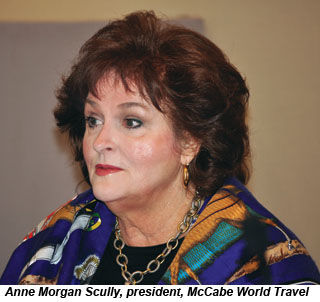
ANNE MORGAN SCULLY, president, McCabe World Travel: Well, I'm somebody who looks through rose-colored glasses and keeps looking at the positive side. What's strong about [the destination] are the gorgeous [hotel and resort] brands that are now in Mexico, because they are attracting the clients that love those brands. They tend to be higher-end [clients], and there are very few [of them] switching properties. They're also a little bit more knowledgeable, and I think that's key in selling Mexico: having knowledge of where the issues are in Mexico and how far away they are and the security [level] of some of these resorts.
TW: Does anyone Mexico-based have any thoughts on how your destinations or products will perform or are performing?
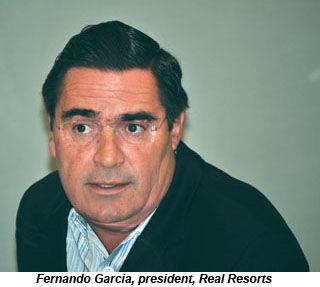
FERNANDO GARCIA, president, Real Resorts: I think the negative [news for us] is very positive for travelers: Current rates are a great deal. There's never been a better time to visit Mexico than now, since the drop in tourism. And everybody at the airports, the shops, the restaurants is really trying their very best to please the visitors. They're treated as royalty, as any Hollywood star would be, by housekeepers, maids and bartenders, because of the [recent] lack of tourism. Hawaii and the Caribbean [cannot compete] with the charm and the professionalism that [visitors] can find in Mexico.
And our resorts are beyond comparison to all those destinations. In Hawaii, as a point of comparison, there are only three to five AAA Five Diamond resorts, while in Mexico they're everywhere. So, the value of the resorts, the restaurants and the professionalism of the people involved in tourism -- there's no comparison anywhere else.
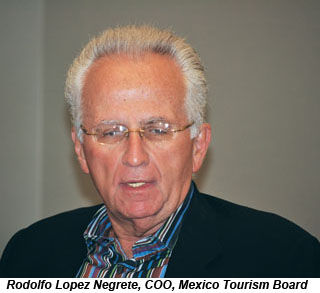
 RODOLFO LOPEZ NEGRETE, COO, Mexico Tourism Board: The level of guest satisfaction, as Fernando reiterated, is incredibly high, and there's the quality of product that Anne was talking about. But the major challenge, in our opinion, is to grow new business.
We realize that [the negative news] that's being published is certainly not conducive to encouraging new business to come to Mexico. But we believe that if we work together, and we are aggressive enough in our communications efforts and just stay the path, we should be able to pick up new business. I think that's where our focus is.
TW: Let's talk about this negative publicity, such as frequent news reports of drug gang violence. Has anyone noticed an impact on arrival rates directly attributed to this?
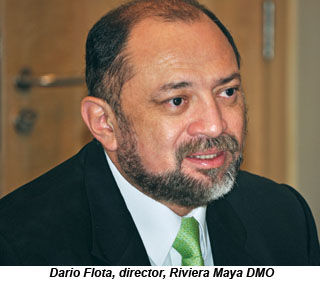
DARIO FLOTA, director, Riviera Maya Destination Marketing Office: It's hard to say exactly whether we're being affected, because we cannot measure the people not coming [apart from] cancellations. We can't measure what is not selling. But bear in mind that this August we have raised our numbers to 2008 [levels]. It's hard to say whether we'd be growing much faster without this situation, but even with it, we're still growing. I think these big numbers mean that the number of visitors is not being affected.
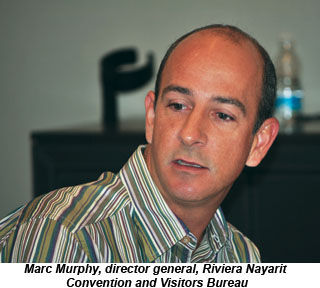
MARC MURPHY, director general, Riviera Nayarit Convention and Visitors Bureau: In terms of investment, the private sector investing [in Riviera Nayarit], even though we are still at the top in terms of investment in the country tourism-wise, we are finding that most developers who had projects that were planned for openings in 2009 delayed them until 2010, and now they're getting delayed until 2011. This is because of the impact of the negative [publicity] that Mexico is getting, which makes sense. The good news is, nobody has actually pulled out or canceled. There's still that confidence that Mexico is going to rebound; it's still going to be a money-maker.
On the tourism level, well, it goes hand in hand. Literally, the tourism levels have not grown compared with 2008. I would say you can't compare 2010 to 2009. Everything's grown compared with 2009, but if we compare [this year] with 2008, I would say there's a dip going down.
We continue to grow our product, so we have more inventory in the destination. So we might actually be getting the same number of tourists, but they're just not filling up the rooms. Mexico has to grow equivalent to the number of rooms being built; this is an extreme challenge.
 So I would say 2010 is not a growth year. I think it's a consolidating year. In 2011, we may hit 2008 numbers, and the [discounted] prices that Fernando was referring to I think are going to take a few years to get back to where they were.
It's challenging, and I would say that at this point a good portion is directly related to the negative news [about Mexico] in the U.S. Because if I take a look at Canada, that's one of the emerging markets that's actually growing for us, while the U.S. is actually reducing, at least during 2010.
GUILLERMO MARTINEZ, CEO, Intermar Caribe: Training at this moment is essential. Training the people in the [U.S.] call centers, the people who are sending us business, in the geography of Mexico. Because it has happened to me in the past: There's an earthquake in Mexico City and they call our [Cancun] headquarters and ask, "How are you? Is everything OK?" Mexico is very large; it's a big country. Nowadays, the places where we're having problems in Mexico [reported] in the newspaper articles are thousands of miles away from Cancun, [where] everything is calm and secure. If the people get properly trained, they can give better information. They can let clients know that the [news] we're talking about is [hundreds of] miles from the vacation destination they're calling about.
TW: Mark, are Apple Vacations' agents trained to that degree?
NOENNIG: It's a great point. If something happens in Mexico City, it affects [perceptions about] the whole country, whereas if something happens in New York, it surely doesn't affect Disney World.
 I think it was in March of 2009 when this first kind of barrage of media came out with the drug problems, and the drug war definitely hit us hard, [with] lots of negativity and, of course, cancellations. So we did a big training program. We do most of our business through travel agents, so it's easier for us to reach them than the consumer. And I think that's one of the problems today: How do you reach the consumer? Our agents responded. They got the good information. We all worked with the tourist board. I think in general it went away relatively quickly, in a couple of months.
You hope in any situation like this that the media reports start dying down and things get back to normal quickly. It did for a while, but now it's almost like a daily thing. You have some U.S. networks that almost have a [news report] every day about something [negative] in Mexico. And we're getting [travel agents] who were convinced and fine now coming back and saying, "I'm having more problems now trying to sell Mexico." So, it is about constant education.
But the challenge is the consumer who hasn't been to Mexico yet and doesn't know where these destinations lie in relation to these places where things are happening. And I think a lot of these people just aren't considering Mexico as an option right now. And, for us, that's an important statement, and I think it's an important statement for Mexico, as well.
TW: Rodolfo, you announced at this forum that the Mexico Tourism Board is planning its first-ever crisis-management team.
LOPEZ NEGRETE: There's a certain amount of space in the media that has to be filled every day. If we let it get filled with the negative, that's what it's going to be. So we all have an obligation to generate positive news, and I think we've got many things to talk about on the positive side. So that's an angle and a direction that we have given to our new public relations agency: generating good stories. We would like to urge the private sector and other partners in tourism to do exactly the same.
Now, having said that, in my opinion we have been behind the curve, not ahead of it. We have to be ahead of the curve, and we have to make sure that we're also constantly informing our partners in the U.S. travel industry about what is happening, what is good news, etc.
We are investing in the neighborhood of $40 million through destination marketing programs with different destinations across Mexico. And that's about to be increased for next year. We believe that we need to support our destinations in Mexico, and that's what we're trying to do.
 Fernando raised a very important point: There's no better time to come to Mexico, because you get the best product for the best value. And Mexico has always been a terrific destination from a point of view for service, warmth, attitude and touristic conscience. Having said that, this issue of business being down is not only applicable to Mexico; it's a worldwide phenomenon. Just look at Las Vegas, Hawaii [and] the Caribbean. Look at every single destination. Literally, with few exceptions, they're all suffering.
And they're all trying to do the same thing: They're trying to generate incentives so the consumer goes their way. They have been sacrificing [higher rates] in lieu of volume, and that's something that's been happening throughout the world. So we are basically competing in the same landscape, in my opinion.
So the reason we launched our $25 million media campaign in [the U.S.], and $7 million campaign in Canada, from July to the end of November is because we want to be on the front line.
GARCIA: What Rodolfo was saying [about supporting individual Mexican destinations] is music to our ears in Cancun, because [the destinations] are what the U.S. consumer knows. I mean, the consumer is hearing the bad-mouthing of Mexico, but there's still the strength of the destinations -- of Riviera Maya, Cancun, Cozumel, Puerto Vallarta and Acapulco -- and that's still recognized by travelers.
It's very sad that the U.S. groups markets are switching to the Caribbean for whatever reason, but Real Resorts is seeing double-digit growth from Canada, South America and the U.K. These other markets are still growing. This perception of poor security in Mexico is really only in the U.S., so I think it's great if we [focus] on the [individual] destinations instead of Mexico, which might help regenerate growth out of the American market.
NOENNIG: To put all this in context from Apple's perspective, we are flying more seats into Mexico in 2010 than we did in 2009 and more in 2011 than we did in 2010. So we still believe in Mexico; it's just that there are some issues out there. The reason we are flying more seats is because there is great value, and the customer satisfaction is extremely high. And that's what we're talking about to the travel agents and the consumers. We still think that overrides some of these other things. And in the future, as some of this negative media dies down, things can really take off again.
TW: Anne, do you sell the individual Mexican destination brands and de-emphasize Mexico at this point?
SCULLY: Everyone here is now talking about brands. I think we [travel agents] should also, and I certainly agree that we all have to change our focus. But, for example, the same beautiful [resort and hotel] brands can be found everywhere in the world. So why should clients come here, to Mexico? They come here because there's something wonderful to see, like the Sea of Cortes, which Jacques Cousteau called "the world's aquarium." Or the second-largest barrier reef in the world, on the Riviera Maya.
 If you do want to sell Mexico, you will do it with people who will talk of Mexico, not as this or that brand but of what they can do here. Look at things people really love to do that sustain their lifestyle. Focus on it. Talk to those people about it. Talk about the great fishing you have. Talk about children's [activities]; children are the decision-makers in many families. What do the children want to see? Like the blue-footed boobies off of Puerto Vallarta; otherwise, you have to go down to the Galapagos to see them. I do think the Mexico Tourism Board is trying with its new ads, but I think we really need to focus more on experiences.
LOPEZ NEGRETE: In our opinion, at the tourism board, it is not a matter of disassociating Mexico from the rest of the other brands in the country. That would be insulting to the consumer, who knows when he or she comes to Los Cabos or Cancun that it's Mexico. It would be very naive to think that the consumer is so ignorant to the point of believing that Cancun is in Australia or that Los Cabos is in California, not in Baja California. I have tremendous respect for the consumer.
The Mexico brand is an incredibly strong brand and will continue to be strong because of its connotations. When you say "Mexico," you immediately think warmth, experience, friendliness, hospitality, energy, diversity. If the brand is being damaged right now because of the negative publicity, it is our obligation to really clean up that tarnish and straighten out that Mexico brand, because that's only going to help the other brands of the country.
We have to make sure that the Mexico brand is projecting what it should be projecting. And at the same time, we've got to support the destinations, and we have to make sure that the different brands that we have around the country really project their own strengths, their own diversity, their own qualities and so forth.
So in our opinion it's not proper to say, "Let's forget about the Mexico brand" because the Mexico brand is sick right now. To sweep it under the rug and focus on the Cancuns, Los Caboses and Vallartas and forget Mexico would be a terrible approach.
TW: Aren't there political sensitivities at work here, though? One of the new TV ads the tourism board will be showing in the U.S. promotes Mexico City as a leisure destination. Is that really a viable pitch to the typical North American traveler?
LOPEZ NEGRETE: I think it is. Mexico City is a very exciting destination. The diversity, the culture, the museums, just the broad array of activities the city offers. What we really want to project with this TV ad is the modern Mexico. The sophisticated, trendy and fashionable Mexico. The Mexico of the 21st century. Mexico City is comparable to any other worldwide capital. Let's not forget that consumers are moved by aspirational behaviors, and this is a side of Mexico that we believe we'll really have to highlight.
 TW: So it's more about creating impressions rather than driving actual bookings to the city?
LOPEZ NEGRETE: No, it is both. You have to be able to deliver whatever you advertise. I feel wholeheartedly that the level of satisfaction for consumers who come to Mexico City -- whether it's only to the city or to the city in combination with the beach resorts or the interior of the country -- is very, very high.
TW: Mark, does Apple sell much Mexico City?
NOENNIG: It's not that we're not interested; it's just not our target market today. Right now, we're working on some programs to try to marry a beach vacation with a city vacation [out of] some of the U.S. gateways that can handle something [like that]. We think for us, that makes sense. But you have to remember that a lot of beach customers, that's what they want. And a lot of the success Mexico has had is because of that beach customer. But I think Rodolfo was talking about a new customer or a customer who's looking for a different experience.
TW: Another big piece of news out of Mexico this year was the demise of Mexicana. At the same time, United and Continental, both big players into Mexico, are merging. Any impact from either development on your businesses?
GARCIA: Mexicana accounted for 40% of our airline seats [in Cancun], so it was bad that the people who needed to make a decision -- the unions, the entrepreneurs, the government -- didn't reach an agreement, even though they all spoke Spanish. Travelers got affected, suppliers got affected, owners got affected, the government got affected, and the workers, as well. Nobody won.
LOPEZ NEGRETE: We saw a reduction of travelers for just the first few weeks. It's going to be a substitution game. What we're trying to do is to encourage the other domestic and international carriers to accelerate the pace [of adding capacity] as much as they can to fill the gap.
Mexicana enjoyed about a 20% share of seats, and that's a big chunk, obviously. But conversely, there's the extraordinary news about the fusion of United and Continental, both very important players into Mexico. Continental covers more than 30 destinations here, from primary destinations to secondary ones.
American Airlines has announced more frequencies already, from basically every major hub in the U.S. to Mexico. Alaska Airlines has increased its seating capacity by 24%. Virgin America announced new service out of the [U.S.] West Coast to Cancun and Los Cabos. British Airways flies from London to Cancun twice a week, with the 777. Air Canada is covering the Canadian groups that Mexicana used to have out of major hubs out of Canada. West Jet is increasing their capacity in a very substantial way by about 46% to different destinations in Mexico.
 We cannot hide the bad news, but we have a lot of good things to convey to the consumer and to the travel agent. Mark just mentioned Apple is increasing their stake in Mexico, that they're here to stay, they'll be here for years, they will always be here. And literally there's not one tour operator that we have spoken with that is not increasing its stake in Mexico. So we believe the appetite is there; we just have to make sure that this negative publicity is really surpassed by a wave of positive publicity.
TW: Josue, does the new, even larger United have plans to address the issue of air capacity into Mexico?
JOSUE MEZA, general manager, Mexico, for United Airlines: Mexico used to be served with nine daily flights. A couple of them were bigger jets; a couple of them were regional jets. Now all of them are regular jets. The loss of Mexicana was very sad; they used to be a partner of ours. Hopefully, Mexicana will recover. In the meantime, we have to fill the gap. United used to have three daily flights to Mexico City, and after January we are going up to nine daily flights. We are adding more capacity to Chicago, San Francisco, Los Angeles, Washington and Denver. We are looking at our business plan.
TW: What about the drop in lift into the purely leisure destinations, such as Ixtapa-Zihuatanejo, Oaxaca and the Riviera Nayarit?
MEZA: It's going to be a temporary situation. The good thing is that this crisis at Mexicana has happened during the low-low season. This is giving us the time to be ready for the big decisions. We are adding more flights effective November, December and January. So in the future we are going to be very well covered, but at the present time we are suffering.
MURPHY: Definitely what I saw with the Mexicana situation, more than the point-to-point, were the connections from Mexico City to [Mexico's] west coast. We had a lot of passengers on those planes, and that just went away. So hearing that United may add more seats, more frequencies, that will help the situation. For the west coast beach destinations, that connection through Mexico City is very important because there's not that many point-to-point flights [out of the U.S.], especially for places such as Ixtapa. You just have to go through Mexico City.
TW: Marc, we've been talking about brands, in particular the Mexico brand and these longtime, iconic local destination brands. But Riviera Nayarit is a relatively new brand. Do you have any trouble getting the attention of the potential visitor?
MURPHY: Like any new brand, we have a challenge, which is penetration. Considering the brand is only three-and-a-half years old, I think the penetration in that time frame has been very successful. There's no doubt that Riviera Maya has actually helped that process, because they went through it already. So the educational part of the equation to the travel agent was very easy, because all you had to do was give the example of Cancun/Rivera Maya, and they understood it right away. So I think the penetration went quickly. But it's still a challenge.
The largest challenge is not through our partners such as Apple Vacations and other tour operators, and not even through the travel agent. It is through the airline industry. The airline industry has two facets: the vacation portion, which is, let's say, their tour operator [arm], and the airline itself. So the vacation portion or the tour operator, which is a very small portion of their business, understands it, gets it. But it's a small side of the actual airline industry. And the airline industry is very focused on filling up a seat, as we all know, and works on an airport code, and you have to go through a certain process.
As long as you don't have an airport to your own name, it's a struggle of trying to convince the airlines that their home page booking widget should recognize the [destination] name and so on. Back to the topic of Mexicana: Yes, it has hurt us. It represented 12% of all lift into the Puerto Vallarta International Airport, which serves us. And I think now the concern with the airline industry -- with Mexicana leaving, the mergers of both United-Continental and Delta-Northwest -- is maybe on the competitive side. There are both pros and cons, the pro being the airlines have opportunities; the con could be the airline pricing goes up and we become not so competitive anymore.
As we know, our hotels are suffering, so they're bringing down the prices, but there's only so low they can go. If the airline ticket is not at par with that lowered price, it doesn't matter, you're out of that competitive cycle. So sometimes these failings of these airlines, these mergers, although they sound sometimes great, my concern can be: Will they get into the game of bringing their prices up, or will they keep them stable so Mexico as a whole is competitive?
SCULLY: Something I'd like to talk about is sitting at my desk interviewing clients and finding a proper place in Mexico for them. One thing I think is lacking is when I go on a website and I look at a hotel, I can see how large the suites are, I can see where the value is by looking at price differentials, the different categories. But nobody puts a calendar of events on a site, and I'm going to bring a client here to build something special. Mexico just had a bicentennial a month ago; I don't know how many travel agents were told about that. I don't know how many hotels were smart enough to put that in as a marketing opportunity.
It really is giving good information that's really valuable to a client. They're smart, and they want to trust us. The only way we're going to get a client is that trust. So I think if you're a new hotel and you have a new brand, try to get some buzz out in the beginning, but it's staying in the game. The game of sales is a tough one, and not everybody's ready for it. And I truly believe in presenting yourself with more and better information so whoever is online can get it. I don't know why anyone's thinking that we shouldn't have it.
FLOTA: We need to get together behind the brand of Mexico in this market, and maybe because of that there is now a good opportunity to rethink [our approaches]. We have all been working on the North American market for many years, and we're all very secure in what we're doing right. But we are forgetting some basic things, like this list of events Anne mentions.
We were talking earlier about internal competition between destinations: Cancun competing with Rivera Maya when the competition is out for [blood]. We need to be smart at doing things together. We can take advantage of our strengths together instead of hitting one another.
TW: To wrap up: Any forecasts about Mexico in 2011? What are you foreseeing?
SCULLY: 2011 is strictly a year of growth, certainly a year of opportunity to present something new. What I'm excited about in Mexico is that I do have some exciting things to say to a client. Clients want something they didn't know they could have. Mexico is something they didn't know they could have, and I'm excited to show it to them.
MEZA: We're very excited with our plans for Mexico City as well as for the rest of the country, and we are totally committed to bringing more tourism and more business to Mexico.
MARTINEZ: I think this year will be a great year for opportunities for everyone.
LOPEZ NEGRETE: I think it's time for us in Mexico to make a big shift, from a victim to a leader. We're a leading country, and we have to stop behaving like a victim and forget about this gloom and doom. I see 2011 as fantastic.
NOENNIG: Two words: communication and collaboration. I think that with Apple and the tourism board and the destinations, we've got to communicate together and collaborate on things. During a difficult situation, that's important. Highlighting the positives, communicating the positives, and we need to do the same with the travel industry.
MURPHY: I would probably say [2011 will be] a year of consolidation, a year where I think we're going to be looking at 2008 numbers. I think tourism-wise, there's great opportunity for the U.S. market, and I think we're looking forward to great investment and opportunities again next year.