The souks in Marrakech are the perfect place to solve the problem of leftover Moroccan currency.
I certainly solved mine, buying a Tuareg trinket with my last coins, only to have the merchant wrap my head and face with a long strip of blue fabric, then volunteer to photograph my new look while I, very tentatively, held the gun he had put in my hands.
 My merchant was a Tuareg himself, meaning a Berber-speaking member of a generally nomadic Saharan people. Tuareg men are called "blue men of the Sahara" because their hand-dyed veils stain the skin.
My newfound friend, who was a bit citified and didn't look especially blue, directed me around the corner to my next goal: the Ben Youssef Madrasah, a former Islamic school. The building dates from the 16th century, and the main attraction, in the courtyard, are the four components of traditional Moroccan architecture: carved wood, ornately sculpted plaster, hand-cut tiles and, finally, marble.
The most impressive of the four was the plaster, from which artisans here carved numerous pine cone and palm motifs to produce a three-dimensional effect. The beautiful work in the public space contrasts with the tiny, dark student cells that surround the courtyard.
The same elements of Moroccan architecture are on display at the 16th century Saadian Tomb.
The school and the tombs are reminiscent of Moorish architecture that travelers typically seek out in Seville and other points in Spain. A 19th century iteration of the Moroccan style appears in Marrakech at Bahia Palace, which was recently restored. Wood ceilings, painted with geometric designs and Arabic script, were the palace's most impressive feature.
All three attractions, now museums, are within the thick adobe walls that encircle the historical heart of Marrakech. The 12th century walls and most buildings on either side of the walls are the color of terra cotta.
Also, by law, structures cannot be taller than five stories, which makes the 12th century Koutoubia Minaret, at 230 feet, the tallest thing around. The result of the building restrictions is a beautiful, low-rise, rose-colored city.
An inspired renovation
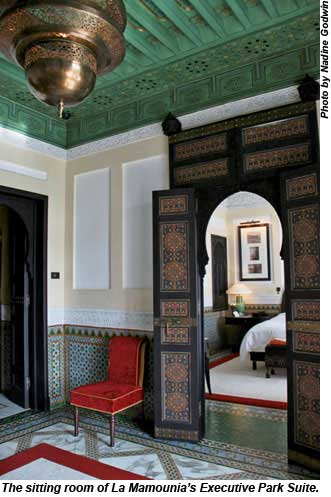
I visited tourist attractions by choice, but I didn't have to leave my hotel, La Mamounia, to see fine examples of traditional architecture.
 In fact, Denys Courtier, the hotel's executive director for marketing, spa and leisure, said some guests never leave the property despite the exotica that awaits them outside.
The upscale hotel offers comforts and services enough to keep a willing guest diverted and happy.
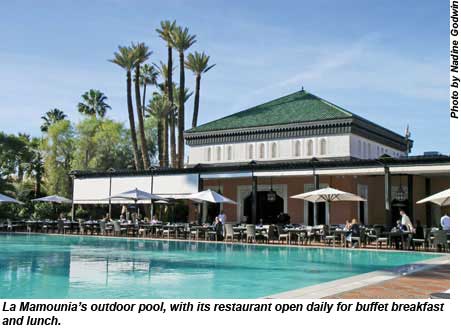
Built in 1923 on the site of a palace just within Marrakech's city walls, La Mamounia offers a 17-acre park plus a fitness center, tennis courts, indoor and outdoor swimming pools and a 27,000-square-foot spa. A casino, under separate management, is available, too.
Many rooms have balconies with views of the snow-capped Atlas Mountains. There are five bars and four restaurants; French, Italian and Moroccan plus the poolside buffet with Mediterranean choices. My press group sampled them all, with results ranging from excellent to outstanding.
The 209-unit property has 71 suites and three riads — 7,500-square-foot houses with three bedrooms and central courtyards — rented at about $15,600 a night.
It's a deluxe property with a unique connection to Marrakech history. For 80 years, it has been an attraction in its own right, although in 1986, the property strayed from its roots with an art deco makeover.
With a view to reconnecting locally, La Mamounia's owners forfeited three years' worth of business and spent about $156 million for a complete remake in traditional styles, taking inspiration not only from historical Moroccan architecture but also from a local tradition favoring terra cotta in the color scheme.
Courtier said management also wanted to attract a younger clientele. Before the renovation, the average age of guests was around 70, but since the 2009 relaunch, that average is in the 50s. The property is kid- and dog-friendly.
France is the No. 1 market, Courtier said, followed by North America and the U.K. The hotel's overall mix includes about 5% conferences, and occasionally someone reserves the entire property for a wedding or a business purpose. Room rates start at about $780 a night.
Visit www.mamounia.com.