On the Arabian Peninsula, close to booming flight hubs in Dubai and Abu Dhabi, the once-hermit-like sultanate of Oman is fast becoming a popular destination for international tourists.
The country offers a wide variety of attractions, including watersports along its beautiful coastline, which stretches from the Gulf of Oman to the Arabian Sea before reaching the border with Yemen. Inland, a mountainous range with dramatic rock formations in the center of the country leads to vast areas of rolling sand dunes.
Oman's ruler, Sultan Qaboos bin Said, has led the country since 1970. He's invested recent wealth from oil and natural gas in a major infrastructure program with the construction of a network of highways, many with four lanes, which makes traveling the country by car safe and speedy.
There has been a focus on education and health, with new schools and medical facilities. New housing and business facilities have changed the country from a sleepy, rural country to a modern nation.
The ancient heritage of the country is also being preserved, through the restoration and reconstruction of old forts, castles, museums and other places of historical interest.
 The capital, Muscat, lies on the Gulf of Oman coast. Its Old Town area, known as Mutrah, is a small port enclave with forts perched on hilltops, narrow streets and a lovely souk, or bazaar, where traders offer myriad goods, from fabrics to jewelry, from spices to old guns and other weapons.
The sultan has an "office" palace at Mutrah, surrounded by buildings of the royal court and other government structures. The palace where he resides is located farther along the coast.
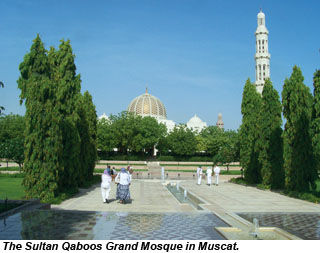
Muscat is distinguished by many mosques, including the Grand Mosque. Built by the sultan and named for him, it is a marvelous building set on extensive grounds with lovely trees and flowers and a glorious marble courtyard. The enormous interior contains a 45,000-square-foot, one-piece prayer mat; huge chandeliers; and intricate, delicate and colorful inlay work on the walls and ceiling.
For visitors who want to learn more about the history of Oman, the exhibition at the Armed Forces Museum in Muscat presents it in fascinating detail. Note that most museums are not open on Thursdays, and mosques are closed to non-Muslim visitors after 11 a.m. on Fridays.
Despite the boom, development in Muscat is strictly controlled, with no tall buildings dominating the skyline. Buildings are constructed to ensure harmony with heritage attractions. A new opera house is nearing completion, and upgrades are well under way at the international airport, which is located quite close to the city.
Muscat boasts numerous hotels. The Crowne Plaza and InterContinental overlooking the Gulf are popular with tourists, while the excellent Park Inn, closer to the airport, caters to both tourists and businesspeople. New resort spas, such as Barr al Jissah, offer relaxation and private beaches, and there are water-based activities such as snorkeling, scuba diving and dolphin-watching tours.
Within a day's drive of Muscat are a number of places that enable visitors to experience the dramatic countryside. A popular "circular" tour is to travel inland through the mountains; the road makes for fast and easy driving even for visitors, although most take organized tours.
Nizwa is a vibrant town with a central area encapsulating the fort, mosque and bustling souk. The fort has been beautifully restored, and its many rooms contain examples of the town's history and arts, handicrafts and lifestyle of earlier inhabitants.
Try to time clients' visits for early Friday morning (the museum shuts at 11 a.m.), as it coincides with the busy goat market in the souk nearby where locals, including the Bedouin people, auction and haggle over goats as well as camels and cows. Close to Nizwa, the pre-Islamic fort at Bahla and the castle at Jabrin are also worth a visit.
In Nizwa and other places in the countryside, travelers should look out for the falaj, or water channels, that divert the water from the mountains through the villages and towns for drinking, washing and agricultural purposes. They are a marvel of ingenuity.
 Driving east from Nizwa, visitors should stop at Sinaw, where in the market Bedouin women sell perfumes made from local ingredients.
Much of the interior of Oman is covered in vast, rolling sand dunes, and the Wahiba Sands region contains a number of camps where vacationers can stay, Bedouin-style.
Four-wheel-drive tours are a great way to experience the thrill of riding the dunes, and many tours stop at a Bedouin tent for coffee and dates. Date palms proliferate throughout the country, and the fruit is delicious. (For all its deserts, Oman offers much in the way of other horticultural delights; the sultan is passionate about flowers, and throughout the country they provide a surprising blaze of color.)
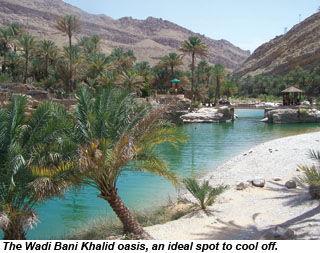
Somewhat surprisingly, in the rugged mountain areas, visitors will find lush oases with water pools surrounded by date palms. The best is Wadi Bani Khalid, ideal for a dip to cool off after a day of driving.
At Sur, on the coast east of Muscat, one historical boatyard remains, constructing wooden boats in the old dhow style. Once a thriving industry, boats are now made only to specific order.
Farther east at Ras al-Jinz, on the Arabian Sea, coast turtles come in to lay their eggs as they have been doing for millennia; night and morning tours are available.
There are flights to Muscat from the U.S. via Abu Dhabi with Etihad Airways or Dubai with Emirates. Visitor visas, which cost about $20 each, can be obtained on arrival at the airport in Muscat. The best time to visit is from October to April.
Visit www.omantourism.gov.om.
This report appeared in the May 24 issue of Travel Weekly.