Latest accommodations in the 'new' Kenya
Here are some examples of recently opened and upcoming properties that exemplify the innovations and upgrades Kenya has been making to its product to attract a new generation of safari-goers and experiential travelers.
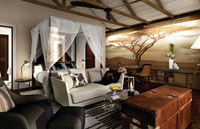 Hemingways Nairobi
Set to open in late summer, Hemingways Nairobi is a luxury, boutique hotel in the suburb of Karen, nine miles southwest of Nairobi's city center, with views of the Ngong Hills. It features 45 suites, a wellness center, pool, gym and spa.
Mahali Mzuri, a Virgin Limited Edition property
Virgin chief Richard Branson is building a property on the Motorogi Conservancy in the Masai Mara. The property, Mahali Mzuri, part of the Virgin Limited Edition portfolio, is slated to open next year as 12 tented suites. Rates will start at $580 per person, per night, including meals, drinks and daily game drives in the Olare Orok and Motorogi Conservancies.
Emakoko Lodge
The Emakoko Lodge is located on 15 acres of land bordering Nairobi National Park, 20 minutes from Nairobi's airport. It has 20 rooms situated along the Mbagathi River. The idea is the brainchild of Anthony and Emma Childs, created as an alternative to exhausting transfers through Nairobi to get to game destinations around the country. They created a property designed to serve as a respite at the start or end of a trip to Kenya.
Solio Lodge
A property in the Safari Collection portfolio, the Solio Lodge opened in August 2010 as six luxury cottages in the valley between Mount Kenya and the Aberdare Mountains. The lodge is located on the Solio Reserve, which is part of a private ranch. Each cottage has an outdoor deck, indoor lounge area, fireplace and bathrooms with double sinks, bath and shower.
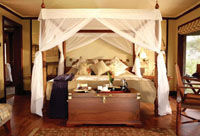 Lake Elmenteita Serena Camp
A collection of 24 luxury tents, Lake Elmenteita Serena Camp opened in late 2011 on the Soysambu wildlife sanctuary near Nakuru, northwest of Nairobi. The property also houses a restaurant, a bar and lounge and a swimming pool.
Sleeping Warrior Lodge
This lodge, which opened in December, is also on the Soysambu conservancy, with views of Lake Elmentaita and the Rift Valley. The lodge houses seven bungalows. It offers day and night game drives, bush walks, a hot springs spa and excursions to nearby Lake Nakuru National Park and Eburru Forest Sanctuary. -- M.B.
It's been a long and bumpy road for Kenya since deadly political clashes in 2008, followed by the global economic downturn, brought its tourism industry to a near standstill.
But despite ongoing challenges, this East African nation is finally starting to see signs of a rebound, in part because the hit its tourism industry took forced Kenya to step up its game.
"In the '90s, you didn't have to be good, you just had to be there," said Mark Wheeler, managing director for Abercrombie & Kent in Kenya. It was a decade, he recalled, when South Africa was still battling apartheid, Tanzania's properties were not well developed and Zambia and Botswana hadn't come into their own as mainstream tourism destinations, "so Kenya was the only option."
But the new century brought sweeping change to the continent.
"South Africa took off, Tanzania has got better properties and Zambia and Botswana have come onto the scene," Wheeler said.
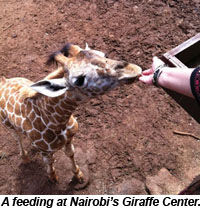 With increasing pressure and competition from the rest of the continent, exacerbated by the crippling 2008 crisis, Kenya has been forced to reinvent itself as a destination. No longer are canned safaris cutting it. (View a slideshow from Kenneth Kiesnoski's safari trip in April here.)
Ashish Sanghrajka, president of Big Five Tours & Expeditions, recalled that "in 2008, tourism had been decimated. What it forced the country to do was to take a look at the long-term problem it's had, which is an overcrowding of tourists. We've moved away from those typical hotel chains in the reserves to private camps on private land owned by the Masai. You have direct revenue shares with the tribes. There's nowhere near the type of crowding that occurs in the national parks. The value proposition becomes much stronger in these conservancies. There's an authenticity."
Kenya's public relations challenges, however, are not likely to be fixed anytime soon. Just last month, the U.S. State Department updated its Nov. 4 travel warning for Kenya due to "heightened threats from terrorism and the high rate of violent crime in some areas."
Operators in Kenya say the violence has been concentrated on its border with Somalia, where the Kenyan military has been clashing with rebels from the Islamic militant group al-Shabab.
But on March 10, assailants threw four grenades at a bus station in Nairobi, killing nine and injuring more than 50. Kenyan officials blamed al-Shabab for the attack. There have also been attacks reported in and around the coastal city of Mombasa.
Violent crimes can "occur at any time and in any location, most particularly in Nairobi," the State Department warned.
So far at least, Africa operators report that the most recent warning has not affected bookings.
"I'm not saying [the State Department warnings] are wrong, but in some ways they've lost their credibility," said Dave Herbert, CEO of Great Safaris. "Travelers seem to be more resilient."
Claudia Gordon of Naples, Fla.-based Naples Luxury Travel Advisors said she will be sending a couple to Kenya on their honeymoon in the next few months, and while they're somewhat concerned about the warning, they're not considering canceling their trip.
Operators report that travelers to Kenya have not called with concerns about safety or security, and they think that's largely due to the fact that the incidents appear to be far from the game reserves.
Despite the steady trickle of challenges Kenya has faced, nearly 120,000 U.S. travelers visited Kenya last year, a 10.9% increase over 2010, according to the Kenya Tourist Board. That was on top of a 5.9% increase in 2010 over 2009.
The total number of inbound travelers to Kenya in 2011 reached 1.3 million, a 15.4% increase over 2010.
Similarly, operators reported big year-over-year gains of as much as 25% to 30% in bookings in 2010 and in 2011, as Kenya started to haul itself out of its hole. The jury is still out on 2012. Operators are currently reporting that bookings are more or less flat compared with 2011, and they admit that business is still not back to pre-2008 levels.
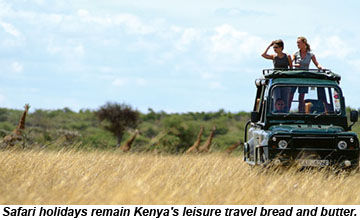 Interestingly, they don't attribute any of Kenya's resurgence to displaced travelers from Egypt due to the revolution there or to the Arab Spring in general.
"There is displacement from Egypt, but not to Kenya," Sanghrajka said. "The displacement we're seeing from Egypt is to Morocco or Jordan."
Wheeler concurred that "before the Arab Spring happened in January last year, we were already tracking roughly, in terms of forward bookings, the way we ended the year. So I wouldn't say zero impact, but it's limited impact."
In a paradoxical twist of fate, the dire economic challenges Europe is facing this year has helped Kenya, and indeed much of Africa, as a destination overall.
Jim Holden, president of African Travel, said, with a bit of a chuckle, "People are now looking at Europe, and because of the fuel surcharges and taxes, the price of a flight to Africa doesn't look that bad. I think people are saying, 'I can consider going to Africa.' It's being seen as a safe destination. You definitely get the feeling that Europe will always be there; the Middle East is a little bit unstable."
He added, "It's a bit of an irony, but Africa right now is comparatively pretty stable."
Future prospects
Whatever relative recovery Kenya might be experiencing is still vulnerable, a notion not lost on travel industry vets in the region.
On March 4, 2013, the country is scheduled to hold its first general elections since the violence-inducing presidential elections of 2007.
 Kenyan President Mwai Kibaki, whose disputed victory over opposition leader and current Prime Minister Raila Odinga sparked the violence, will not be running again in 2013 and has promised a smooth transition of power. But, said Sanghrajka, "anybody who says they're not concerned is lying. I've been through enough elections. Having unrest around election time is normal."
Still, he and others are cautiously optimistic, namely because the new constitution, put in place last year, established a parliamentary system. As a result, the president no longer holds all the power in the country, giving a voice to various tribes and factions and, hopefully, diminishing tensions over who is elected president.
"I point out to people who are concerned about the elections that if there was going to be a revisit of what happened in 2007, it would have likely happened last year during the constitutional referendum," said A&K's Wheeler. "The constitutional referendum was to determine the constitution for the next hundreds of years, whereas next year it's just an election for five years. So, we're all taking that very positively."
The experiential premium
Regardless of how things shake out next year, Kenya's tourism economy is forever changed.
What was once a high-volume, wildlife safari destination has evolved into a much more diversified marketplace with an emphasis on experiential, luxury travel.
"The largest single market out of the States is the boomers," Herbert said. "They're the ones who are accumulating experiences now. I had a client say to me, 'At [this] stage of my life, I've stopped accumulating assets and started accumulating experiences.' And Africa is a very experiential destination."
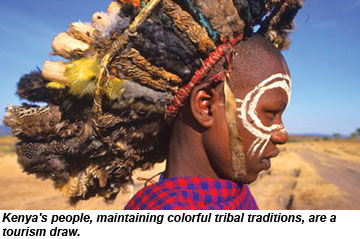
Operators have shifted their attention away from cookie-cutter safaris and are more focused on cultural exchanges with tribal communities and sustainability. Mobile, tented camps, for example, are gaining in popularity.
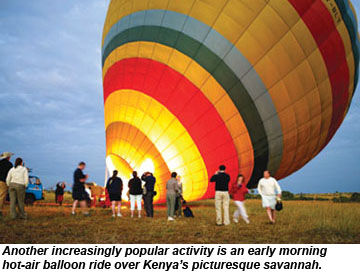 "They are really popular because they leave such a limited impact on the environment," Gordon said. "It is really back to the 'Out of Africa' experience. My very [eco-conscious] clients are thrilled with that."
In the past, "a typical safari had become a commoditized product," Sanghrajka said. But now, "the per-person spend has gone up. People are willing to spend the money, because what we're finding is that authenticity doesn't have a price point. ... The animals are wonderful, but what's being done to make a difference? People are willing to pay a premium for that."
Once apartheid ended in South Africa in 1994, Wheeler said, hotel knowledge from that country began to spread across the continent, and boutique properties began cropping in Kenya. That, combined with the quality of game, has helped the country survive and ultimately thrive despite its tribulations over the last several years.
"I think there's a lot of people who even five years ago wouldn't have considered East Africa as a possibility," Wheeler said. "But now, with these private conservation areas and private boutique lodges, it's suddenly opening up. Ten years ago, it used to be all centered around the national parks and reserves.
"The national parks and reserves are still important now ... but we went from in the '90s of having this reputation of being lots of minibuses and that sort of thing, to offering a real exclusive product."
Follow Michelle Baran on Twitter @mbtravelweekly.