 It took decades to create Las Vegas' reputation as Sin City, and it could take just as long to recast it as a bastion of health and healing. So said a handful of speakers at last month's MediTourExpo, a two-day international medical tourism conference where industry professionals discussed how to enhance global health care, increase patient numbers and develop medical tourism destinations.
The conference was held at the South Point hotel-casino. Conference speakers presented dueling narratives about the city's ability to capitalize on the global medical tourism industry, which caters to more than 3 million patients and annually generates upward of $75 billion.
Former Lt. Gov. Lorraine Hunt said the city could create wellness programs for senior executives. Others touted the abundance of spas and proximity to mountains, national parks and outdoor recreation. But skeptics said Vegas and medical tourism will never go hand in hand.
"Las Vegas is the antithesis of wellness," Mindy Terry, president of the consulting firm Creative Spa Concepts, told the Las Vegas Review-Journal. "People who go to a spa here do so to get over a hangover or get ready for a big night out. Even if you spent millions of dollars and hired the best marketing firm for an ad campaign, I don't think you can change that mindset."
The concept of medical tourism isn't new here. Sunrise Hospital and Medical Center, built in the 1950s, treated injured and ill Mafiosi. In recent years, Vegas has been touted as a good place for cosmetic surgery (actors and professional fighters come here for nips, tucks, touch-ups and repairs) and weight-loss surgery (minimally invasive procedures like laparoscopic gastric banding or sleeve gastrectomy).
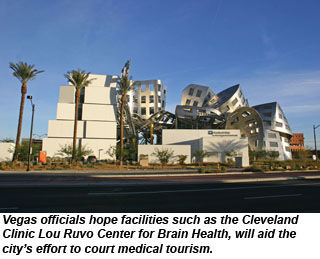
A longtime supporter of medical tourism, Mayor Oscar Goodman has been emboldened by the recent additions of the Nevada Cancer Institute and the Cleveland Clinic Lou Ruvo Center for Brain Health.
Opened in 2005 as the official cancer institute for the state of Nevada, the NVCI has treated 15,000 patients from around the country. In 2008, the NVCI earned the highest accreditation from the Joint Commission, which accredits and certifies more than 15,000 health care organizations and programs across the nation.
However, the NVCI has had its share of problems. Like other large nonprofits (the institute has raised $240 million in philanthropy since 2006), it's been severely hurt by the recession. In April, it laid off half of its 330 employees. Some of those workers have filed lawsuits claiming their terminations violated federal law requiring two months notice of staff dismissals.
Since treating its first patient in July 2009, the Cleveland Clinic Lou Ruvo Center for Brain Health has quickly gained a national reputation. The Frank Gehry-designed center was featured in a CNN special last month for its work on researching and treating neurodegenerative brain illnesses such as Alzheimer's and Parkinson's. On its staff are powerhouse doctors in the field brain disease research, including noted neurologist Charles Bernick and Jeffrey Cummings, a world leader in Alzheimer's research.
Making it legal
Goodman isn't alone in his push for medical tourism. Earlier this year, state lawmakers floated legislation to create a medical tourism district in Clark County, thus allowing taxes generated in that district to be devoted to private, capacity-building projects.
Senate Bill 502 would make "any building or complex of buildings to accommodate or house activities as part of a multifaceted center for medical tourism" eligible for a portion of local and state sales taxes.
To build a viable medical tourism industry, experts on both sides of the medical tourism argument agreed that the following building blocks must be in place:
• Superior medical care: People will only travel to Vegas if a hospital, medical facility or treatment center's services are regarded as superior to other services within a few hundred miles. No local hospital has the reputation of, say, the medical center at the University of California at Los Angeles.
• Competitive pricing: Costs should be low enough to justify out-of-town travel; experts noted that the availability of inexpensive domestic and international flights to Las Vegas is a plus.
• Range of specialties: In a Jan. 3 article in the Las Vegas Business Press, Clark County Medical Society President Mitchell Forman said that local hospitals specializing in stroke care, oncology and orthopedic surgery attract patients. But none of them is UCLA, which is ranked in the top 10 nationally by U.S. News & World Report in urology, gynecology, heart surgery and geriatrics, among other specialties.
• Rebranded image: Vegas must simultaneously combat its image as an anything-goes adult playground while playing up the benefits of medical treatment in the entertainment capital of the world.
Easier said than done.