 I grew up with tales of Vegas wise guys who ruled with open hands (financing hospitals and schools) and iron fists (ordering hits) and of local law enforcers like Senate Majority Leader Harry Reid who risked life and limb to bring them down.
As such, I expected a lot when I visited the National Museum of Organized Crime and Law Enforcement: the requisite seriousness the topic deserved, a slew of revelatory information and, this being Vegas, something cheeky, fun and unexpected.
Consider me impressed.
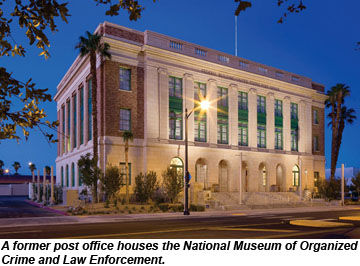
The so-called Mob Museum, housed in a former federal courthouse and post office opened in 1933, delivers a serious and seriously fun walk down mafiosi memory lane, as told through photos, movies, artifacts and interactive games spread through 17,000 square feet on three floors.
The museum examines the global impact of organized crime; checks in on retired mobsters and mobsters-turned-informants; debunks mob myths; probes the history of mob violence, corruption, conspiracy and murder; and provides an in-depth look at how Las Vegas became a haven and playground for organized crime and ground zero for efforts to dismantle the mob.
A gang of offerings
The Mob Museum opened on Feb. 14, the 83rd anniversary of the St. Valentine's Day Massacre in Chicago, when gunmen posing as cops (said to be members of Al Capone's South Side Italian gang) slaughtered thugs from George "Bugs" Moran's North Side Irish gang. The museum boasts a portion of the original, bullet-riddled brick wall where the killings occurred.
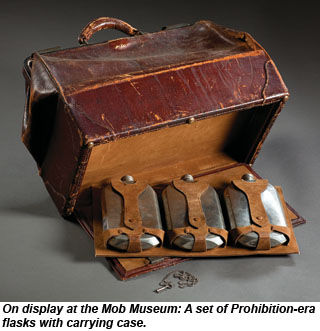
 Similarly macabre artifacts abound, including the replica of a Tommy gun, a favored mob weapon, and the barber chair where Gambino crime family boss Albert Anastasia was assassinated on the morning of Oct. 25, 1957, at the barber shop of the Park Sheraton Hotel in midtown Manhattan.
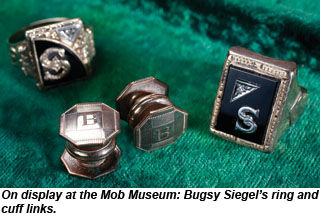
Other sections of the museum examine the mob's legacy and its impact on modern-day organized crime and chronicle law enforcement's fight to bring down the mob and its various criminal enterprises (money laundering, human and drug trafficking, kidnappings, murder for hire and more). It explores the most notorious mafiosi, including Al Capone, Benjamin "Bugsy" Siegel, Frank "Lefty" Rosenthal, Joseph Bonanno and John Gotti, as well as the lawmen who hunted them down, such as J. Edgar Hoover, Eliot Ness, Harry Anslinger and Joe Pistone.
As he led me on a tour of the $42 million facility, spokesman Mike Doria framed the story of organized crime's growth in America in general and in Las Vegas in particular through the lens of choices: "This museum really highlights choices: the choice to do what's right or what's wrong, to do what's good and what's bad."
The museum connects a lot of historical dots: showing how Jewish and Italian immigrants created underworld empires financed by alcohol, prostitution, murder for hire and, eventually, Las Vegas casinos; drawing parallels between mob activities and modern-day crime such as human trafficking; and outlining the reach of organized crime throughout the country, from hot spots like Detroit to unexpected places such as Phoenix and San Jose, Calif.
Museum is a hit
The Mob Museum is a bit of an anomaly in this implosion-happy town. The building is one of the few remaining historically significant buildings in Las Vegas and is included on both the Nevada and National Registers of Historic Places.
 Its proprietors recruited Dennis Barrie, the brain behind Cleveland's Rock and Roll Hall of Fame and Washington's Spy Museum, to design it.
In addition to being aesthetically distinct with its Depression-era, neoclassical architecture, the building played a significant role in mob history. In 14 cities in 1950 and 1951, a series of hearings led by Sen. Estes Kefauver (D-Tenn.) sought to expose and dismantle organized crime: A film of the Kefauver Committee hearings plays in the museum's revamped courtroom, where the Las Vegas hearings took place. The building also houses the same courtroom where former Mayor Oscar Goodman defended the likes of Meyer Lansky and Anthony Spilotro.
The courtroom is quickly becoming a popular place for events for private parties and corporate functions.
"The historic courtroom at the center of the museum is a perfect backdrop for an elegant sit-down dinner for groups up to 120," Maria Sawyer, sales manager for the museum, said in a statement.
An offer you can't refuse
With so much to see and do, visitors might have a difficult time choosing where to start.
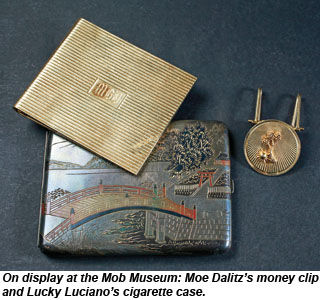
Fans of mob lore might want to examine the exhibits of notable gangsters like Capone and Salvatore "Lucky Luciano" Lucania, which depict how their choices often led to brutal consequences -- for themselves and others.
For the justice-minded, there's a bevy of information on how law enforcement developed tools to catch criminals. There's even an exhibit for fans of mobsters from film and TV.
 Those with time to spare can explore the exhibits on the mob's legacy, current local and global mob activities and a timeline that includes the birth of the mob, its geographic "families" around the globe, the impact of prohibition, drugs and prostitution on the mob's bottom line and how organized crime is evolving.
Guests can also "shoot" a simulated Tommy gun, listen to real FBI surveillance tapes on wiretapping equipment, take part in FBI weapons training and play interactive games that test your knowledge of mob lore. The museum also features a specialty retail store, special-event areas, educational areas and office space.
Admission to the Mob Museum is $18 plus tax for ages 18 and older; $12 plus tax for children ages 5 to 17 and students ages 18 to 23 with ID; and $14 plus tax for seniors, military, law enforcement and teachers. The museum is open Sundays through Thursdays from 10 a.m. to 7 p.m. and Fridays and Saturdays from 10 a.m. until 8 p.m.
For more information, call (702) 229-2734 or visit www.themobmuseum.org.