 Long a mecca for free-spending athletes and the sports fans and sports bettors who love them, Las Vegas has quietly become a playground for fitness-minded folks, a group more enamored of burning calories than burning through cash.
In recent years, hundreds of thousands of recreational, amateur and professional athletes have come here to ski the slopes, hike in the canyon, run and bike through city streets and compete for sports glory.
According to the Las Vegas Convention and Visitors Authority (LVCVA), fitness tourists spend $645 per trip, but only recently have hoteliers and tourism officials begun coordinating their efforts to market to this demographic.
Buoyed by the enduring magnetism of staple events like the National Finals Rodeo as well as the surging popularity of newer offerings such as the Rock 'n' Roll Marathon, the LVCVA plans to pour more resources into sports tourism.
Fun and games
Last month's Rock 'n' Roll Marathon and Half Marathon, sponsored by Zappos.com, drew 44,000 entrants. In three years, the Las Vegas event has become the third-largest race in the Competitor Group's 20-event series, behind races in Chicago and New York.
Billed as the world's largest nighttime race, the Las Vegas Marathon and Half Marathon drew 75,000 spectators and generated an estimated $50 million in economic impact for the city.
Las Vegas draws softball players in large numbers, as well: 42,000 annually from all over the country. To accommodate them, the city opened the 35-acre Big League Dreams Sports Park in January 2010.
Its six fields replicate famous Major League Baseball stadiums. The stadiums are Boston's Fenway Park; Yankee Stadium in New York; Southern California's Dodger and Angels stadiums; Chicago's Wrigley Field; and Crosley Field, the former home of the Cincinnati Reds.
Three-fourths the size of the originals, the replicas include each field's nuances, such as Fenway's Green Monster left-field wall and the ivy-covered walls at Wrigley.
Each summer, the city becomes the epicenter of high school basketball, as nearly 50,000 of the nation's top prep players compete in high-profile tournaments.
 The tournaments bring in top-flight college coaches and their recruiting staffs and, more importantly, tens of thousands of parents and their checkbooks.
More than 85,000 participants competed in the U.S. Bowling Congress Open Championships in 2009. The event was spread over 154 days and partially sponsored by the LVCVA, which hopes to lure the championships back in a few years.
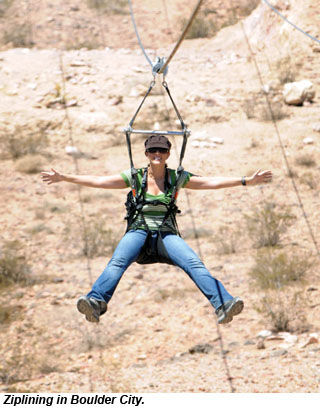
Golf is a huge draw, with 800,000 to 900,000 rounds played annually. Outdoor sports are also popular and run the gamut from rock climbing and sport fishing to riding ziplines and competing in triathlons. Last year's Nevada Silverman Triathlon drew 5,000 athletes.
Thousands of Vegas visitors routinely trek to Lake Mead for watersports and to nearby national parks, including the Bryce Canyon and Grand Canyon conservation areas, where they can choose from an array of activities, including hiking and white-water rafting.
Exercising opportunity
According to a report issued during the 2010 North American Society for Sport Management Conference in Tampa, sports tourism remains a largely unstudied and generally untapped demographic for hoteliers, tourism officials and travel agents.
"It has become common marketing practice for travel agents to create featured packages for fans who want to attend such events (like the Super Bowl) and for travel companies to offer customized plans for individuals who want to take active vacations," wrote the study's authors, ChienHsin Wang of the National Taiwan College of Physical Education, Dianna Gray of the University of Northern Colorado and LiWen Hsieh of National Taipei University.
"Despite the prominent role of sports travel in the global consumption culture, few studies have focused on the factors that influence sport tourists' travel decisions and their subsequent impact on sport tourists' consumption behavior.
"This absence of emphasis on sport tourist behavior has resulted in few theoretical frameworks from which to derive sport tourism marketing practice."
Julian Dugas, director of sports marketing for the LVCVA, concedes that the local tourism entity has yet to expend significant resources on luring fitness-minded tourists. "Historically, we've pushed Las Vegas as an entertainment destination and for conventions, trade shows and meetings," Dugas said. "We didn't diversify beyond that message because the city is a huge draw."
Made for sports
The Great Recession altered that dynamic, forcing tourism officials and the city's hotel and gaming industries to think about new ways to get visitors to spend. Marketing to event promoters and athletes made sense because of the city's history of hosting athletic events.
 "We have some of the best rock climbing in the world, a world-class BMX [bicycle motocross] facility in Boulder City, bicycle events and a great resource in Lake Mead," Dugas said.
"We've had Ironman and other world-class triathlons here.
"You're going to start seeing things like Tough Mother [a military marathon] in the future. Other types of endurance events are beginning to look at Las Vegas as a viable destination. Our pitch to them is, 'Let us help you make your events more successful.' "
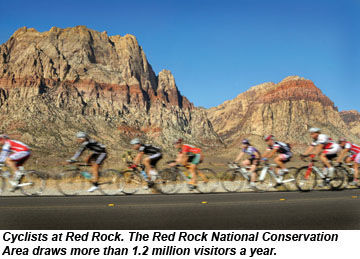
Located 15 miles west of Las Vegas, the Red Rock National Conservation Area draws more than 1.2 million visitors a year to its sandstone rocks and gigantic red cliffs, which were formed thousands of years ago and rise to 3,000 feet in some spots.
It's also home to the Red Rock Rendezvous, a climbing festival that draws participants from around the world. Activities include 19 hiking trails, jogging paths and horseback riding, among other activities.
For information, log on to www.redrockcanyonlv.org.
Thirty minutes away and typically 25 to 40 degrees cooler than Las Vegas, Mount Charleston is known for its peaks, which range from 3,000 to 12,000 feet in height. Thirty-five percent of the guests at the Las Vegas Ski and Snowboard Resort come from out of state.
Mount Charleston also features hiking trails for all skill levels and mountaineering. For information, log on to www.hikinglasvegas.com/MtCharleston.html. For information on the Las Vegas Ski and Snowboard Resort, log on to www.skilasvegas.com/winter/index.html.
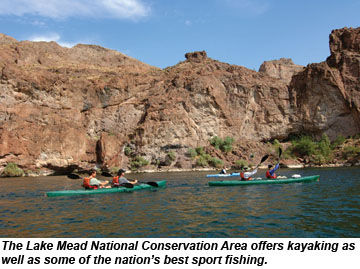
An avid visitor to Lake Mead over the past 25 years, Dugas said she's seen more kayaks than ever lately. Kayaking is one of a variety of water recreation activities at the conservation area, which features Lakes Mead and Mohave.
The lakes also offer some of the nation's best sport fishing, in addition to boating, water skiing, canoeing, biking, horseback riding, hunting and scuba diving.
For information on the Lake Mead National Conservation Area, log on to www.nps.gov/lake/index.htm.
Within a few hours' drive of Las Vegas, there are a handful of state and federal parks offering a bevy of outdoor activities. Nevada's oldest and largest state park, Valley of Fire State Park is located 55 miles northeast of Las Vegas and features hiking and camping.
Two hours outside of the city, in Utah, Zion National Park offers hiking in additional to hotels, restaurants, art galleries and boutiques. Bryce Canyon National Park is 4.5 hours away and annually attracts 1 million visitors for activities like hiking and horseback riding. Five hours away is Grand Canyon National Park.
Target marketing
Dugas expects sports tourism to play a larger role in diversifying tourism's revenue streams.
"There are other things to do than go on the Strip. As part of that message, we'll identify those things you can do outdoors. Northern Europeans enjoy hiking, bicycling, parachuting, ziplines," Dugas said.
The world's most popular sport, soccer, will take center stage from Oct. 28 to 30, as the city hosts the 12th annual Las Vegas Mayor's Cup International Soccer Tournament. Youth from 318 soccer teams spanning 14 U.S. states, Mexico and Canada will compete on soccer fields across the city.
"I am thrilled to continue the annual Mayor's Cup Soccer Tournament," Mayor Carolyn Goodman said in a statement. "This tournament has grown bigger and better every year. I invite all to come share in the fun and see these wonderful young athletes compete."
Dugas said combining Las Vegas' overall appeal with a targeted approach to reach sports tourists could open up new markets.
"As we move into the next decade and identify other assets to drive occupancy, these activities will become more important," Degas said.
"Sports groups are beginning to look at Las Vegas and see that we can handle these types of events. We've got the terrain, the mountains, Lake Mead, everything."