 The term "camping butler" might sound like an oxymoron, but summer travel trends suggest that the concept could soon become more familiar to affluent travelers.
With U.S. travelers boosting their travel spend and leaning more toward experiential travel, some owners of luxury campgrounds are reporting increased demand, while lodging investors are putting more money behind these sorts of hybrid accommodations.
Safari specialists such as Micato and Abercrombie & Kent have, of course, long offered ultraluxury accommodations for affluent types who like to shoot photos of animals on the savannas and in the rain forests of Africa.
Now that tradition is making its way to less exotic but still exciting destinations in the great U.S. outdoors.
The upscale abodes in this case range from tents complete with hardwood floors to cabins that have more amenities than most upscale hotels and even "trailer parks" with fully decked-out Airstream RVs.
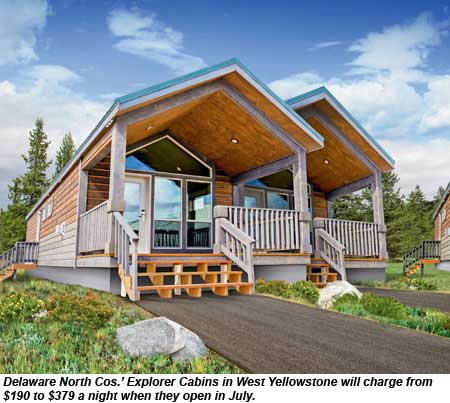
The most current example is Delaware North Cos., whose properties range from Boston's TD Garden (home of the Celtics and Bruins) to the Yellowstone Park Hotel. In July, Delaware North, which also manages Yosemite National Park's Ahwahnee Hotel, will debut a product it calls Explorer Cabins in West Yellowstone.
Complete with such touches as flatscreen TVs and WiFi, the cabins range from 640-square-foot, single-bedroom units to 745-square-foot, two-bedroom cabins. They will be priced at two to four times the $75 nightly rate fetched by more spartan cabins in the park. Travel sellers will be paid commissions for renting the Explorer Cabins.
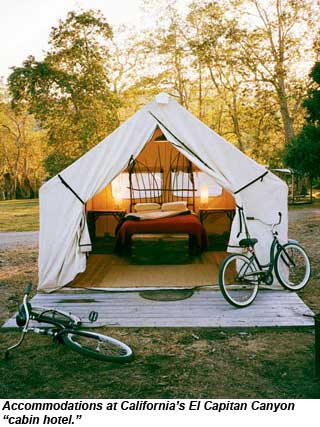 Delaware North joins a subset of luxury-camping providers that includes places like El Capitan Canyon near Santa Barbara, Calif., and Montana's Resort at Paws Up, whose five camps totaling 30 luxury tents include Jacuzzi tubs and the aforementioned butler, who does everything from starting campfires to making s'mores.
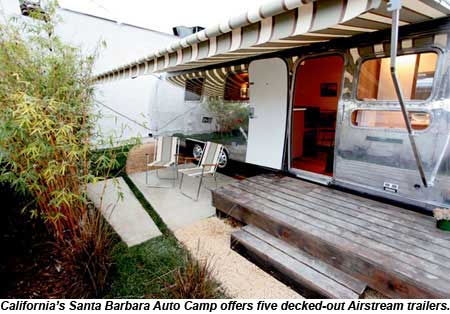
Meanwhile, just down the road from El Capitan is the Santa Barbara Auto Camp, which reopened earlier this year with five Airstream trailers that will set a "camper" back about $200 a night.
Just how much of a share of the U.S. lodging market these type of accommodations account for is difficult to measure because of their lack of categorization and the fact that this type of lodging is relatively new.
The Outdoor Foundation's American Camper Report estimates that about 43 million people spend a collective 535 million nights on overnight camping each year. But these accommodations suggest an audience drawn from typical upscale hotel guests, who routinely pay $150 to $250 a night for a standard hotel room, rather than from a market of campers. The latter group is accustomed to paying, typically, $25 for a campground entrance fee and are more conditioned to roughing it.
Even the terminology can be puzzling. Luxury tents are often grouped under the term "glamping," i.e., glamorous camping. Meanwhile, Delaware North refers to the Explorer Cabins as "cabineering."
"Cabineering best describes a new way to provide the comforts of home and the perks of a hotel in a remote setting," said Delaware North spokeswoman Laura Gray, who added that the new properties will better cater to multigenerational travel.
 Regardless, the prices suggest a sector on the rise as more Americans look to combine nature with creature comforts.
Kampgrounds of America, which operates more than 400 campsites across the U.S., features higher-end cabins at places such as its Petaluma campground in the San Francisco Bay Area, where deluxe cabins that sleep as many as six people go for $185 a night and include microwaves and cable TV.
Further up the food chain, the Resort at Paws Up, whose luxury tents range from 505 to 1,030 square feet, charges nightly rates of between $1,000 and $2,000, inclusive of meals and butler.
And Delaware North, which operates a resort at Australia's Emma Gorge, is "working on a long-term movement for cabineering," Gray said.
As for El Capitan Canyon, which started as a typical private campground in 1970 and reopened as a "cabin hotel" with 109 cabins and 26 tents in 2001, charges anywhere from $155 to $795 a night for summer reservations at its tents. Revenue has been increasing about 10% a year, according to managing partner Terri Bowman.
"Our clientele includes affluent families seeking a nature experience without the work normally associated with camping," Bowman said. "We've noticed over the last couple of years that more extended families are visiting, including grandparents, parents and children."
Follow Danny King on Twitter @dktravelweekly.