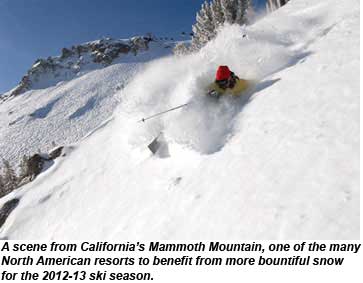
 Late-December storms helped many North American ski resorts make up for lost ground caused by last year's anemic snowfall and a resulting delay in bookings among skiers for this season.
Resorts from California to Vermont reported Christmastime storms that helped either boost ski visits from a year earlier or closed much of the gap stemming from prospective travelers looking to play it safe and hold off on bookings.
While advance reservations for December in much of the Western U.S. and Rocky Mountain resorts were down about 12% from a year earlier, occupancy rates for last month ended up 7.9% lower than December 2011, according to the Mountain Travel Research Program (MTRiP), which tracks 16 resorts totaling 24,000 rooms.
"There was a little bit of a no-snow hangover from last year, and people booked a little later in the season to buy themselves some insurance," said Ralf Garrison, director at MTRiP.
"But there was a white Christmas, so there was a pop in bookings."
Vail Resorts benefited from storms in both California and Colorado, where the company owns resorts such as Lake Tahoe's Heavenly Valley and its eponymous Colorado property. The company said skier visits to its seven resorts through Jan. 13 rose 2% from a year earlier, while lift-ticket revenue was up 4.3%.
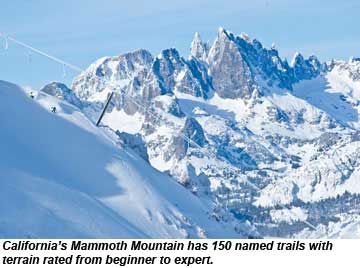
In California, Mammoth Mountain got a whopping 12 feet of new snow in December, compared with just 2 inches in December 2011, and had a base of 94 inches at its Main Lodge as of last week.
Utah's Park City has received more than 11 feet of snow so far this season, or 55% of last season's total.
Wyoming's Jackson Hole Mountain Resort had a record December in terms of skier days after getting 2 feet of snow from a storm that hit the region on Christmas Eve and has received more than 16 feet of snow for the season.
 Only New Mexico's Taos Ski Valley was late to the party, opening its season with just 1 foot of natural snow. The resort has since made up much of the difference and reported receiving about seven-and-a-half feet of snow by Jan. 14, down 12% from a year earlier.
Meanwhile, East Coast resorts whose business was decimated a year ago by warmth and a lack of snowfall were also buoyed by the late-December weather patterns. Some Vermont resorts received as much as 30 inches of new snow in the two days after Christmas. Stowe Mountain Lodge and Sugarbush Resort each reported ski-visitor increases of about 15% over last season.
Going forward, MTRiP says bookings in December for stays through the end of the season jumped 10% from a year earlier, while January occupancy rates as of Dec. 31 were 3.5% higher than a year earlier. While March and April occupancy rates remain below year-earlier figures, numbers for February, May and June are up.
A year ago, Western U.S. and Rocky Mountain ski resorts started the season strong largely on record snowfall during the 2010-11 season, but business slowed amid dry, warm weather conditions. Occupancy fell about 2% compared with the 2010-2011 season, though revenue was slightly up because of higher room rates and strong advance reservations.
Follow Danny King on Twitter @dktravelweekly.