Jeff Rubin says the global economy is slowing down as a direct result of ever-escalating costs for oil and other fuels. No industry or business will remain unchanged.
But that’s not necessarily a bad thing, says Rubin, an economist and energy expert who worked for CIBC World Markets for 20 years. He believes that the slow-growth economy can be the ticket to a different travel dynamic and a better, kinder and gentler world.
Rubin has outlined his well-researched and documented ideas in his latest book, 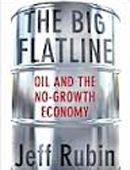 The Big Flatline: Oil and the No-Growth Economy, (Palgrave MacMillan, 2012). This is the third excerpt of a dialogue between Rubin and Travel Weekly PLUS Editor in Chief Diane Merlino.
Merlino: We’ve talked a little about the need to establish different metrics to define growth, success and prosperity. Can you elaborate on that in context of increasing costs for oil and other energy sources?
Rubin: Particularly in North America we believe that our wellbeing is a linear function of our GDP per capita, or even more so of our energy consumption per capita. And when you suggest to people that maybe they should consume less energy they think you’re proposing going back into some sort of primeval, Neanderthal state.
But if you look at any of the surveys of human wellbeing, it’s always countries like Denmark that come out way on top of places like Canada and the United States. And Denmark is a place where they pay 30 cents per kilowatt-hour for power, which is probably three to four times what you pay in the [San Francisco] Bay Area. And they slap a 180% surcharge on buying a car. Yet when I was Copenhagen I didn’t see a whole lot of people lined up at the Canadian or U.S. embassies looking for visas to migrate to our cheap-power economies.
I think there’s a lesson there that maybe consuming more and more energy and having ever-greater GDP per capita is not necessarily making us better off. That’s a hard sell in North America, an easier sell in Europe.
Merlino: Why is the idea that an ever-greater GDP doesn’t necessarily make us better off a harder sell in North America than in Europe?
Rubin: Because in Europe there’s a different sensitivity. It’s not that Europeans are intrinsically greener than North Americans; it’s the capriciousness of nature’s endowments. Nature has given North America a lot of hydrocarbons, whether we’re talking Canada or the U.S. And when you get a lot of hydrocarbons, you feel you’ve got a God-given right to burn them.
Look at Denmark. It’s easy for Denmark to put a huge carbon tax and charge 30 cents per kilowatt-hour. But you know all the coal they’re burning? It comes from Germany. And when they slap a 180% surcharge on that Audi Z8 engine, it’s German autoworkers that get unemployed.
Take where I live, in Ontario. Ontario assembles more motor vehicles than any province in Canada or state in the United States. How do you think a 180% surcharge on motor vehicles will go over in Ontario? So if you’re asking why they have done this in Europe, it’s because they don’t have the tar sand. They don’t have natural gas like North America. Necessity has forced them to consume less energy.
The average house in Copenhagen consumes 30% less power than the average house in Toronto, but Copenhagen is not some energy wasteland. People from all around the world want to go there and live there. The challenge is for us to understand that.
Merlino: You posit in “The Big Flatline” that a more static economy could actually create a kinder, gentler world and benefit humanity.
Rubin: I mean the carbon challenge, as your president addressed in the State of the Union. From a carbon challenge standpoint, a more static economy will achieve what neither the Durbin nor Copenhagen nor Kyoto [Climate Change conferences] could, which is a real break on our emissions. That increasingly seems to be our biggest  challenge. And when I say "ours," I mean collectively, humanity’s greatest challenge.
We’re seeing climate change before our eyes. What’s particularly disconcerting is now even the EPA is no longer talking about whether climate change is going to be happening. It’s talking about how best to adapt to drought in the Midwest, and rising sea levels along the coast, and the increasing frequency of super storms. It reminds me a lot of all the economists who argued that we’d never see triple-digit oil prices. But now that we’re seeing them, suddenly it’s "Oh well, we can’t do anything about it anyway, right?"
So, from that perspective, this [slow-growth or static economy] is a game changer, because now we’re not dependent on the Waxman-Markey climate change bill. We’re not dependent on President Obama actually walking the walk and not just talking greenwash in the State of the Union. If the U.S. economy — and more importantly for emissions, if the Chinese economy — is not going to be growing any more at 10% a year, then maybe they’re not going to go from 3.6 billion tons of coal combusted every year to 5 billion tons. That alone could be very decisive.
Merlino: How would that benefit humanity?
Rubin: Well, it could prevent the four- or five-degree change in global climate that most people, including President Obama, think could have catastrophic consequences. We just got a little taste of that in Super Storm Sandy. We got a taste of that a few years ago with Katrina. These are now real costs, when you look at the physical costs of remediation.
The key here is how do we devise policies that best allow us to adapt to a world of slower growth rather than continuing to keep our foot on the accelerator trying to get 0% interest rates and a trillion-dollar budget deficit to do what $20-per-barrel oil used to do for the U.S. economy.
Merlino: How are these ideas pertinent to the business world? Corporations are all about growth. Do you see that entire paradigm shifting?
Rubin: I think we’re going to go more towards value than growth. There are, of course, going to be certain industries that will grow, even in a static economy. I talked about manufacturing jobs coming back. We also talked  about the example of a possible revitalization of local tourism.
But if you’re going to look at the whole economy and it’s not going to be growing at the same pace as it used to, that’s going to translate at the micro level to a lot of corporations not being able to grow their revenues like they used to. In that world, I think you’re going to find that value is going to be generated the most by those who can control costs.
Merlino: And what do you mean by value, specifically, Jeff?
Rubin: Profit margin, rate of return, willingness of investors to invest money in business venture.
Merlino: You mentioned controlling costs as part of businesses shifting focus to value as opposed to growth.
Rubin: I don’t think we’re going to able to grow the top line revenue to the same extent that we have in the last three decades because the economy’s not growing. Governments will have the same problem of not having the same tax revenues on the top line. That’s going to mean that if you want to generate returns, you’re going to have to generate a margin. It’s going to become important to make sure that your costs are in line.
Merlino: Apart from what government and financial institutions might or might not do, what’s your best advice about what leaders of travel companies can do to position for the changes already occurring?
Rubin: Two things. First, prepare for even higher energy costs and to whatever extent you can, minimize energy usage. That’s probably the best way to go, specifically in usage of oil.
Second, realize that the growth market is going to be local, that people are still going to want vacations. In fact, I’d argue that people may have more leisure time in a static economy than they’ve had in the economy that we’ve known for the last three decades. The opportunities here are going to be in places that are around large urban communities like the San Francisco Bay Area and Los Angeles. The Catskills for New York would be a prime example.
ALSO SEE an earlier excerpt of the interview with Jeff Rubin on How the High Price of Oil Is Reshaping the Travel Industry.
Smokestack image courtesty of Shutterstock.