Put aside what you think you know about innovation. In particular, let go of this idea: Innovation is about one brilliant person with one brilliant idea.
Not so, says Chris Trimble, co-author of four highly regarded business books on innovation and a faculty member of the business school at Dartmouth College. Rather, Trimble says, innovation is a team sport.
In the third and final installment of a dialogue with Travel Weekly PLUS Editor in Chief Diane Merlino, Trimble overturns common myths about how to implement innovation in business, including why leaders need to get in there and get their hands dirty.
Merlino: You talk about innovation's most toxic myths. That’s an intriguing phrase. What are the most common toxic innovation myths you encounter in businesses?
Trimble: Hands down it's the myth that innovation is about brilliant people with brilliant ideas that take initiative and make things happen. Innovation is not an individual sport; it's a team sport.
Merlino: You’ve probably used that last line many times, but it's still a great line.
Trimble: I actually only started using it recently, in conjunction with How Stella Saved the Farm(St. Martin's Press, 2013), because in a parable you can only deliver a small number of lessons. And boy, if you had to boil it down to just one lesson that Stella teaches it's just that — that innovation takes a team.
What that book shows is the positions on the field, if you will. It shows that innovation requires a handful of very specific players, each doing their job. What How Stella Saved the Farm does is analogous to teaching a group of 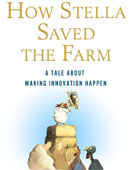 people who've never heard of the sport of baseball that there are nine positions on the field, and this is what the pitcher does, and this is what the catcher does, and this is what the first-baseman does, and so forth.
Merlino: So it covers the basics of the innovation team.
Trimble: Yes. Mainstream management practice hasn't yet even recognized that innovation is a team sport, much less started to recognize what the positions are. So that's what I'm trying to push.
Merlino: Why do you think this idea persists, especially in the United States — that innovation is about brilliant ideas from brilliant individuals who then implement them?
Trimble: I've learned through travels around the world that the myth that I described resonates everywhere, but it resonates most strongly in the U.S. and probably least strongly in cultures that are more collective, like Japan.
We have that image of the cowboy riding his horse into the sunset, and that’s sort of unique to the U.S. We also idolize startup entrepreneurs to such a huge degree here, the Bill Gates and the Steve Jobs of the world. I love their stories too, but I think focusing so much on a heroic leader is extremely misleading, especially when we're talking about innovation initiatives inside of established organizations.
Merlino: In How Stella Saved the Farm, you emphasize open and non-defensive conversations as critical to innovation. Why is that?
Trimble: Innovation involves failures, and nobody likes to do an autopsy. So sometimes having an open and non-defensive conversation about innovation is difficult. But when you give a group of people a parable about a farm that's run by animals, it becomes substantially easier. Doing that also completely removes everyone from their day-to-day lives and therefore removes people from the complexities and details of their day-to-day business. That's very effective for getting our fundamental messages through, especially about the kind of team it takes to make innovation happen.
Our other goal with Stella is simply to get teams reading, as opposed to individuals. We’re extremely proud of a book like The Other Side of Innovation(Harvard Business Review Press, 2011). But as your readers will recognize, the number of businesspeople that make time to read business books is not that large. A traditional business book doesn’t usually reach an entire team, but we believe that Stella can. It's a book that anybody can read in an hour.
Almost everybody that starts reading it finishes it, and then wants to talk about it. You can do that very easily with a team, and then have a productive conversation about what it really takes to win.
Merlino: Chris, do you have any insights specific to innovation inside a travel industry company, like a cruise line or a hotel company?
Trimble: We designed our research from the beginning to be applicable in any industry, and we believe that the main ideas we talk about in our book are applicable in all types of organizations. That doesn't mean there isn't something unique about travel that is a particular challenge to the industry, but I don't think you'll find anything in the industry that is in opposition to the principles we've been outlining.
I'm currently studying healthcare very closely. Lots of people in healthcare have read Stella and they've had very positive reactions to it. But there are some peculiarities to healthcare that make innovation particularly challenging.
For example, it's a very fragmented industry, so even if you get a big academic hospital in a big city to do something new, it's actually very hard to spread those innovations to the rest of the country. So there are peculiarities within industries, but the general principles apply anywhere.
Merlino: These principles of innovation, these practical examples that you give from working with various companies, it seems to me they all require change.
Trimble: Yes, it does involve change, but it's not wholesale change. We're prescribing very targeted change, in such a way that you don't break anything that already exists. We take as a sacrosanct obligation that we're going to do no harm to what already exists. So yes, it involves change, but it's more about being willing to make an exception to your standard rules than to overturn your standard rules.
Merlino: In your experience, how willing are most companies to make even targeted changes?
Trimble: In general, companies are reluctant to do this, and points of resistance often come up in functions like IT or human resources or finance. These functions are sometimes referred to collectively as support functions, which I think is unfortunate, because these functions are enormously powerful in shaping dedicated teams and creating conditions for success for innovation.
One of the most toxic things that can happen is for these functions in particular to go with “one-size-fits-all” policy-making. This is often the most convenient thing to do; it's the cheapest thing to do, it's the most efficient thing to do, and in many cases it seems like it's the fairest thing to do.
But you'll never get a dedicated innovation team with that mindset, at least not an effective one. You'll never be able to build a new business model with that mindset. So these are pretty key resistance points that have to be overcome. Again, it's not about overturning everything; it's about making exceptions.
Merlino: What role do company leaders play in being willing to do what it takes to truly create innovation?
Trimble: I think the most important role of senior executives may be a communication role. And the key message is, “We are now trying to do two very different things at the same time: sustain excellence in the business that we're already in, and create something new. Both sides are equally important, and yet we have to treat each side differently. That's just the way we're going to operate.” The leader has to set that tone. That's critical.
It’s also very important for senior executives to get their hands dirty, often at operational levels that are well below their radar screen, specifically in order to resolve conflicts. Innovation and day-to-day operations are always in  conflict, and left unattended these conflicts will always be won by the powers that be in the established business; they have far more power. So the ability for leaders to get their hands dirty and adjudicate those conflicts is very, very important.
Merlino: Chris, any concluding thought on the importance of innovation, particularly in today's volatile business world, which is nestled within an extremely volatile global economy?
Trimble: Companies' interest in innovation goes up and down depending on the business environment of the day. But the fact is that innovation always has been and always will be the key to growth and the key to organizational vitality. I've never known another answer.
ALSO SEE:Chris Trimble on Your Innovation Dream Team: How To Make It Happen