If you think you’re in business to make money, think again. That’s not your purpose, says Simon Sinek. It’s just the result. And if your focus is on making money, you’ll eventually lose the loyalty of your employees and your customers, and the competition will wipe the floor with you.
Sinek is the author of Start with Why. How Great Leaders Inspire Everyone to Take Action(Penguin Group, 2009). The book, which had its genesis in Sinek’s personal quest to rediscover his own excitement about work and life, has been described as a simple and pragmatic approach to great leadership.
Sinek’s unconventional views on business and leadership have earned him invitations to meet with an array of leaders and organizations, including Microsoft, MARS, SAP, Intel, 3M, the United States military, members of Congress, and multiple government agencies and entrepreneurs. He has also presented his ideas to the ambassadors of Bahrain and Iraq and to the senior leadership of the United States Air Force.
Sinek shared a few of his key ideas on purpose and leadership in business with Diane Merlino, editor in chief of Travel Weekly PLUS.
Merlino: From a business leader’s perspective, why is basing everything on the why question so important?
Sinek: Every single organization on the planet — and our own careers — always function on the same three levels: what we do, how we do it, and why we do it. This is a biological imperative. It's based on how the human brain makes decisions and how we interact.
Every organization knows what they do, and some know how they do it, but very, very few can clearly articulate why they do it. And by why I don't mean to make money or fulfill some obligation. Those are results. By why I mean what's your purpose? What's your cause? What's your belief? Why does your organization exist? Do we really need another one of you?
Merlino: I think most business leaders would say their purpose is to make money.
Sinek: First of all, to make money is not a purpose. It's not a reason to exist. It's simply a result.
Merlino: I would agree with you, but a lot of business leaders would not.
Sinek: Those are the people who have higher stress, greater pressures, and lower cooperation, where trust has declined and loyalty is nonexistent. And the only way in which they can “fulfill their purpose to make money” is with bonuses to incentivize people to do things and with huge signing bonuses to get people to join them and huge bonuses to get them to stay when they threaten to quit. That's the only way you can do it. You can't buy loyalty.
Those organizations that do have a clear sense of why outperform their competition consistently, year over year over year, and they are not subject to all of those ridiculous games, because their employees don't leave, they don't require anything to join, they don't demand excessive amounts to stay, and they willfully and willingly help each other to advance the cause, to advance the organization.
Those leaders and those CEOs who put why first and who care about the human being first not only outperform their competition, but they enjoy their jobs more, and everybody who works for them enjoys their jobs more. These are the companies and organizations that are more innovative, more profitable, and command the greatest loyalty both internally and externally for prolonged periods.
Merlino: Simon, you just mentioned leaders who put the human being first. Is that related to the idea of conscious or compassionate capitalism?
Sinek: I think they're largely the same thing, which is that great organizations, strong organizations, would sooner sacrifice the numbers to protect the people. Weak organizations would sooner sacrifice people to protect the numbers.
Merlino: How would those two different approaches play out in a real-world scenario?
Sinek: In the real world, you would get, "Oh my God, we're having a bad year. We're not going to make our numbers. Let’s do layoffs. Let's look at destroying careers and eviscerating the livelihood of families so that we can make our numbers work for one year."
The joke is that those companies often have to hire the people back at higher rates or as consultants, and/or they put additional 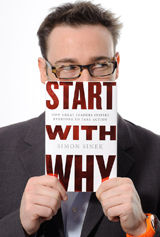 pressures on the people left behind because now those people have to do more work. In the short term, that strategy does exactly what it's supposed to do: it makes the numbers work for one year. But the long-term impact of that model is so detrimental to a company.
Great organizations will find other ways to suffer through it, but they would never look at people as the first thing to go. By the way, it’s a relatively recent phenomenon where we use layoffs to balance the books. It pretty much didn't exist as a business strategy prior to the 1980s. So when people say, "Oh, that's normal," no, it's not.
Merlino: Where does the answer to the question about why a business exists come from?
Sinek: Actually, the why is born in history; it’s the reason the organization was founded in the first place. Almost every time, there was a person or a small group of people who personally suffered a problem, or somebody close to them suffered a problem, and they found a solution to that problem. That solution, that opportunity they saw, became the business.
And somebody early on took a risk and went into a venture that had a high probability of failure. What was so compelling that the stress and the huge risk of failure was worth it? That's usually where the why comes from. It's that founding problem, the original frustration.
Merlino: As companies grow and evolve, what’s the role of the business leader?
Sinek: It’s the responsibility of the leader to uphold that why and keep it alive. The founding of an organization is like setting out on a journey. The people there at the beginning know what direction to go in. Subsequent leaders represent the compass; they must now continue on the same journey in the same direction.
Otherwise, if you veer every time the wind changes or the market demands something, you get lost. You end up somewhere dark in the woods, thinking that you know where you're going simply because you have a compass with you, but you don't know the direction you set out on, and all you can do is articulate the direction you're walking in right now. There's a huge difference.
Merlino: Are there any companies in the travel industry that are good examples of starting with why?
Sinek: Southwest is a great example because it has nothing to do with being an airline; it’s not about what they do. It was founded way back when taking a plane somewhere was expensive. It was elitist, and it was complicated. And these sort of average joes showed up and said, "Well, hold on, hold on. Everyone should be allowed to go wherever they want. Everyone should be allowed to use aircraft."
And when you're the champion for the common man, you make it cheaper. When you’re the champion for the common man, you make it simpler because you remove the elitism. Those are the reasons they did these things. They weren’t competitive advantages per se; they were the means to get to their cause.
Southwest represents this concept of freedom, the freedom to travel. That’s what they do, and that’s why you see them talking about it even today. They’re still not an airline; they're in the freedom business, and this is why it works. That's what it means to have a cause. They just happen to do it through an airline, but that was incidental.
Merlino: You also mention Disney in your book.
Sinek: Disney is in the good, clean, family fun business. That’s their cause, which is what has allowed them to do so well in everything from theme parks to films to DVDs to toys. We know that when we see the word Disney on something, what's in there is guaranteed because we know what Disney's cause is, and we know that Disney is consistent in delivering that cause.
I think one of the things Walt Disney provided was relief, an escape — you could get away and have fun, leave your troubles behind. He was all about imagination and that anything is possible. In a time of pessimism in our country, he presented optimism. There’s nothing more beautiful than that. He gave us optimism. That’s an amazing thing.
To view a video of Simon Sinek's recent TED Talk— which has had more than 10 million views — click here.
NEXT ISSUE: Simon Sinek on leadership, the capacity to inspire and your limbic brain.