When Simon Sinek reached the point when he no longer had any passion for the work he was doing, he knew something had to give.
“It was in that really dark period of my life that I went on a search to try and get myself out of it,” Sinek said. “And that’s when I discovered this naturally occurring pattern — that every single organization on the planet always functions on the same three levels: what we do, how we do it, and why we do it.”
Sinek said he knew what he did, and he knew how he did it, “but I couldn't tell you why I did it. The best that I could tell you was I did it to make money, to have freedom — all these things that we say to ourselves. Yet that didn't alleviate the way I felt about having to force myself to get out of bed and go to work every day. When I realized I needed to understand the third component, the why — the fuzziest part — I became obsessed with the question.”
That obsession led to an answer on a personal level and eventually to writing a highly regarded book, Start with Why. How Great Leaders Inspire Everyone to Take Action(Penguin Group, 2009,) describing a philosophy and approach that Sinek has been asked to share with a variety of businesses and organizations, including Microsoft, MARS, SAP, Intel, 3M, members of Congress, the U.S. military, the ambassadors of Bahrain and Iraq, and multiple government agencies and entrepreneurs.
This is the second installment from a dialogue between Sinek and Diane Merlino.
Merlino: Simon, what happened when you found the answer to your own career why?
Sinek: It restored my passion beyond levels I'd ever experienced before. Then I shared it with my friends, because that's what you do when you discover something beautiful: You share it with the people you love.
They started making crazy life changes, and they would invite me to their apartments to share it with their friends. And people just kept inviting me, and I just kept saying yes, and I kept talking about it and sharing it, and it grew very organically from there. But it all came from a very, very personal reason.
Merlino: It sounds like it was a matter of the heart for you.
Sinek: Yeah, except I know enough to say that there is no such thing as a matter of the heart. It's the limbic brain. The limbic brain controls all of our feelings and all of our behavior, all of our decision-making. But it doesn't control language or rational and analytical thought, which is why we say we are making a gut decision — "It just feels right." We feel it in our heart. We feel it in our gut.
That's the reason this stuff gets dismissed by a lot of businesses as fluffy — it lacks words, and it lacks measurement. When someone says, “You need to create emotional connections with your customers” or “You need to lead from the heart,” what the heck is a CEO who's looking for metrics and numbers supposed to do with that kind of instruction?
That’s the problem: The part of the brain that controls rational and analytical thought, our neocortex, doesn't control behavior. So creating emotional connections means appealing to the part of the brain that makes decisions and is also responsible for feelings. Hence the reason we say “emotional connection.” It's all very scientific. It’s not fluffy at all. It's just hard to describe, and it's hard to measure.
Merlino: You've said that leaders who have had the most influence all think, act, and communicate in the same way, and that way is completely opposite what everyone else does.
Sinek: We all know what we do. We all know how we do it. But those leaders with the capacity to inspire — everybody from Martin Luther King to Steve Jobs — don't start by telling you what they do; they start by telling you why they do it.
Martin Luther King gave the "I Have a Dream" speech. He didn't give the "I Have a Plan" speech. He didn't start with the product. He didn't start with the service. He didn't start with a differentiating value proposition. He talked 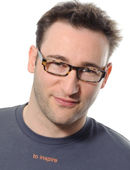 about why he began on the journey in the first place, which is he imagined a world in which little black children and little white children would play together on the playground. That's why he did it. He had a vision of the world.
Steve Jobs, too. It wasn't about making a better computer. It was about giving people access to technology. Steve Jobs understood that we have to adapt the technology to fit into our lives. We shouldn't have to adapt our lives to fit into the technology. We should make the computer so intuitive and so simple that it would more seamlessly integrate into the way we already live our lives — which is why he was obsessed with simplicity and things looking nice. Because he wanted them to literally fit into our lives. Those things are bigger than the technology, and they're bigger than computers.
Jobs believed that human beings come first and the technology comes second. The technology integrates, not the other way around. When you talk to most computer people, they believe the technology is the be-all and end-all, and we have to change the way we do things to fit how the technology functions. Jobs had a distinctly opposite point of view. He understood why it mattered; he was not necessarily enamored by what the thing did.
Merlino: We’re back to the point you make about putting people rather than profit at the center. How many major companies actually do that, would you say?
Sinek: Fewer than 10%. That's the problem. That's why we all use the same examples. That's why everybody's tired and bored of listening to people talk about Apple and Southwest and Harley-Davidson. It's the same handful of companies that everybody talks about because there only are a handful of companies that do it. There are not a lot of good examples. Who am I going to talk about? Goldman Sachs? I mean, come on. Seriously?
Merlino: We’re getting used to that kind of corporate misbehavior, especially in the financial realm. It seems intractable.
Sinek: This is not about rogue traders. Those guys would be hailed as heroes if the bet went right. You know, these things don't happen by accident. It’s the culture of the company, the tone from the top that creates the environment in which irresponsible behavior happens.
NEXT WEEK: Simon Sinek on the role and responsibility of leaders.
ALSO SEE: Simon Sinek on Why Making Money in Business is Not the Point.