Accommodations
• Hacienda Pinsaqui
www.haciendapinsaqui.com
Doubles from $144
• Hosteria Pantavi
www.hosteriapantavi.com
Doubles from $54
• Patio Andaluz
www.hotelpatioandaluz.com
Doubles from $190
• Hacienda Umbria
www.haciendaumbria.com
Doubles from $150
• Hacienda San Agustin
www.incahacienda.com
Doubles from $425
• Mansion Santa Isabella
www.mansionsantaisabella.com
Doubles from $90
• Posada Ingapirca
www.posadaingapirca.com
Doubles from $105
• Hotel Santa Lucia
www.hotelsantalucia.com
Doubles from $90
• Mansion del Rio
www.mansiondelrio-ec.com
Doubles from $125
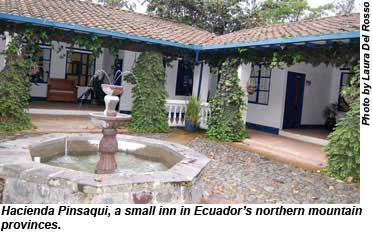
A steady rain pounded the roof, thunder boomed and lightning struck around the lobby lounge at Hacienda Pinsaqui, a small inn in Ecuador's northern mountain provinces. The fierce storm soon knocked out power, leaving a small group of guests in total darkness.
As staff rushed to light tall candelabras and flickering light illuminated old stucco walls, we had a sense of what it must have been like 200 years ago, those nights when Simon Bolivar and his lover took refuge here on trips from Quito to Bogota.
Pinsaqui, which is just outside the crafts and weaving market of Otavalo, is one of Ecuador's centuries-old estates that operate as hotels. The property was founded in 1790 as a textile workshop and later was transformed into a 30-room hotel, run by the last five generations of the Freile-Larrea family.
Before dinner each evening, guests are led to a cozy, cave-like cellar where, by a roaring fire and with local musicians performing, a family member describes Pinsaqui's long history and the rituals for drinking canelazo, Ecuador's sugary, hot rum drink, and eating a local version of empanadas.
Francisco Saa, one of the family members, said it's the history and hospitality that makes a stay special.
"Most of my family live here and spend time with guests," he said. "We look at this not as a hotel but as a home that welcomes friends."
On a recent trip through Ecuador, that kind of hospitality was repeated again and again at a variety of hotels.
In the northern province of Imbabura, Quito artist Camilo Andrade created a luxurious haven on an old estate at Hosteria Pantavi, whose 15 suite-like rooms are surrounded by lush gardens, a swimming pool and decorated by mosaic murals and colorful pieces of Andrade's art.
Pantavi lies in an area with much to see, including the Cotacachi-Cayapas Ecological Reserve and its towering Cotacachi volcano, Otavalo and other crafts towns and the Ibarra-Salinas tourist train.
 Ecuador's sprawling capital city of Quito has several historical hotels, including Patio Andaluz in the colonial center. The 32-room hotel, just off the main square, is a restored 16th century mansion with a large inner patio where breakfast and dinner is served. The large guestrooms are decorated with handsome antiques.
In the central highlands of Ecuador, former businessman Alvaro Samper designed the Hacienda Umbria off a stunning stretch of the Pan-American Highway known as the Avenue of the Volcanoes, an hour from Quito. The four-room Umbria is one of Ecuador's most elegant small inns, with Samper emphasizing fine dining using ingredients from the estate's own gardens and wines from his native Chile. Umbria's large, homey living room offers gorgeous views of the snow-capped Cotopaxi volcano.
Near the entrance of Cotopaxi National Park is the Hacienda San Agustin, built on a centuries-old working farm and around an Inca palace and a 16th century monastery.
 For decades the property has been operated by the Plaza family, which played an important role in Ecuadoran politics. Carved volcanic stone rooms built by the Incas in the 15th century remain, serving as a chapel and the hotel dining room. Public areas and rooms are furnished with antiques and plush sofas and armchairs.
At the southern end of the Avenue of the Volcanoes is the city of Riobamba, surrounded by fertile fields of the Chimborazo province, which has Ecuador's highest percentage of indigenous people. The city, a jumping-off point for treks in the Andes, is halfway between Quito and Ecuador's other cultural capital, the colonial city of Cuenca.
Two years ago, London-born Ben Cox and his Ecuadoran wife, Jenny Delgado, opened Mansion Santa Isabella, an 11-room inn in a restored 115-year-old colonial house that had fallen into disrepair.
The building's foundation is made of hand-carved stone and laced with a network of tunnels. The couple created a cozy English tavern in the cafe-like tunnels and transformed the mansion's central atrium and public areas into warm, inviting spaces.
South in the province of Azuay and several miles off the Pan-American Highway is Posada Ingapirca, a 200-year-old hacienda within walking distance of Ingapirca, Ecuador's largest Inca ruins. The rustic lodge-like hotel is set amid green, rolling hills.
Dinner, including fresh-caught trout, and a two-course breakfast are served before roaring fires in a room filled with indigenous crafts and colonial-era antiques. The hotel's 23 rooms are simple, but a stay here is special because of its history and views of ancient Inca buildings.
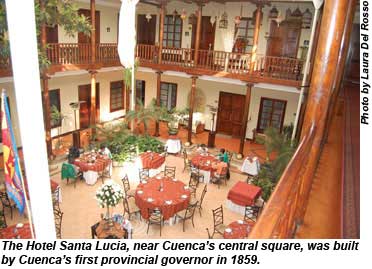 Cuenca's core is lined with once-grand 18th and 19th century buildings, many renovated to their former glory, including the Hotel Santa Lucia, an elegant property just a few minutes' walk from the lively central square and massive pink travertine cathedral.
The hotel, originally built by Cuenca's first provincial governor in 1859, is full of antiques and lavish decor, and its central patio houses a romantic, candlelit Italian restaurant.
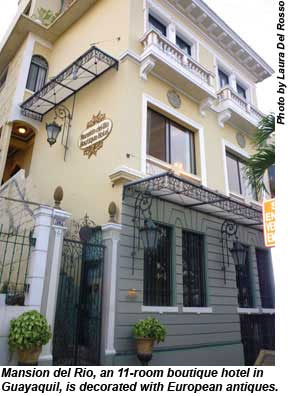
Down at sea level is Ecuador's coastal city of Guayaquil, which has undergone civic improvements in recent years, including much renovation of the waterfront area of Las Penas around Mansion del Rio, a boutique hotel owned by Maria Gardella and her family.
The hotel's 11 rooms are sumptuous, decorated with European antiques and artwork that Gardella has collected on her travels.
Built in 1926 in art deco style, the former home was fully restored by Gardella and opened in 2010. "Cuenca and Quito have had some wonderful boutique hotels, but Guayaquil didn't have one, and we felt it was needed," she said.