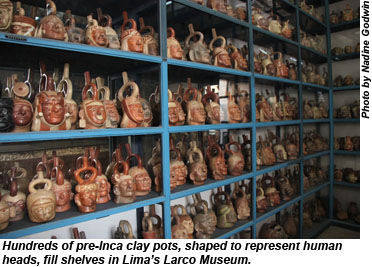
 The Larco Museum in Lima boasts that it has "the finest gold and silver collection from ancient Peru," and indeed, its gold and silver pieces are eye-popping. Nevertheless, it was the lowly pottery that grabbed my attention first.
The museum houses 45,000 artifacts, the vast majority of which are clay vessels of various sizes. In one hall, floor-to-ceiling shelves are densely packed with clay pots shaped like human heads, but each face is apparently meant to represent a specific person. Expressions vary, too, from happy or amused to distressed.
This pottery, and the Larco Museum's fabrics, jewelry and other goods, represent 3,000 years of pre-Inca cultures.
The collection is available for public viewing in an attractive 18th century mansion set amid flower gardens. The house itself sits atop, and hides, a pre-Inca pyramid from the seventh century.
I visited the museum with a press contingent previewing the city where ASTA will stage its next International Destination Expo, set for March 1 to 4 at the Westin in the San Isidro financial and shopping district. (View a slideshow previewing Lima here or by clicking on the photos.)
As part of the Lima program, delegates at the expo are invited to choose one of a range of free sightseeing tours in and around Lima, including one that makes the Larco Museum its centerpiece.
Lima's past
Some of the tours for IDE delegates will focus on the metropolitan area's history, both before and after the Spanish arrived.
Beginning a few years after the conquistador Francisco Pizarro founded the city in 1535, Lima spent nearly 200 years as the capital of a colony that encompassed almost all of Spanish-ruled South America. Evidence of Lima's early wealth and political importance survive in the colonial city center, now a Unesco World Heritage Site.
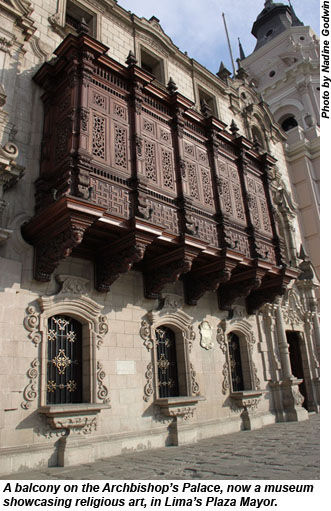 The colonial area's natural magnet is the Plaza Mayor, site of the Presidential Palace, the Archbishop's Palace and the Lima Cathedral.
For our press group's short visit, we strolled the Plaza Mayor under brilliant sun, then focused on the Archbishop's Palace, newly incarnated as a museum showing off its collection of religious art and something of how an archbishop lived in the colonial capital.
Visitors don't have to go inside, though, to admire the best feature of this building: the two enclosed wooden balconies on the exterior. There are many balconies, which reflect Moorish influences on Spanish architecture, in the older areas of Lima. Our guide said, "Lima loves balconies." She said there was a time when the well-to-do competed to create the finest or most decorative balconies, which enhance the city for those of us who visit in the 21st century.
Colonial Lima is a key reason serious sightseers linger in Peru's capital, but there are other attractions. Lima's site on the Pacific coast was occupied for centuries before the Spaniards appeared. Pre-Hispanic peoples built adobe pyramids: Huaca Pucllana in the Miraflores district and Huaca Huallamarca in the San Isidro district.
We made a short stop to view Huaca Pucllana, a surprisingly large mud-brick structure set among the high-rise buildings of the modern city. Huaca Pucllana was a ceremonial and administrative center for the Lima culture, which controlled the Lima valley around the beginning of the fifth century. Now the structure and its grounds are a historical park with an on-site museum, as well.
In the here and now
While the past provides a compelling reason for client to visit the Andean country, Peruvians live in the here and now.
Lima, in particular, is strong on 21st century appeal. The city bills itself as a gastronomical capital, and travel companies build culinary tours around Lima's eateries.
For Lima's most popular restaurants, shopping and folkloric shows or other nightlife, visitors head to the artsy cliffside neighborhood called Barranco as well as the Miraflores and San Isidro districts. It's a great combination of experiences to eat in a fine fish restaurant in a setting overlooking the ocean.
Tourists can take boat trips from Callao to see dolphins, whales and sea lions; they may also see a variety of seabirds, including penguins.
Go to www.visitperu.com.