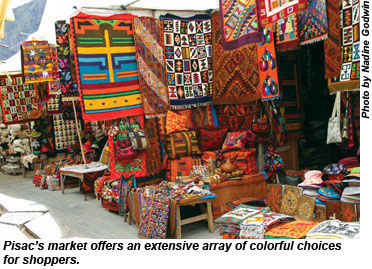
 La Raya Pass, at 14,172 feet above sea level, was the highest point on my small group's drive from the shores of Lake Titicaca in southern Peru to Cuzco, the former Inca capital.
The site offers dramatic and sweeping Andes Mountains views; it's a particularly satisfying scene for the memory bank because of a large, even stereotypical, Andean market in the foreground.
We were about three hours into a 10-hour day and, from this point, we began our descent into the Vilcanota River Valley.
Never heard of the river? Not many have, but the name is a disguise of sorts. The Vilcanota rises in the Andes traveling northwest, but once it passes through the mountains to the east of Cuzco on its way to Machu Picchu, it becomes the Urubamba, and the terrain around it is known as the Sacred Valley. (Some maps use the names Urubamba and Vilcanota interchangeably for the entire river.)
The 'Overlooked Valley'
The Vilcanota Valley, under any name, is green and rich with agricultural activity, home to Inca ruins large and small and dotted with tourist-friendly Andean markets.
However, Inca and pre-Inca terraces -- ubiquitous and still used in many Andean valleys, including the Urubamba -- are largely absent along the Vilcanota. The terraces weren't necessary in the latter valley because it is much broader and hence easier for farmers raising local staples: corn, potatoes and quinoa, a grain common to Peruvian cuisine.
 I also judged the Vilcanota Valley the more beautiful and, in some ways, reminiscent of Tuscany with its undulating terrain, many earth-colored houses and red-tile roofs.
Given it is not the Sacred Valley, I dub it the (too often) Overlooked Valley.
Travelers can fly from Juliaca, near Puno, to Cuzco if their itineraries include both Lake Titicaca and a Cuzco-Machu Picchu component. However, taking the drive is a good idea for clients who like more contact with the lands they visit, but it is a better idea in the dry season, roughly April to October or November. We were lucky early last month with shimmering sun.
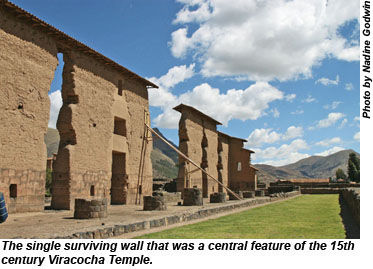
One of the top attractions, in the sense of a touristic stopping point, is the 15th century Viracocha Temple at the Raqchi Archaeological Site. The site and an eponymously named nearby town are about 75 miles southeast of Cuzco.
Raqchi, on the slopes of the Kinsachta Volcano at 11,417 feet above sea level, is surrounded by three miles of stone walls. The striking centerpiece is easy to spot: a single 39-foot wall that bisects the Viracocha Temple and still extends most of the temple's 300-foot length.
The surviving wall, aside from broken areas, is pierced by original windows and topped by a narrow tile roof that is not original.
The wall is believed to have once stood 54 or 55 feet tall, and the modern roofing aims to prevent further erosion.
Also on the site are 24 roofless residences and workshops for workers who made textiles and ceramics; some observers believe the temple was really just a factory, as well.
 Another 160 circular stone units accommodated livestock and stored food and arms, suggesting the enclosed Raqchi site was important for preserving resources and controlling the area. Further, the principal trunk of the empire's Inca Road passed through the middle of Raqchi.
An Inca primer
It's helpful to visit Raqchi before Machu Picchu for a preview and short primer on Inca construction. The bottom quarter of the surviving Viracocha wall illustrates Inca stonework, with big, carefully hewn stones that fit together perfectly without mortar. The top part of the wall -- built with mud, not an Inca medium -- presumably reflects the local culture, which was absorbed into or allied with the Inca Empire.
Trapezoidal windows and doors, utilized in Raqchi buildings, are a device to stabilize buildings in the event of earthquakes. The Incas used lots of them at Machu Picchu, too.
Another Inca favorite, also seen here and at Machu Picchu, was construction that aligned the rising sun of the winter or summer solstice with an important window, gate or pathway.
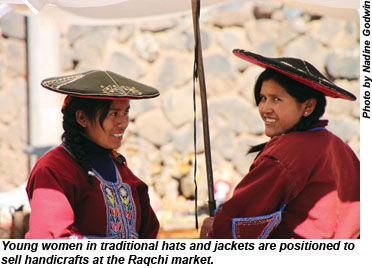
The tourist visit at Raqchi ends pleasantly at a market near the entry to the site's grounds. The sellers, mostly women, wear traditional dresses and hats, and they sell the full range of Andean handicrafts.
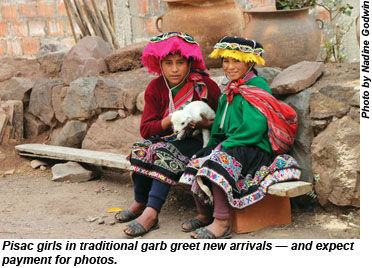
 A day later, in the Urubamba or Sacred Valley, we visited the renowned Pisac market town, which in its gorgeous setting offers many more choices for shoppers. The Raqchi and Pisac markets are attractive and useful -- bringing local goods home is one way for tourists to extend the vacation sensation -- but Pisac seemed to have lost some of its authenticity. I preferred the Raqchi market despite the fact the CD of Andean music I bought there merely chirped when it met my player at home.
It's perhaps ironic the Incas are so central to a Peru itinerary considering the Inca Empire spanned only a century, until ended by the conquistadors in 1532.
Hispanic heritage
The Spanish had 300 years to make an impression, and our last stop for the day played to that history. The village of Andahuaylillas, 10,209 feet above sea level and only 29 miles from Cuzco, is the unlikely site of the so-called Sistine Chapel of the Americas.
The attraction is the 17th century St. Peter's Roman Catholic Church. The plain exterior belies an interior covered with an amazing array of artwork meant to keep illiterate recent converts loyal to Christianity. My favorites were a pair of paintings just inside the front door; images on one side show the path to heaven while those on the other graphically illustrate the path to hell.
As happened often on this trip, our guide, of indigenous descent, emphasized that Andean peoples never stopped worshipping the mountains and other pre-Christian gods even as they made space for Christianity.
After leaving Andahuaylillas, we passed Rumicolca, an outsized stone gate attributed to the Incas and their predecessors. It served as a travel checkpoint for the Incas, and for us, a suitably grand symbol for the empire as we neared its capital.
For more, visit www.peru.travel/en.