British Airways CEO Willie Walsh, a vocal proponent of allowing greater coordination among members of the Oneworld airline alliance, said he was "pleased to see" Air France-KLM and Delta launch their joint venture.
The agreement between Air France-KLM and Delta allows greater cooperation for planning transatlantic routes between the two largest partners in rival alliance SkyTeam.
"It reinforces the case we make for antitrust immunity to work with American and Iberia," Walsh said. "Now we need a level playing field. It would be unfair to be curtailed in what we want to do in our joint business proposal. It’s not good for competition."
When asked if he viewed the Delta-Air France arrangement as a prototype for BA, American and Iberia, Walsh professed he hadn’t "spent much time looking at their model." But the fact that it was allowed by regulatory bodies in the U.S and Europe to move forward made him "optimistic we’ll get our approvals."
"But it doesn’t mean we’ll follow anyone else’s model," Walsh said.
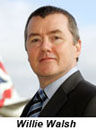 Walsh was in New York to discuss with analysts and media the airline’s earnings for the fiscal year ended March 31, which were released May 22. BA had an operating loss of $352 million, including restructuring costs of $125 million, compared with a restated profit of $1.4 billion the prior year.
BA's loss before tax for the recently completed fiscal year was $634 million, versus a $1.5 billion restated profit the year before.
Walsh told the group that he hoped to get a formal response from the U.S. Department of Transportation in October on BA’s request for antitrust immunity to work cooperatively with American and Iberia.
"The file is formally closed; the period of public comment is finished. The case is strong," he said.
As regards permissions he needs from the European Competition Commission, Walsh said BA "decided not to take a fast-track approach," hoping to align the timing of a decision with the DOT results.
Walsh said discussions with Iberia to merge under a jointly owned holding company were "continuing, but very slowly."
"It’s taking longer than expected," he said. "There are delays as they work to understand our pension system. But I’m confident their concerns can be addressed. And there remain concerns about how the holding company will be structured. Governance structures are critical to delivery of synergies. We will take the time needed to get to the end we all want."
Open Skies, the BA subsidiary that launched a year ago, had hoped to capitalize on expansion of premium seating just as the premium market began to contract. Walsh conceded that "it wasn’t a great time to launch an airline," but maintained that the model was sustainable.
"We didn’t know what the economy was going to be like, [nor anticipated] the significant decline in premium seats," Walsh said. "But we’ve learned quite a lot, and we have established significant market share in premium seats between New York and Paris -- 25% -- which is more than we thought we’d do.
"But it is trading behind its business plan. It has demonstrated the difficulties in selling to corporations outside your own market."
The transatlantic premium market, traditionally a dependable profit center for international carriers, has fallen overall, Walsh said.
"Some believe the premium market is dead," he said. "I don’t believe that. We don’t usually talk about this, but we’re still seeing capacity in the low 60s. While the recovery will take some time, and we will not get back to the volumes we saw in 2007 and 2008, I do believe the market will recover in time."
Walsh said that rather than spending money to reconfigure aircraft to reflect the decline in premium sales, BA is "overselling in economy then tactically upgrading."
We’ll contact certain customers and offer them an upgrade [at an attractive cost]," Walsh said. "Upgrading for money is actually much better than upgrading for free on the day of the flight. It’s all in an effort to maximize revenue."