 Despite piling up orders with Europe's major airplane manufacturer, Airbus, Middle East airline Emirates continues to face strong opposition from European nations as it tries to gain access to their airports and travel markets.
The problem, analysts said, is that Emirates is gobbling up market share from European carriers, and their home countries are protecting their airlines' turf and business.
The question, the experts said, is if, in the interest of free trade, the European Union will allow Emirates to expand in Europe at the expense of those national carriers. A related question is whether that decision will be affected by Emirates' orders for the giant, double-decker Airbus A380 aircraft.
"From Emirates' viewpoint, the A380 represents Europe's fat and vulnerable aviation underbelly," said Richard Aboulafia, vice president of the Teal Group aviation industry consultancy.
"Not only are you hurting taxpayers with a subsidized airplane, but you're hurting your airline industry, too," Aboulafia said. "Europe has shown it is quite willing to protect its national plane, even if that means throwing its national airlines under a bus. As Europe supports the A380 by getting Emirates and friends to take them, Lufthansa and its fellow European carriers face a tough time."
Germany has already started to fight back.
The European Commission said in February it would start looking into a German law enacted last year forcing Emirates to raise certain fares, particularly business-class fares for the Frankfurt-Johannesburg, South Africa, and Hamburg-Singapore markets, by as much as a fifth.
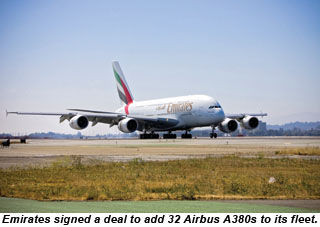
In a move seen across the industry as a maneuver to mollify the German government and the European business community, Emirates made headlines at last month's Berlin Air Show by signing an $11.5 billion deal to buy 32 additional A380s.
Aboulafia called the order an "overhyped event" that "represents the only significant A380 order in years. It also cements Emirates' status as the only enthusiastic A380 customer."
Aboulafia said the A380 "offers a very quiet and comfortable passenger experience. But it's a commercial disaster. Put aside Emirates' 90 planes, and Airbus has sold a dismal 144 aircraft over 10 years."
He added, "The only hope for the A380 program, therefore, is Emirates. Like its wannabe colleagues Etihad and Qatar, Emirates is enjoying remarkable growth rates by grabbing other people's traffic. They've achieved that by siphoning traffic away from legacy carriers, especially Lufthansa, Air France-KLM and British Airways."
Those three carriers, Aboulafia pointed out, have ordered a combined total of 39 A380s.
It's unclear if Emirates' big A380 order in Berlin hit the right notes with German authorities, but the plan certainly struck a sour chord in France.
Soon after the order became public, Peter Hartman, CEO of the KLM unit of Air France-KLM and a member of the airline's governing board, told the Dow Jones Newswires the Dubai-based airline is likely to face greater reluctance from other European governments to grant traffic rights.
Emirates maintains that those decisions are up to the respective governments.
And those European governments will have to decide whether a strong Airbus is more important than protected national airline routes as well as the competitive benefits that Emirates offers passengers, Aboulafia said.
"Europe would only hurt its consumers if it kept Emirates out of its air travel markets, and protectionism is a bad idea," he said.
This report appears in the July 12 issue of Travel Weekly.