 Incentive travel has come a long way since the "AIG effect" made it a dirty word in 2008.
The term was born when the insurance giant American International Group spent more than $400,000 on a trip for its 100 top-performing insurance agents only one week after accepting $85 billion in federal bailout funds. And while the term is no longer a media catchphrase, the damage done to the industry is undeniable.
Conference centers, hotels and cruises experienced mass cancellations of incentive trips, some of which had already been paid for, to avoid the perception of being lavish or imprudent during the economic downturn.
Add the AIG effect to the overall impact of massive corporate budget cuts, and the incentive travel segment might have suffered the worst one-two punch in the industry during the recession.
At its lowest point, incentive travel planners say, business fell by as much as 40% as companies either canceled annual incentive trips or greatly reduced what they spent on them.
Now, almost four years after "AIG effect" was first coined, incentive planners say business has rebounded, though not to prerecession levels.
In a recent survey of its members, the Society of Incentive and Travel Executives found that 52% of respondents believe it will take two or more years before the motivational-events industry returns to the level of sales it recorded in 2007.
There are strong signs of encouragement from the industry. When asked if their customers were using more or fewer motivational travel experiences, 66.6% of SITE's survey respondents this year answered that the use of trips was growing or the same. Last year, only 22.1% answered that way, while 72.9% said it was less.
Moreover, SITE members think things can only get better; 62% of respondents expected the use of motivational travel to increase in the next six to 12 months, with 84% predicting major improvement in the one- to three-year span.
There may no longer be any public backlash against incentive and motivational travel, but planners say the business has changed.
What is most salient is what many planners describe as the need for companies to be able to measure the return on investment of incentive travel.
 One year ago, SITE reported that a survey of its members found that 73% of respondents felt that senior management would "expect justification for their programs" as measured by return on objective and return on investment.
"The measurement piece is more critical than ever," said SITE President Mary MacGregor, vice president of account development for Chicago-based BCD Meetings and Incentives. "There is a heightened conscientiousness of ensuring that the motivational event or incentive travel program or meeting has a very solid business case."
SITE board member Sean Mahoney, global vice president for corporate and incentive sales at Silversea Cruises, said the justification measurements are a "new reality" of the business environment resulting from the downturn.
"It made us understand what business travel is all about," Mahoney said. "There is major emphasis on measurement, transparency and exactly how meeting and incentive events and consumer shows are all contributing to the bottom line."
Before the downturn and AIG effect, he said, there had been a lot of data to support the use of business travel as an incentive tool, but most of it was anecdotal.
"Few companies were talking about what they were spending and how they were spending it, but more importantly, how that spending was resulting in increased profits and marketing share," he said.
The backlash, Mahoney said, encouraged CEOs to publicly explain why incentive travel was "not a problem, but a solution in a down economy and in a poor business environment."
MacGregor and other planners stress that the point companies have had to hammer home is that incentive travel is self-liquidating.
"The true essence of an incentive travel program is that it does pay for itself," MacGregor said.
Typically, she said, the trips fund themselves and also result in incremental earnings for the organization.
"The formula varies a bit, but on average about 10% of the incremental income goes back into funding the program," she said.
As the economy tanked, the role of many travel planners was to bolster support for the industry and hand-hold skittish clients.
Aash Shravah of Montrose Travel in Montrose, Calif., No. 51 in Travel Weekly's 2011 Power List, said that during the downturn, his team often talked clients out of canceling programs. He would explain to companies that it would be more difficult to cancel and start again in two to three years, and thus that a better solution was to reduce costs.
"We see the people who canceled, and the ones that didn't but maybe reduced it or cut from business-class to economy airfare, and they were able to increase market share," Shravah said. "That's the kind of education we provide to these companies."
MacGregor said that according to members, there are signs that the incentive travel business is coming back. That has been particularly true over the past six months, during which time, she said, members have been reporting an increase in inquiries and requests for proposal.
"Colleagues and companies that are part of SITE are seeing positive improvements in their business for 2012 and '13," she said.
 Still, while business is on the rise, some incentive planners say the quality of the trips has changed.
"It will never be like it used to," Shravah said. "Before, maybe they were willing to fly people first and business and are now flying people economy. The accommodations are still five-star but getting you there isn't as wonderful as it used to be."
Shravah noted that cutting the air cost meant big savings without downgrading the experience.
"The true experience starts at the destination," he said. "Companies want to save money but not give up the four- or five-star, the all-inclusive and the amenities. Where do they go to cut costs? The most obvious choice is the air."
Another way companies have saved money is by staying closer to home, he said. Over the last few years, he said, incentive trips to the Caribbean and Mexico increased while travel farther abroad saw reductions.
Those trends have been particularly painful to companies that serve the luxury incentive market.
Corporate and incentive travel has typically represented about 15% to 20% of Silversea Cruises' total business mix.
Mahoney said that incentive business has been returning for the line, but slowly.
"There is still a reluctance for some, especially publicly traded companies, to do anything that might be perceived as extravagant or irresponsible," he said. "Many are still avoiding luxury destinations and cruise lines because they are afraid of those perceptions."
This year, the cruise line exceeded its goals for incentive business. Helping Silversea is that international businesses are still doing elaborate programs, and private companies don't worry about shareholders' perceptions.
Next year appears to be back down somewhat. Mahoney blames both continued economic issues and a glut of cruise capacity in the Mediterranean, which historically represents about 50% of Silversea's corporate and incentive business.
In addition, he said, North American companies are staying closer to home and not undertaking the long-haul programs they used to, or they are going to Europe but with fewer people and with fewer perks, such as expensive gifts at turndown or elaborate themed dinners.
Beyond mere perceptions, he said, the economy has not recovered as hoped.
"The greatest challenge of the industry is not the perception and perceived value of business travel," he said. "It's the general economic environment we're in right now."
Echoing this, SITE found that the largest area of concern for incentive travel planners involved corporate budget issues. In the SITE survey, more than 80% of respondents predicted that reduced budgets would continue to have a negative impact over the next few years.
Still, Mahoney said, companies are changing and realizing that less expensive incentive programs might not have their intended effect.
"You can't take a group of people earning six-figure incomes who are themselves used to doing five-star resorts and business-class air and tell them you are going to reward them with a three- to four-star experience," he said.
The mantra of "cheaper is chic-er," Mahoney said, is slowly being dispelled.
"Companies are returning to the kinds of programs that are required to motivate performance," he said.
Dianne Der Bogosian, president of Corporate Incentive Travel, also found that during the downturn, some companies were not willing to cut back on trips, preferring to cancel them altogether, which she encouraged.
Her company experienced a major downturn in business during the recession, and the European piece of business shrank quite a bit, she said, but mostly because companies simply stopped the programs rather than scaling them back.
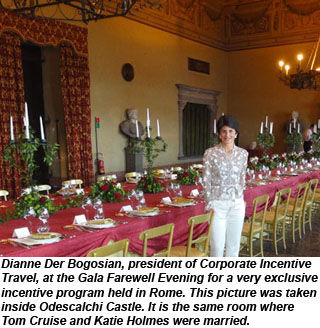 Having just returned from what she described as a "super, over-the-top trip to Paris and Monte Carlo" that included world-class properties on the French Riviera, business-class air and helicopter transfers from the airport, she said the company that purchased the trip had taken a break in 2008 rather than downgrade the program.
"When you do an incentive, it's important that you build," she said. "Maybe you do Caribbean for a few years and then go further to Europe."
Both she and Mahoney noted that pent-up demand from those companies that canceled or postponed trips is leading to increased inquiries and business.
"We experienced from early to mid-2010 that things were changing in a positive direction," Der Bogosian said. "We found that we've been getting clients that never used incentives before, which is very encouraging. And clients that had stopped using incentives for various reasons put their toes in the water again."
Mahoney said companies that contracted their programs or did other things to incentivize their employees, dealers or distributors, such as offering merchandise or cash rewards, are now returning to incentive travel.
"Having done that over the last couple years, there is a real need for corporations to get their employees together to talk about how they function in this new economy and new business environment," he said.
MacGregor agreed, noting that companies that held back during the past couple years were returning to face-to-face meetings.
She also said many companies that for the past few years did not consider travel outside of their particular region or borders are now more open to going abroad, and that travel to Europe and Asia is back "on the radar."