From recession and slow recovery to the uncertainty of worldwide elections and an Arab world still in turmoil, it is fitting that the 2012 World Travel & Tourism Council (WTTC) Summit in Japan this week will focus on leading the travel industry through turbulent times.
Looking back at the 12 months since the 2011 summit was held in Las Vegas, the WTTC described the period as "exceptionally turbulent," citing the debt crisis, democratic uprisings around the globe, the unpredictable global economy and concerns over the future of global institutions such as the European Currency Union.
Looking ahead at the rest of 2012, with elections scheduled in the U.S., France, Taiwan, Russia, India, Mexico, Kenya, Venezuela, Egypt, South Korea and China, the council stated, "This turbulence has implications for the travel and tourism industry, which is both a driver of global economic growth (accounting for 9% of global GDP) and dependent on the world's economy as a driver of its own success."
 Being both a driver of the global economy and one of its dependents highlights the simultaneous importance and frailty of the travel industry.
Travel and tourism continues to be one of the world's largest industries. Its 9% contribution to global gross domestic product in 2011 equaled a value of more than $6.5 trillion, accounting for 255 million jobs, according to data published by the WTTC in an annual report prepared by research partner Oxford Economics.
"Over the next 10 years, this industry is expected to grow by an average of 4% annually, taking it to 10% of global GDP, or some $10 trillion," WTTC CEO David Scowsill wrote in an introduction to the report. "By 2022, it is anticipated that it will account for 328 million jobs, or one in every 10 jobs on the planet."
This year's summit, the WTTC's 12th, comes off what Scowsill called "one of the most challenging years ever experienced by the global travel and tourism industry."
Still, the industry has proved resilient.
 "Our latest research suggests that, despite political upheaval, economic uncertainty and natural disasters, the industry's direct contribution to world GDP grew by nearly 3%, to $2 trillion, and directly generated 1.2 million new jobs," Scowsill wrote. "Moreover, while the macroeconomic environment remains very challenging, our latest projections point to continuous growth in the contribution of travel and tourism to global GDP and employment." (Click on the graphic, left, for a chart of the total contribution of travel and tourism to the global GDP.)
In addition, the WTTC reported in March that this year would bring several other milestones for the travel industry: international travelers are expected to surpass 1 billion for the first time, and the industry is on pace to account for 100 million jobs.
"But these numbers are dwarfed by the total forecasted contribution of our industry: $6.5 trillion to the global economy and 260 million jobs," Scowsill wrote.
 In the Oxford report, he predicted that rising incomes in emerging economies would continue to fuel increased leisure demand, and not just in the so-called BRIC nations of Brazil, Russia, India and China "but increasingly across the rest of Southeast Asia and Latin America." (Click on the graphic, left, for a chart of travel and tourism's contribution to global GDP, business vs. leisure, for 2011.)
Those nations and their growing international trade, he said, would sustain demand for business travel.
The forecast is less rosy when looking at fully developed economies.
The WTTC predicted that consumers were likely to remain cautious this year, especially in Europe, where austerity measures are being implemented widely.
This echoes a recent U.S. Travel Association report indicating that just over half (56%) of U.S. adults plan to take a leisure trip in the next six months, lower than the 59% who answered similarly in February 2011.
"Americans are continuing to travel, but intentions remain somewhat restrained compared with pre-recession levels, which is not surprising given the uneven nature of the modest economic recovery to date," David Huether, senior vice president of research for U.S. Travel, said in a statement.
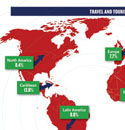 The WTTC expects growth in travel and tourism's direct contribution to worldwide GDP to remain stable in 2012, at 3%, and to directly generate more than 2 million new jobs, with a 2% increase in visitor exports and 3.5% growth in investment. (Click on the graphic, left, for a map of travel and tourism's contribution to GDP, by region.)
"Rarely over the past 20 years have we been challenged by such economic and political uncertainty as we are seeing now," Scowsill said. "Our ongoing research underlines the importance of travel and tourism as a stabilizing force globally, providing jobs, generating prosperity and facilitating international trade and investment."
Matthew Upchurch, chairman and CEO of Virtuoso, said he hopes this year's summit will address the continued need for the entire travel industry to coalesce and work together to facilitate travel, adding to advances made in expediting visas to the U.S.
"Last year's summit included a strong focus on the visa situation, and guest speakers from the current administration seem to have heard the concerns shared throughout the industry," Upchurch said. "I am very pleased at the steps President Obama has taken toward visa reform. Not only does it allow for more travelers to visit and spend within the U.S., bolstering the economy, it inspires reciprocity with other countries to the benefit of American travelers."
He also pointed to other initiatives, like Brand USA, which are "clearly positive and a step in the right direction."
 "There is still work to be done so that travel is not viewed as a frivolity by lawmakers, the U.S. press and consumers alike, but rather a vital contributor to job growth and economic stability," Upchurch said. "I'm not sure we're fully capturing imagination or mind share, but I do think the WTTC is on the right track to make these issues heard." (Click on the graphic, left, for a chart of travel and tourism's contribution to global GDP, domestic vs. foreign, for 2011.)
Upchurch said that at this year's summit he expects the WTTC "will take a look at where the world is right now and what role travel and tourism is going to have over the next five, 10 and 15 years, specifically as it relates to the economy.
"If I had to guess, I'd say most people, including U.S. politicians, do not view travel and tourism as an export," Upchurch said. "Yet it is one of our only surpluses, and it's poised to be an even larger contributor to global GDP in the coming years."
This is the message that Scowsill has been promoting in the little over a year that he has been the WTTC's chief.
"It is clear that the travel and tourism industry is going to be a significant driver of global growth and employment for the next decade," he said. "Our industry is responsible for creating jobs, pulling people out of poverty and broadening horizons. It is one of the world's great industries."
Follow Johanna Jainchill on Twitter @jjainchilltw.