 Government spending run amok or political football?
That's what travel trade groups are debating after the federal government's Inspector General office disclosed details of a one-day Washington-area awards ceremony for a department of the General Services Administration (GSA) in 2010.
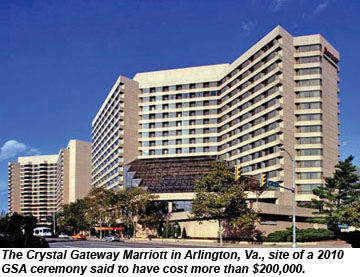
The GSA's Federal Acquisition Service (FAS), among other fees, paid $34,000 in venue fees, $28,000 for picture frames and more than $20,000 for drumsticks as part of an awards ceremony that took place on Nov. 17, 2010, at the Crystal Gateway Marriott and Key Bridge Marriott in Arlington, Va., according to testimony given on Aug. 1 by Brian Miller, the GSA's inspector general.
All told, the event cost taxpayers more than $200,000, with some estimates in the $270,000 range.
"The 2010 FAS awards ceremony is another example of what the acting administrator has already recognized: a pattern of misjudgment which spans several years and administrations," Cynthia Metzler, the GSA's chief administrative services officer, said in her Aug. 1 testimony.
The probe is part of a broader investigation of 77 GSA conferences that took place during the 18 months leading up to April 2012. The spending on the 77 conferences totaled about $6.5 million, including 30 FAS conferences costing more than $3.5 million and 38 events hosted by the Public Buildings Service costing more than $2.5 million, the Washington Post reported, citing the GSA's preliminary findings.
The investigation is taking place just three months after a similar probe revealed details of an October 2010 GSA conference near Las Vegas that cost $823,000 and caused GSA chief Martha Johnson to fire top adviser Stephen Leeds and Public Buildings Service chief Robert Peck before resigning herself.
Whether investigations reflect rampant overspending or isolated incidents depends on whose interpreting the data. House Transportation and Infrastructure Committee Chairman John Mica (R-Fla.) and Economic Development, Public Buildings and Emergency Management Subcommittee Chairman Jeff Denham (R-Calif.) both took the GSA to task.
"The GSA tried hard to claim the problem was limited to one regional office and the guy in the hot tub," Mica said in an Aug. 1 testimony. "We suspected the Vegas conference was just the tip of the iceberg."
Still, some within the travel industry say the events are more notable for providing a way for some members of Congress to bash the current administration than they are a true reflection of government-travel policy. Highlighting big travel tabs is an effective political strategy because most people have a general knowledge of travel expenses, as opposed to other forms of government spending, said Erik Hansen, director of domestic policy at the Washington-based U.S. Travel Association.
"It's easily identifiable as waste even if it's not symptomatic of a larger problem," Hansen said. "What's not being paid attention to is the 99% of travel that's within the rules."
Either way, the publicity represents an additional challenge to a business-travel industry in which growth has lagged that of leisure travel because of a combination of conservative U.S. business spending, lower government per-diems and uncertainty stemming from the European debt crisis.
Last month, the Global Business Travel Association said U.S.-initiated business-travel spending this year would increase 2.2%, down from the association's prior forecast of 3.6% growth.
And that spending might be further hamstrung starting this fall. The federal government in October will set the upcoming fiscal year's per-diem spending rates for government employees, and some travel analysts and hoteliers have estimated that per-diem rates could be cut by as much as 10% or 15% as the current administration looks for ways to show it's trying to reduce the federal deficit in advance of the November presidential election.
The 2010 GSA event near Las Vegas gained attention for including expenses such as $136,504 on two pre-event scouting trips, $75,000 on a bike-building activity, $7,000 on sushi, $5,600 for in-room parties, $3,700 for T-shirts and $3,200 on a mind-reader.
The fallout from those findings led the American Hotel & Lodging Association (AH&LA) to create a "best practices" checklist that meeting planners can use to minimize wasteful travel spending, according to Eric Reller, director of legislative communications at the AH&LA.
"We know that meetings and conventions are very helpful and can serve a great purpose of networking," Reller said. "But we need to be mindful that it's done in the best way."
For hotel and hospitality news, follow Danny King on Twitter @dktravelweekly.