 NEW YORK — Some leading hoteliers at last week’s New York University International Hospitality Industry conference had a blunt message for various levels of government in the U.S., ranging from local on up to federal: When it comes to international travel policies and airport operations, lead, follow or get out of the way.
While the executives acknowledged that many people are resuming pre-recession travel patterns, they added that other would-be travelers are discouraged by a combination of aging U.S. airport infrastructure that can ruin a trip before it begins and stringent Department of Homeland Security policies that prevent wealthy travelers from countries like China and Russia from getting travel visas to the U.S. in a timely fashion.
In his keynote to about 2,000 people gathered at the Marriott Marquis here, Loews Hotels Chairman Jonathan Tisch specifically cited two recent Frommer’s lists of the world’s “most beautiful” and “worst” airports to argue that more airport operations need to be privatized and taken out of the hands of public entities.
The Frommer’s lists, while subjective and somewhat random, rather than empirical, included four U.S. airports among the “worst” and just one terminal — New York Kennedy’s Terminal 5, operated by JetBlue — among the most beautiful.
“We’re right on the verge of potentially the greatest boom market in our industry’s history,” Tisch said. “But there’s a giant elephant in the room. Traveling today can be an enormous hassle. We’re deluding ourselves if we don’t understand and fix that problem.”
In the wake of the 9/11 terrorist attacks, the U.S. tightened its visa policies for overseas travelers looking to visit the U.S. As a result, said Vasant Prabhu, CFO of Starwood Hotels & Resorts, the country continues to lose international tourist market share as other countries reach mutual agreements to ease cross-border visits and take advantage of the rapidly grow ing middle class in some developing countries.
“There’s a revolution in travel going on outside the U.S., and we’re missing out on it completely,” said the India-born Prabhu, who was speaking on a separate NYU conference panel. “If you’re in China or the Middle East, it’s extremely hard to come to the U.S.”
The comments were striking because the hoteliers focused on an area outside their industry — specifically, aviation — as a key to further recovery at a time when they are already benefiting from both an uptick in domestic travel and international visits.
In a report released June 4, Smith Travel Research (STR) said U.S. hotel revenue increased 7.5%, to $137.5 billion, last year, marking the industry’s fastest sales-growth rate in a decade.
Whether such improvements are occurring as a result of or despite airport and visa initiatives is open to debate.
Last year, the U.S. hosted 62.3 million international travelers, who spent $153 billion, according to the U.S. Department of Commerce. Compared with 2003, which marked the lowest level of inbound travel since 9/11, visits are up about 45%, while spending has doubled.
Meanwhile, executives with Brand USA, the public-private collective that was recently launched to market the U.S. globally as a tourist destination, said at the International Pow Wow conference in April that wait times for visas for travelers from countries such as Brazil have dropped about 50% in the past year.
And last month, the Obama administration introduced the Jobs Originated Through Launching Travel Act, which would fund interagency coordination designed to boost inbound travel by, among other things, improving security-related technology and further speed up visa approvals.
As for privatizing airport operations, that idea has been floating around for decades. It was formally introduced as an option in 1996 when the FAA was authorized to start a pilot program with a handful of U.S. airports, the largest being Chicago’s Midway Airport.
Still, that process, which would allow private companies to lease out all or part of various airports, has been slow going. Although the FAA recently doubled the number of potential candidates to 10, none of the airports has reached an official agreement with a potential private operator.
“We cannot look to Washington to help us solve this problem,” Tisch said. “The Washington legislative process is as gridlocked as our airports.”
Regardless, the idea of taking the federal government out of airport operations is an unrealistic one, said Darryl Jenkins, chairman of the Virginia-based consultancy American Aviation Institute.
That’s because liability issues associated with a private company running air-traffic control would be far too great, while the American public isn’t likely to support privately operated airport security as long as terrorism remains a public-safety threat.
Moreover, all the airport expansion and updates in the world won’t change the fact that the peak U.S. travel season is June and July, which is exactly when what Jenkins calls “pop-up” thunderstorms are most likely to strike the East Coast airports that serve as many of the largest airlines’ hubs and shut down much of the country’s air-traffic system as a result.
“The government did a really bad job over a large number of years modernizing equipment,” Jenkins said. “We all hope that within the next 10 to 15 years, air traffic control becomes better. But you cannot fly a plane through a thunderstorm. Only a Looney Tune would do that."
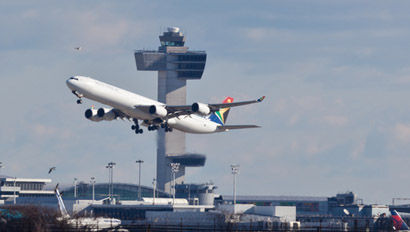
Photo of JFK Airport courtesy of Christopher Parypa/Shutterstock.com.
Follow Danny King on Twitter @dktravelweekly.