Developers are pitching two hotel projects totaling more than 400 rooms along a prime stretch of coastal Santa Monica, Calif., that has seen little in the way of new hotel-room supply since the Art Deco era of the 1930s.
Owners of the 89-year-old Fairmont Miramar Hotel & Bungalows are pitching a plan to add a 21-story tower and 280 rooms near the corner of Ocean Avenue and Wilshire Boulevard.
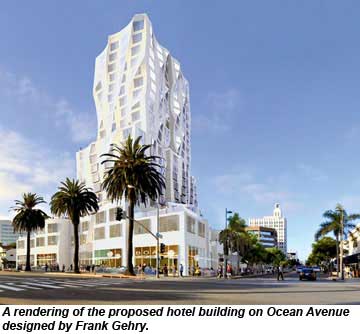
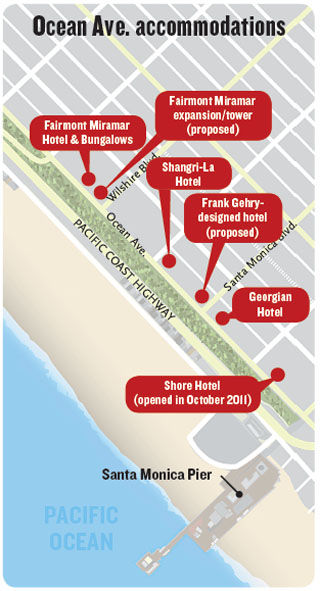 And two blocks south at Ocean and Santa Monica Boulevard, developers M. David Paul and Worthe Real Estate Group, along with noted architect Frank Gehry, are proposing a 22-story building that would include 125 hotel rooms and 22 condominiums.
Both the latest revisions for the Miramar site and the first documents from the Gehry project, proposed as simply the Ocean Avenue Project, were filed with the city in February. (Click here or on the image, right, for a larger view of a map of the projects in the area.)
If completed, both hotel towers would be among the tallest buildings in Santa Monica.
"The Miramar will be a new landmark for downtown Santa Monica," the owners wrote on their public-outreach website. "The redevelopment of this beloved hotel will ensure its place as one of the premier luxury hotels in Southern California."
The projects are being pitched for a stretch of Ocean Avenue that runs just north of the Santa Monica Pier and parallel to the bluffs above the Pacific Coast Highway. It is among the most sought-after real estate in the region.
While Santa Monica's population of about 90,000 people is about one-fortieth that of Los Angeles, the city gets almost 7 million annual visitors, or about a sixth of Los Angeles' tourism numbers.
That high level of demand is reflected in room rates. For early-April weekend stays, Fairmont Miramar rates start at $379 a night, while rooms at the nearby boutique hotels the Shangri-La and the Georgian start at $365 and $325 a night, respectively. Those rates are more than double the average Los Angeles-area rate of about $130, according to Smith Travel Research.
As for hotel-development activity, just about all of it along Ocean Avenue has occurred south of the pier in recent decades. The 342-room Loews Santa Monica Beach Hotel opened two blocks south of the pier in 1989. Since then, it received $7 million worth of upgrades in 2010 and is in the midst of a $4.5 million facade renovation.
Meanwhile, between 1993 and 2002, the 198-room Shutters on the Beach, the 129-room Casa del Mar (converted from what was originally a beach club), the 175-room Le Merigot (which flies under the JW Marriott flag) and the 162-room Viceroy Santa Monica all opened just south of the Pier. The Viceroy was acquired by LaSalle Hotel Properties in 2011 for $80 million.
 North of the pier, however, there have been few changes in hotel inventory. The Fairmont Miramar's oldest building was constructed in 1924 and has since been built out in phases to a total of 296 rooms. The 84-room Georgian Hotel was built a half-block south of the Gehry site in 1933, and the 71-room Hotel Shangri-La opened a block south of the Fairmont Miramar site in 1939.
In fact, the only recent addition to hotel-room inventory north of the pier was the October 2011 opening of the 164-room Shore Hotel, which was built where two motels had previously stood. It had an 88% occupancy rate during its first year of operation.
As for the proposed projects, no timetable has been set for potential city approvals or a possible groundbreaking, and the city can be notoriously difficult when it comes to approving building projects.
Still, both projects are looking to parlay their long histories and cachet to win both community support and city approval. The Fairmont Miramar, has long been considered a coastal hideaway of sorts; it boasts actress Greta Garbo as an early resident and has hosted U.S. presidents John F. Kennedy and Bill Clinton.
As for Gehry's Ocean Avenue Project, the architect can claim strong local roots. He designed Los Angeles' Walt Disney Concert Hall and designed the Santa Monica Place mall one block east of Ocean Avenue in 1980.
The project's "iconic design will represent an element of distinction within the entire community," its developers wrote in its project application submitted to the city on Feb. 28.
Follow Danny King on Twitter @dktravelweekly.