 Back in 1889, Mark Twain famously observed that there was “more than one way to skin a cat.” Today’s analogy might well be ways to book a hotel room on the Internet: There appear to be about a thousand of them.
The newest way consists of a class of websites that promise consumers discounts by having hotels bid against each other to force room prices down.
But analysts suspect that the model might have been created on the assumption of a desperate hospitality industry saddled with lots of excess inventory and flagging rates.
If so, their timing probably couldn’t have been worse, as the industry appears to be experiencing a slow but steady recovery.
TripAdvisor’s Tingo, Silicon Valley-based Guestmob and Montreal-based BackBid have all launched within the past six months. All say they can beat prices offered by hotel websites and online travel agencies (OTAs) like Expedia, Priceline and Travelocity by having participating hotels engage in a bidding process to unload unsold inventory at the last minute.
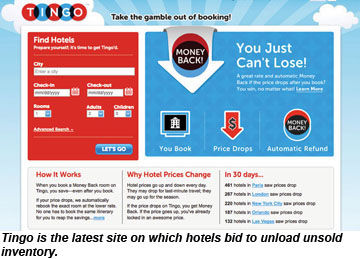
The most recent entrant is Tingo, which TripAdvisor launched March 21. It claims to be the first booking site that automatically rebooks a reservation at a lower price in the event that the published rate for a particular stay falls, then refunds the difference to the customer.
Tingo, citing PhoCusWright’s estimate that OTAs booked $15.2 billion in U.S. hotel reservations last year, estimated that American travelers would have saved almost $314 million in 2011 by using its site instead.
Meanwhile, Guestmob, which launched last fall and now serves 20 markets, including New York, Los Angeles, Chicago and Las Vegas, presents a “basket” of about a half-dozen hotels in a particular geographic location and lets customers book at a predetermined price within that basket.
Then, Guestmob informs the customer between one and six days prior to the stay which hotel was booked. Guestmob claims its model enables it to offer prices 20% to 50% lower than the best available rates at hotel sites, OTAs or metasearch sites like Kayak.
Reservations are fully refundable up to three days prior to the stay, meaning that Guestmob is more or less splitting the difference between refund-eligible customers who know where they’re staying and customers who won’t find out where they’re staying until after their refund period has expired.
Guestmob and Tingo join BackBid among websites that try to rejigger the room bidding process to offer potential customers discounted rates.
BackBid, launched late last year, essentially flips the opaque pricing model popularized by Priceline.com and Hotwire on its head.
Travelers enter reservation information such as dates, room rates and amenities — but not the name of the hotel — on the site, at which point participating hotels can bid on the reservation by coming up with more compelling offers.
The company, which collects revenue through commissions from hotel reservations it generates, has said it’s more than just a room-discounting site, because hotels have the opportunity to swipe an existing reservation from a competitor by offering amenities such as free parking or meals, not just by offering price cuts.
 Like daily-deal sites such as Groupon and LivingSocial, BackBid appears to be working primarily in the independent, non-affiliated hotel sector. As such, they are among an increasingly crowded field of hotel-room distributors who are banking on a rising tide of online hotel-reservation revenue.
At first blush, market data would appear to support their optimism. Between 2009 and 2013, annual online U.S. hotel bookings from leisure travelers will have jumped 44%, to $39.2 billion, and will account for a third of all hotel bookings, PhoCusWright predicted last November.
Henry Harteveldt, principal analyst at Atmosphere Research Group, said, “Given the state of the economy and that there’s too much hotel supply and not much brand loyalty, these sites have a chance.”
But he was quick to add that “their success will be determined more by hotels than by consumers.”
An improving hotel market
Indeed, while a growing legion of travelers is using the Internet to book hotels, an improving U.S. hotel market could work against these sites because hotels might be less willing to drop their prices and create discount opportunities.
Last year, revenue per available room (RevPAR) in the 25 largest U.S. markets rose 9.2% from 2010 on a 4.5% increase in average room rates and a 4.5 percentage-point increase in occupancy, according to Smith Travel Research (STR). In January, STR forecasted a 2012 RevPAR increase of 4.3%, almost exclusively on room-rate increases.
Meanwhile, PKF Hospitality Research last month revised its 2012 RevPAR forecast upward, to a 5.8% growth rate, and said average U.S. hotel room rates would advance at least 4% every year through 2014.
That means that with higher occupancy rates on the way, there’s a greater chance for hotels to boost prices during the days just prior to a booking date and a lower chance of their dropping rates.
 Carroll Rheem, a research director at PhoCusWright, said, “There are too many hypotheticals, and in a marketplace that’s improving, I don’t know how much you’re really going to see prices go down.”
Rheem added: “All of this noise is just that. People want simplicity in their model.”
Either way, getting a handle on BackBid’s pricing relative to OTAs and other distribution channels is challenging because the final price is determined only after a competing hotel bids on an existing reservation.
As for the other two sites, Guestmob appears to beat Tingo at first glance.
For a two-night weekend stay near Times Square starting April 20, Guestmob lists a “basket” of hotels that includes the Hilton Times Square, Westin Times Square and Renaissance New York Times Square and quotes a rate of $318 a night, adding that the nightly rate would be $389 “anywhere else.”
Meanwhile, Tingo beats Guestmob with a $313 nightly rate for the Hilton Times Square, but it is more expensive with the Westin and Renaissance, at $395 a night and $379 a night, respectively.
Still, price alone doesn’t tell the story. Guestmob’s customer, for example, won’t know exactly where he or she will be staying until after the reservation has been made. Moreover, Tingo promises to refund the difference between its rate and a lower, published one.
And there may be an even more basic problem facing the room-bidding models: Much of these websites’ success depends on the industry’s current, predominantly lax policy when it comes to hotel-room cancellations.

Both Rheem and Harteveldt said that should the industry tighten those policies as the economy improves, the opportunities for these sites to offer discounts to their customers and still make money will diminish.
Despite Tingo’s having the deepest pockets through its TripAdvisor parent, Harteveldt said that of the three sites, Guestmob might have the best chance of success, because it buys its rooms in bulk and buys them close to the booking date, making its model closer to that of a group reservation.
“Hotels can better apply better revenue-management strategy with Guestmob,” Harteveldt said. “If hotels participate in Tingo and BackBid, their economic failures can only be blamed on the ownership and management of those properties.”
Follow Danny King on Twitter @dktravelweekly.