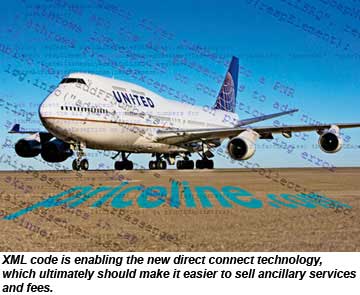
 Priceline, the world’s largest online travel agency (OTA), last week announced a direct-connect deal with United Airlines that upends the revenue model that has served as the foundation of airline distribution since the late 1990s.
In effect, Priceline is walking away from the segment fees that GDSs pass on to travel retailers for bookings made through the GDSs.
What’s more, Priceline is using GDS-free direct connect not just with United but also with American Airlines; it began selling some, though not all, of American’s ancillaries through a direct-connect relationship last summer.
Virtually all of American’s bookings through Priceline are now done via direct connect, according to Brian Ek, Priceline’s spokesman. The few exceptions are sales of interline tickets.
Priceline started rolling out the direct-connect bookings with United last month. While not all of those bookings are yet via direct connect, Ek said,
“We’re getting there.”
The United-Priceline deal doesn’t mean that the model for airline ticket sales is going to be transformed wholesale overnight, but it clearly represents another step in the trend of moving away from the GDS model to sell airline seats and ancillary services.
Neither Priceline nor the airlines would comment on whether the carriers are compensating the OTA in any way for the GDS revenues it will be losing as a result of the direct-connect relationship.
However, industry observers, while speculating that Priceline could be collecting commissions or marking up tickets slightly, also said air sales were somewhat irrelevant to its revenue model.
According to PhoCusWright, the OTA makes its money on hotel sales, not air.
Douglas Quinby, senior director of research with PhoCusWright, said that Priceline has long employed a strategy of focusing on hotels and lessening its dependence on air.
“For OTAs, air is really like the milk in the grocery store, and they are really hoping you’ll pick up a hotel room on the way out,” Quinby said. “Hooking into airlines directly enables them to provide more convenience to their customers, more stickiness to their user experience.”
Under such a business model, Priceline might well decide it would be worth losing the GDS fees, which are not that important to its revenue model in the first place, in order to be a leader when it comes to third-party sales of ancillaries that right now are booked most easily, sometimes exclusively, on airlines’ own websites.
“I think the leadership at Priceline is being pragmatic,” said Henry Harteveldt, travel industry analyst at Hudson Crossing. “They’re saying, ‘Yes, we would miss some of those GDS incentives we would earn, but the overall value is far greater.’”
Even so, Harteveldt said he believes that American and United probably are doing something to make the direct connect “financially worthwhile” to Priceline, whether enabling markups to cover Priceline’s distribution costs or some other type of compensation.
“If Priceline saw that its use of American’s direct connect was not working, they would not have made the decision to proceed with United,” he said.
Still, Harteveldt said, the evolution of airline distribution remains a crawl-walk-run process, and the market is still in the crawl stage.
Priceline is the world’s largest OTA as measured by both revenue and market capitalization. It ranked No. 4 last year in Travel Weekly’s Power List, which is determined by sales.
Even given its own size and its deals with two of the world’s largest airlines, the industry and consumers are still a long way from a brave new world of customized offers tailored to the individual.
(American moved a step closer to becoming the world’s largest airline last week when its proposed merger with US Airways received bankruptcy court approval.)
 Bob Offut, senior technology analyst for PhoCusWright, said, “Airlines are still a long way from providing personalized offers to Bob Offut and Kate Rice based on our flying history.”
That’s because, he added, most airlines “aren’t equipped” yet to handle XML direct.
Offut was alluding to the fact that the current limitations of the technology involved mean that the Priceline-United deal is only partially direct connect.
Farelogix, the company that operates airlines’ billing systems, connects with United’s internal res system via Edifact, a legacy code that many airlines criticize for being expensive, unwieldy and outdated.
Farelogix then connects with Priceline, using XML code and a standardized API that is essentially the same API Farelogix is using to connect American with Priceline.
“From a technical point of view, they’re not that different,” said Jim Davidson, president and CEO of Farelogix.
The limitations of Edifact are enough that ancillaries are not now easily available, even at Priceline’s site.
For example, American’s Preferred Seats, which are simply seats located at the front of the cabin, and its Main Cabin Extra seats, which have extra legroom, are sold by Priceline. But its Choice fare families are not, even though American has made Choice fare families available to Priceline. Those fare families are available on American’s own website.
Priceline said last week that offering those fares was on its “road map.”
And, though United and Priceline ostensibly hammered out this deal to enable the sale of ancillaries, neither Priceline nor United could give a timeline as to when United’s ancillaries would be available through the OTA. Nor could they say which ancillaries would ultimately be available through Priceline.
When asked if Priceline would be able to display United’s and American’s fares and ancillaries side by side, Ek said it might eventually be able to do so on a bundled basis, but he could provide no timeline.
The two carriers might have had some leverage with Priceline because both participate in Priceline’s name-your-own-price air program.
Harteveldt observed: “Priceline wants to make sure that it maintains access not only to standard inventory but to deeply discounted inventory it uses for its name-your-own-price options.”
Moreover, there are other hurdles to clear when it comes to presenting ancillaries to consumers through a third party.
“It’s not just a matter of waving a magic wand and saying ‘Ancillaries appear!’” Harteveldt said. Part of the challenge, he said, is just figuring out how to present ancillaries in a way that is clean and intuitive.
“It’s not just a technology challenge, it’s a design challenge,” Harteveldt said.
Sabre said it had no comment on Priceline’s direct connections with American and United; Travelport did not respond to a request for a comment, and Amadeus was unable to provide a response by Thursday last week because of a bank holiday in Europe.
Follow Kate Rice on Twitter @krtravelweekly.