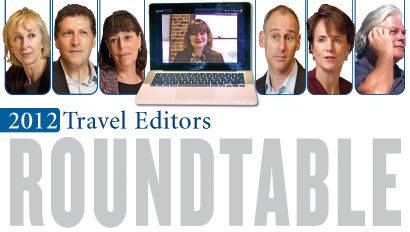
 At the invitation of Travel Weekly, the chief editors of Afar, Budget Travel, Conde Nast Traveler, National Geographic Traveler and Travel + Leisure and the leisure travel editor of USA Today convened in New York earlier this year for the seventh annual Travel Weekly Consumer Travel Editors Roundtable.
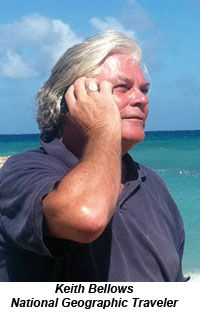
The event was held at, and lunch provided by, Del Posto restaurant, a member of Relais & Chateaux. Julia Cosgrove of Afar participated from San Francisco via Skype, and Keith Bellows called in on his cellphone from Treasure Beach in Jamaica.
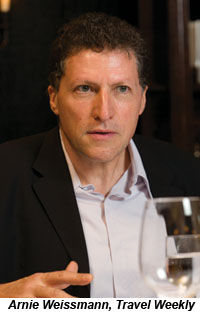
Travel Weekly Editor in Chief Arnie Weissmann moderated. This year, destinations dominated the discussion, with the editors revealing where they most want to go, exploring how Americans react to world events and giving their opinions about various destination marketing campaigns. Changing perceptions of travel agents and the intersection of social media and travel were among other topics discussed.
The original transcript has been edited for length, and the chronology has been altered to keep dialogue about specific topics together, even though the topic might have been discussed in recurring intervals during the course of the conversation. Photos by Steve Hockstein/Harvard Studios.
Arnie Weissmann, editor in chief, Travel Weekly: From Egypt to Greece to Japan, there has been a fair amount of disruption in traditional tourist destinations around the world recently. Americans have a reputation for skittishness, and we're perceived as being reluctant to visit destinations where there have been recent disturbances, or even a whiff of potential problems. Given the variety of options American travelers have, and their relatively few vacation days, is this skittishness a reasonable response?
Julia Cosgrove, editor in chief, Afar: A few days after [former Egyptian president Hosni] Mubarak resigned, our founders went to Cairo. They felt it was an unusual opportunity for travelers and an exciting time to go. They found it fascinating, and we asked our readers if they were interested in joining us for a return trip. About 750 people emailed for more information, and in October, we went with about 35 readers for a three-day experience. We met with artists, architects and people from the political realm. We had home dinners and visited galleries, listened to music, and the group bonded with the people they met. Since then, four of the readers who were on the trip have already returned to Cairo. So the connection has been made. It was such an exciting moment to share.
 Weissmann: If I'm remembering correctly, there was actually a disturbance right before your group arrived?
Cosgrove: The military moving against the cops happened right before, and then there were protests right after. But you know, if you talk with people locally, you can avoid it, you can avoid the protests. When we were there, we did not see any trouble, and we had the pyramids all to ourselves. Even when there are headlines, it's not like the whole city is erupting in violence. And I'm sure, by the way, that there will be more violence -- they are basically re-creating their country -- but still, I think experienced travelers can figure out when to go, and when they're there, where to go.
Keith Bellows, editor in chief, National Geographic Traveler: Look at what happened in Japan. After the nuclear disaster, the media portrayed the entire country as being one great nuclear wasteland, even though that really only affected a small part of their country. That would have been the time to go to Japan. Prices were cheaper in a country where prices are normally astronomically high, there weren't too many [tourists] there, and the Japanese people would bend over backwards to do anything they could to make you welcome. This actually is a tactic that some people use, to travel in reaction to the media.
Weissmann: I would imagine that that group -- the subset of travelers who go to a country that's in the news, especially something like what is happening in Egypt -- is a relatively small niche. But it's certainly true that, as far as pricing and crowds go, it can be a great time to visit. Marc, is the Budget Travel readership the type who would want to pursue this type of opportunity, or are they looking for a more mainstream experience?
Marc Peyser, editor in chief, Budget Travel: We just did a piece on this very topic, "To Go or Not to Go." We also looked at ways you can get more for your money in destinations which are generally overlooked by the public, whether it's because they're considered "over the hill," and no one wants to go there anymore, or because they're over a barrel, as in the case of Japan or Egypt. In either case, they drop prices drastically because they want people to visit.
So it's always going to be part of the decision-making process for a budget traveler, and we look at it as an opportunity for them to do something that they might not have been able to afford to do before. Normally, Japan is very much out of the reach of most of our regular readers, but we told people that this is a great time to go to Japan. You know, obviously you don't want to visit a nuclear reactor -- not a good idea. But Tokyo is a great place, and this may be a good time.
That being said, when there is a risk of unrest that's utterly unpredictable, whether it's violence in Mexico or political uprisings in Greece or Egypt, most people think rather hard about whether they want to take a risk for that kind of experience, even to save money. I think Americans are often scared off -- perhaps too easily, as in the case of Japan. But there are opportunities on the value side as well as for the experience.
Klara Glowczewska, editor in chief, Conde Nast Traveler: Well, it seems to me that when they are scared off, it doesn't seem to last very long.
Peyser: Oh, absolutely true.
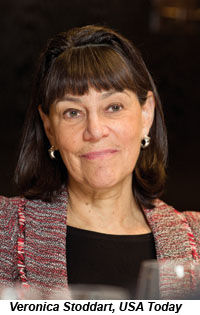 Veronica Stoddart, deputy managing editor for travel, USA Today: We're overlooking, I think, Main Street in this discussion. I'll speak to that because that's really who our audience is. We did a story on the Arab Spring movement very, very quickly after it occurred, and it got limited readership. For sure, there is a subset of Americans who are very interested, very experience-oriented, and who want to see what happened for themselves. But the majority of people in the United States don't have passports. It's too scary for them. We need to temper this a little with a reality check.
Nancy Novogrod, editor in chief, Travel + Leisure: But you suddenly throw a spotlight on a destination, if it's a place you haven't been thinking about much, and it's on the radar. I know I've wanted to go to Syria, and because I'm thinking so much about Syria, I am even more eager to have that experience -- ultimately. I wouldn't go to Syria now, but there are different places I seriously would like to go to. As an example, and it doesn't have quite the same safety challenges, Burma is in the news and now suddenly everyone wants to go to Burma. There is this kind of eagerness to experience this destination that has been off balance in the recent past. It's similar to what it was like in Vietnam when it first opened up.
Stoddart: Cuba, as well.
Novogrod: Cuba, definitely.
Stoddart: Cuba has opened, and there is a waiting list. There's clearly an appetite for that.
Weissmann: What about Mexico and the challenges it's facing?
Glowczewska: We've done a lot of features on it. And one very interesting things about Mexico was the number of Mexican properties that made it onto our [Conde Nast Traveler] Gold List. Most of them were in the Cancun area, but that may be because people go there in great numbers. There seems to be very little that will deter travelers from going to Mexico. And the value is so good.
But it's too bad that [travelers] always go to the same places. One of our stories this past year was more or less a geography lesson on Mexico.
Peyser: We had active conversations about, should we be writing about Mexico beyond the more news-oriented pieces? Our readers take a vacation a year, and they like to travel overseas, but what if you send somebody someplace where something bad happens? You'd feel responsible. But clearly, there are people who are happy to go and who are smart enough to differentiate between what's dangerous and what's not in Mexico.
Novogrod: Mexico is accessible for Americans and offers the greatest return on your dollar. Not only value, but real, authentic experiences. It's such a wonderful travel destination for people who are looking for something different. And I love their tourism campaign: "Mexico, the Place You Thought You Knew." It's so smart. The truth about Mexico is that there is such regional variation. There are so many different kinds of experiences that it is a destination that you can return to again and again.
 Bellows: Yes, there are so many different Mexicos, and our job is to direct people to the Mexico that's most rewarding for them. There is the Mayan story; it has these amazing resorts; and the diversity that Mexico brings is so rich.
Weissmann: Julia, is Mexico too close for Afar?
Cosgrove: No, we covered Mexico quite a bit and will continue to do so. And there are quite a few places our readers want to go, like Tulum, like Oaxaca.
Novogrod: I do wonder if all of the disruptions and confusion and pressures we've seen in recent years has impacted the way we make decisions. For instance, it would be interesting to know if travel experts are being consulted more, and what impact social media is having on travel decision-making. People are looking for more and more, and there are so many options out there.
Weissmann: I know that you, Nancy, and you, Klara, publish articles identifying good travel counselors, agents whom you designate as being experts. What is reader reaction to those issues? Is interest in travel agents increasing, decreasing or staying about the same?
Novogrod: Based on the bookings these agents receive after they appear on our list, I would say that [the agent channel is] very healthy and very much alive. I think what has happened is the agent who didn't offer much has been whittled out, and the agents who really are travel experts seem to be thriving.
Glowczewska: We make it very clear who should see a travel specialist and who should not. You have to have certain interests to use them. They offer very specific things. So we help people self-select whether they are someone who would want to choose a specialist. From the responses we get from readers and the information we get from agents, it appears to still be a good business. A specialist told us about a $60,000 trip she booked to the Caribbean. The Caribbean! And she was not terribly surprised by this.
Stoddart: And then there's the issue of travel technology. Travel technology is just exploding. The whole new thing this year is social media sites that help you plan your travel through your social media networks, and of all the new innovative sites that were presented during [the PhoCusWright Conference, which focuses on online travel technology], at least half were social media travel-planning sites. There are just dozens of them now, too many in fact. But with the explosion of information that is out there, it seems that people are hungering for something that makes it simpler for them, because they're just overwhelmed by where to go to plan. There are a million sites, there's a million ways to do it and I'm just overwhelmed. It's kind of the irony of too much information.
Glowczewska: That will help travel specialists.
Bellows: Do you remember awhile back, the travel agent was going to be dead, a victim of disintermediation? Now what you are seeing is the rise of the specialist travel agent. It's a direct corollary to what you're talking about, Ronnie [Stoddart]. People are so overwhelmed.
Weissmann: Some agents are social media experts, and use it to market. We featured an agent who chartered and filled an entire cruise ship using Facebook.
Novogrod: That's an example of how the viral can be monetized.
Weissmann: Let's go back to the destinations themselves for a moment. Which destinations are heating up? Where will you be going in 2012? What's on your wish list?
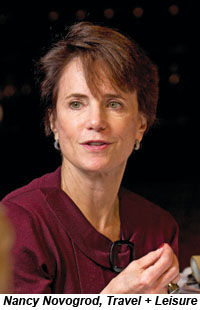 Novogrod: I want to go to Patagonia.
Glowczewska: It's on my list.
Novogrod: I think it's on a lot of people's list, and I think it's a great destination for experiences, a wonderful place to discover. I'd also like to go to Namibia. And I would like to go to Tibet, depending upon circumstances and conditions. It's interesting how many hotels are being built in Lhasa. There is the St. Regis, there's the Shangri-La, and I think there's about 10 others coming in.
Weissmann: About that St. Regis in Lhasa. We've talked for years about the move towards authenticity and local culture. I don't know how local culture has been incorporated into the St. Regis in Lhasa, but when a chain hotel appears in a destination where time has stood still for centuries, as Tibet did before China opened it up, it's bound to have an impact on that locale. Does the travel industry have a responsibility to mitigate the impact of the visitors it attracts, or is it simply the case that globalization is affecting everyone everywhere, and the idea of "protecting" a destination is both less possible and less an issue?
Novogrod: The tourism industry has a huge responsibility not to destroy a location. They should work with what's there, introduce it into their design and into the way they approach the destination. To be respectful, and not to destroy. It is a concern when so many different brands and so many different hotels tend to cluster in the same destinations, and once these flags are planted, it's worrisome.
Peyser: That's the way I feel about Cuba, that everybody's waiting for the time when the doors are open. And when they open, that time-capsule atmosphere will disappear. Don't we all have places that we don't ever want to tell anybody about because we don't want the masses to change them?
Glowczewska: On the other hand, when visitors come into a destination in a respectful way, they also promote local cultures and put artisans to work and support local crafts. You know, Banyan Tree has been wonderfully supportive of artisans and works hard to offer opportunities to people in extremely remote areas.
Novogrod: Yes, local artisans find employment, and their children are educated. It's changed cultures in positive ways, too.
Weissmann: Bhutan has a very ambitious program to go from approximately 25,000 visitors to 200,000 within just a couple of years. Until now, it has been very little influenced by the outside world, but officials there say they looked at their options, and tourism is the cleanest and most sustainable way to bring in foreign revenue. They're trying to spread the additional tourists across the country and throughout the year to minimize the impact, and, of course, they're aiming for the high-end traveler.
Glowczewska: It's a brilliant strategy. It's being done in a very smart way, with the smallest footprint.
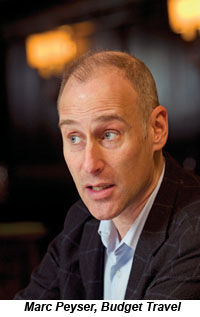 Peyser: The Seychelles was going to do a similar thing. It's extremely exclusive in so many ways, but they also have a long-range plan to really explode the number of visitors. And they're thinking, "OK, we can control this, we can protect the environment." But the locals are concerned. Because this is a place that was this stubborn paradise, and no matter how careful you are, when something that was untouched is going to be touched, it will have an effect. It's complicated.
Stoddart: The Caribbean is a mix, too, isn't it? Some islands have found success in keeping it small scale, vs. other islands, which have gone for the mass market.
Bellows: You know, it's really interesting. I've been going to Jamaica since 1973. When I first came, you went to Negril, to Seven Mile Beach. Progressively, it got worse, and largely because you had multinationals moving in, exploiting the place, and taking all the money out of the country. So here I am today, calling in from Treasure Beach, which is on the other side of the island, towards Montego, and the things they are talking about are sustainability issues, even agritourism. You know, the small footprint. The hotel here, all the power is generated by solar panels. If National Geographic Traveler is supporting ecotourism as a worthy cause, then it's really about preserving the heritage and culture, employing residents, embracing people in their own destinations. The leading edge of this is accountability.
I think hotels -- whether it's a chain, a grand hotel or a small hotel -- play a big role here. You see it in the big hotel renovations, in the "vice president of sustainability." But it's not practiced everywhere. It can be very disheartening at times, and a tragedy in many communities.
Weissmann: What about tour operators?
Bellows: We did "50 Tours of a Lifetime." There are more experiential tours than ever before, and more travelers are really focused on connecting with locals. Tour operators have responded.
 Cosgrove: This notion that there is a last frontier or places that are undiscovered -- everything is already taken, isn't it? So I think that if you're in the travel industry, you're a steward of responsibility. And the industry is responding. Ritz-Carlton does projects that give back to the communities they're in. This is just part of the agenda for everyone because it benefits everyone.
Weissmann: We've diverted a bit from my original question about what you think are hot destinations, where you'll be going, what's on your wish list. Let's get back to that for a moment.
Peyser: At the top of my wish list is Portugal. I've been to Spain but I have never been to Portugal and it has always struck me as being this wild bit of the Iberian Peninsula. Their economy has been hit hard, so it's fairly cheap to go there. You can get a five-star hotel for $115 a night. Budget Travel readers don't stay in five-star hotels very often, but we'd like to, especially ones that are situated in a beautiful location.
One of the rising destinations, one that is most surprising to me, is Belize, the less well-known sibling of Costa Rica. Our readers love Costa Rica, they can never hear enough about it. Belize is beautiful, it has a gorgeous barrier reef. It's rising.
Stoddart: So, he just stole my answers. Actually I am going to Portugal this coming year because it ties in with a story on what I think is going to be one of the hot new topics: taking advantage of currency shifts. The exchange rate for the euro is increasingly going in our favor, so we're doing stories on Portugal, Italy, Greece and Spain.
And I believe that Belize and many parts of Central America will see an uptick in terms of tourism due to focus on the Mayan prediction of the end of the world. Right, as strange and bizarre as that may seem, people seem to be fascinated with that.
And you know, the two perennial favorites, Vegas and Orlando, are always hot, extremely hot, eternally hot.
Bellows: Burma or Myanmar or whatever you want to call it, clearly there is a lot of interest there. I think there is an increased interest in Scandinavia. Helsinki is the [World Design Capital] of 2012, and there's an intense amount of activity in terms of culture there this year. I was in Norway last year, and I'll be returning next week. I'm struck by how interesting their lifestyle is, how unusual it is and how different it is from ours.
We talked about Bhutan before. That's certainly on my wish list. And in Peru you've got Machu Picchu, and everyone focuses on that, Lima and Cuzco, but they forget that you've got a coastal area, Choquequirao, where there's a lot to see. Oman is on my list, I think that is an up-and-coming country. Ronnie and Marc talked about Portugal, and it's right up there.
There are a couple of places that I personally want to go, and I know this is going to sound bizarre, but one is Kashmir. I was convinced that you can get in there and have a good experience. And the Congo. I was born there and haven't been back in a long time. It's a fascinating place, but that's just my personal wish list.
Weissmann: Which Congo? The former Zaire?
Bellows: Exactly. I've been told that if you know the right people, you can have an incredible experience. If you don't, you might not come back.
Peyser: Send us a postcard.
Cosgrove: For me, I think, Sri Lanka. I would say Egypt and any of the BRIC [Brazil, Russia, India, China] countries. Rio, maybe Sao Paulo.
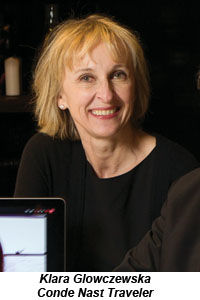 Glowczewska: Brazil. Burma/Myanmar, of course -- I think it's just something on everyone's minds right now. China. We just did a big piece on Indonesia. I've never been, and it's on my list. Bali is so culturally interesting, and a lot of it has been sustained. And, speaking of countries with disturbances, I'm thinking of going to Greece. I've been thinking of Athens for a while, and maybe two islands. That's my plan.
Novogrod: The destination I'm looking forward to is Cambodia. I've been before, and I know that's going to be interesting.
Weissmann: Nancy previously mentioned the Mexico marketing campaign. We've all seen campaigns that we think are excellent, and others where we can't believe how tone-deaf the destination marketers seem to be. What are the campaigns you've seen this past year that you feel have really impressed you?
Bellows: "New Zealand, 100% Pure." It's perfect.
Stoddart: It has done extremely well, I believe. And I can't tell you why exactly.
Bellows: It shows a side of New Zealand that you don't typically think of.
Novogrod: I think it's worth mentioning our own upcoming campaign, which is being put together by Brand USA. And there are some good state and local tourism campaigns in the U.S. now. I like what Bal Harbor is doing, combining shopping opportunities with the beach. I saw the Montana campaign; that was wonderful. And Michigan.
Stoddart: I track all of my stories online very meticulously, so I know which one got the biggest number of hits, and that was the story about the five best small towns in America.
Last year we did a road rally with Rand McNally. It's a very big project that ran all summer long, where teams actually drive across the U.S. and visit the 30 best small towns by categories. It's such a tailor-made story for the USA Today audience, it really is.
Peyser: Our biggest franchise year in and year out are the "small towns in America" franchise. I think that to a degree there's value in staying closer to home.
Weissmann: It sounds like there is a lot of interest in American destinations among your readership. Do you think that there is a shift of interest towards the U.S.?
Novogrod: I do.
Glowczewska: I do, too.
Weissmann: How frequently do you put America on the cover?
Novogrod: Almost never, very little. Because our travelers are international travelers for the most part. I think perhaps international travel ignites their dreams in a different way.
Email Arnie Weissmann at [email protected] and follow him on Twitter.