David Collins, innovator
Colleagues celebrated the career of retiring CEO David Collins this week, noting his drive for innovation. Read More
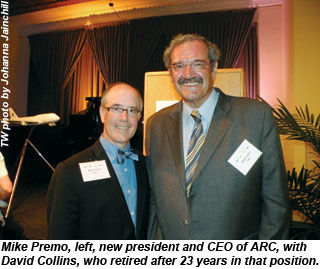
ARLINGTON, Va. — Mike Premo has taken over the top job at ARC, as only the second man to hold the CEO position in more than two decades.
David Collins, the 23-year president and CEO of ARC, said goodbye to his colleagues here last week, marking June 10 as his last day.
Premo, formerly ARC’s vice president of business development, was tapped to take Collins’ spot last September, after Collins informed the ARC board of his intention to retire at age 65, a milestone he reached last month.
What the transition will mean for the organization is still to be determined, but it is hard to imagine that the departure of Collins won’t result in significant changes at ARC.
As Premo explained it, many of the changes that ARC will experience over the next decade were set in motion under Collins, and many have to do with the group’s relations with travel agents, which have often been fraught with agent distrust due to ARC’s airline owners.
 "We are working to learn agencies' needs and wants and how to effectively communicate our offerings with them," he said. "We've moved the needle, but we are not satisfied with our progress. We don’t have the relationships with the business side that we should."
ARC has called the agent distrust a misunderstanding, contending that agents have little knowledge of the work ARC does on their behalf.
Premo said he feels he has a unique opportunity to bridge that gap by communicating with travel agents, having spent years as one himself.
Before joining ARC in 2006, Premo had spent most of his career as president and CEO at SatoTravel, where he oversaw its transformation from a network of airline ticket offices to a competitive travel management company.
Prior to his time with SatoTravel, he was the vice president and general manager at Gelco Travel Services, managing its Northeast U.S. operations.
"I was a garden-variety ARC travel agent until 2006, when I joined ARC," he said.
Having that perspective, he said, is helping ARC as it continues to try to change the way agents view and interact with the organization.
A frustration Collins and Premo share is that agents have not recognized ARC as a "compromise organization," as Collins puts it, one that at times has to say “no” to the airlines as well as to agents.
"The travel agent doesn’t know the inner workings of ARC," Premo said. "What's not visible [to the trade] is what the airlines may have compromised on. [Agents] don’t see where ARC has taken the side of the agents. They do see when ARC takes the side of the carriers."
Premo said the seminal moment that convinced the executive team at ARC that its relationship with travel agents needed to improve was in 2008, when ARC tried to raise the percentage of settlement fees paid by travel agencies from 10%, reducing the 90% paid by the carriers.
Travel agent members brought the matter to an independent arbitration panel, and ARC's proposal was shot down.
Premo said the loss forced a rethinking within ARC of the kind of relationship it wanted to have with travel agents.
To him, raising the fees was meant to help travel agents, because settlement fees were one of the main reasons why airlines don't want to use ARC. Premo said the thinking was that if ARC brought more than the 194 carrier members it now has, it would benefit agents.
"If we don’t exist, every travel agent would have to go to every airline," Premo said. "That’s 194 remittances, 194 applications. ARC is a clearinghouse. The cost of that service is $50 million per year."