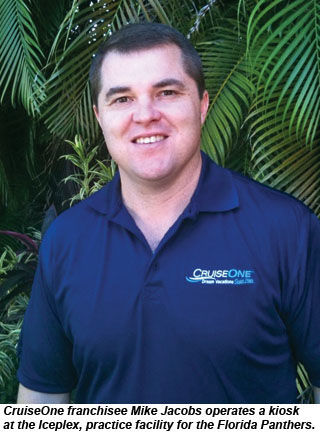
 Mike Jacobs had owned his own restaurant in South Florida for four years when the economy tanked.
He was forced to close it in 2010, and went to work for another restaurant, but missed owning his own business.
Through friends and family members, Jacobs, 38, knew of the CruiseOne franchise network, headquartered nearby in Fort Lauderdale. He called several CruiseOne agents and owners, and they all offered the same advice.
"They said it's not easy but that they wouldn't do anything else," Jacobs recalled. "And that's what drew me to it: the love of travel, being able to help people and having my own business."
 Within the industry, scores of conversations in recent years have lamented the lack of new blood among travel agents, with many predicting that it will eventually mean the profession's demise.
What has been largely ignored, however, is a surge in the number of people in their 20s and 30s who have chosen to enter the business in the last few years.
In discussions with industry insiders about what's causing the influx, two key drivers appear to be the U.S. economy and social media.
The economic downturn has forced business-minded people to consider careers beyond Wall Street.
"The economic downturn allowed talented people to choose the travel business," said Betty Jo Currie, owner of Atlanta-based Currie & Co., who has hired several people in their 20s and 30s. "We didn't have kids like this five years ago. They were going to Wall Street, business school, law school. ... Once the economy slowed down, the opportunities went away and, ironically, freed people up to follow their passion."
When Jacobs opened a CruiseOne in February, he was amazed by the level of support the company's headquarters offered its franchises in terms of technology and marketing, while allowing him to be his own boss. (View a video of Jacobs talking about his decision to open the franchise below.)
But even with these essential tools, Jacobs, like other young agents, has had to be creative to succeed. He couldn't afford a storefront, so he opened a kiosk location at the Iceplex, the practice facility for the Florida Panthers National Hockey League team. Each year, the facility draws 2 million visitors for various events.
His is the only kiosk there, and so far Jacobs has been successful by focusing on the hockey and skating market. For example, he organized a fundraising cruise for local hockey teams and a hockey mom weekend getaway.
"Calls weren't coming in, so I tried to get involved with everything," he said. "But I learned to focus my efforts on one or two things."
One of those focuses was social media. Jacobs, who uses his Facebook page and LinkedIn to spread the word about cruise and travel, has sold vacations to his online friends.
He said his friends originally "looked at me funny" when he told them he was a travel agent, because they didn't consider it a viable career. But now they appear to more intrigued by what he's doing.
Jacobs believes part of the reason is that "the unemployment rate is pretty high, and people are looking at different industries and different opportunities for their careers."
 Elizabeth Gordon, who co-founded New York-based Extraordinary Journeys in 2008, when she was 27, has also noticed an uptick in the number of young people entering the business. She attributes that to two factors: "They are looking for passion -- I get a lot of resumes of people leaving the financial business -- [and] the job market is bad, so they don't mind getting paid less and trying something new."
Gordon typifies many young agents in the industry today in that she does things differently from the older guard.
These younger agents tend to reach out to clients via text, email, Facebook and instant messaging, instinctively understanding that they have to contact their clients the way they themselves want to be contacted. In a hyperconnected world, they also know their clients are on their BlackBerrys and iPhones 24/7 and expect a quick response.
Running Extraordinary Journeys, which Gordon describes as a luxury custom safari company, means that she wears two hats: She is both a travel agent who sells directly to clients and a tour operator who creates trips to Africa, which she sells through other agents. She said this hybrid approach is becoming more common, and the labels matter little to her.
An entrepreneur by nature, Gordon started a vacation-rental management and booking company in Buenos Aires in her mid-20s. But having spent much of her life in Kenya with her family, she has always been drawn to Africa and the travel industry.
She started Extraordinary Journeys with her mother, Marcia, who has been selling travel since the 1960s and was on the cusp of retirement when Elizabeth asked for help starting out. "It'd be a shame to waste all those years of knowledge and connections," Elizabeth told her.
Mother and daughter say their age difference enables them to appeal to all generations of travelers. (View a video of the duo discussing the benefits of selling travel from two generations below.)
"My mother works well with the travel agents," Elizabeth said. "They are usually older, and they know her and trust her. I fit well with the honeymooners and other people in my generation."
Elizabeth and other young travel agents quickly discovered that most of their peers had never used an agent. They find her through a connection with the private sale website Jetsetter.com, where she is the Africa expert, through consumer media publicity and via word of mouth.
"Every client refers three more," she said.
Elizabeth and her mother deal with their respective clients differently. While her mother might be more inclined to pick up the phone, Elizabeth is more new-media savvy. She knows that younger generations "need answers super-fast. They want to know we are always in touch."
For her 30th birthday, Elizabeth arranged a safari to Africa with 25 friends. While it wasn't the point of her trip, she is savvy enough to realize the benefit of having their 25 Facebook pages adorned with photos and posts talking about Extraordinary Journeys.
 The Internet and its social-media progeny are another factor that has contributed to an influx of young travel agents joining the industry today. As they begin selling travel, their peers watch their careers unfold in their tweets, the photos they post on Facebook and videos they share on YouTube.
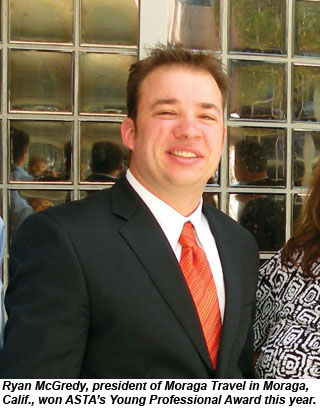
Ryan McGredy, the 34-year-old president of Moraga Travel in Moraga, Calif., and winner of this year's ASTA's Young Professional Award, believes that the influx of new blood goes beyond a bad job market.
"The drastically reduced number of entry-level jobs in our economy is causing young people to be more entrepreneurial in general," McGredy said. "But I think that is only one contributing factor to the growth we're seeing in our organization. The main thing we're seeing is that the word is starting to get out just how great of a job this is for today's young professional. You get to travel, help people, work on your own schedule, and there is a busy season and a slow season so you can spend time on hobbies, your family or any of the myriad other things that enrich your life outside of work."
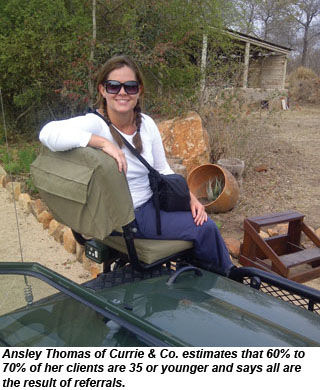
When Ansley Thomas, 29, one of Currie & Co.'s promising young travel advisers, arrived at a Sofitel property in Marrakech, Morocco, on Oct. 31, she posted a photo of the property's pool, describing it as her home for the next week.
Her 846 Facebook friends saw her post. Among the comments she got was one from a friend who asked if she would be dressing for Halloween as "an extremely lucky and talented travel agent."
Thomas started at Currie two years ago after having worked in event planning. She knew she wanted to do something new but wasn't sure what.
"I liked to plan things," she said. When someone suggested she become a travel agent, her first reaction was "'That's not my generation.' I didn't know this side of the travel agent world."
After meeting Betty Jo Currie, who was starting her own agency after almost two decades in the business, she changed her mind. Thomas said the job was "a natural fit," and her timing was serendipitous; she joined Currie just as many of her peers were getting married and looking for honeymoons.
She estimates that 60% to 70% of her clients are 35 or younger and said all are the result of referrals.
"It started off with friends passing the word along that this is what I was doing, and people keep referring me, which is great," she said.
 Unlike some old-guard agents, Thomas is not threatened by the fact that clients do so much of their own online research and shop around. She said this was also true of young travel sellers in general.
"People in my generation can do everything online," Thomas said. "And they might find 15 different properties. But when it comes down to it, they don't trust the Internet. They are not willing to book something without someone vouching for it or backing it up. ... They come to me for an opinion about what fits them best and for the personal relationship. They might have done a lot of the research, but they don't want to book it alone."
And just as Thomas was wary of the idea of becoming a travel agent, so, too, were her peers wary of using one. The vast majority of her clients had never before used a travel agent. They are clearly pleased with the service she offers, because they are coming back.
"A lot of the honeymooners have come back a year later and said, 'Will you plan our first anniversary trip?'" Thomas said.
Proactive recruiting
Concern about bringing new blood into the industry prompted several agency groups and organizations to reach out to younger clientele.
ASTA, which has a long history of cultivating young agents, in 2002 created its Young Professionals Society. Growth has been steady. YPS now has 370 members, with many having already "aged out" at 40.
In 2012, to mark its 10th anniversary, YPS will launch a new website to correspond with its Facebook page, titled The New Breed of Travel Agent, which already has almost 700 likes.
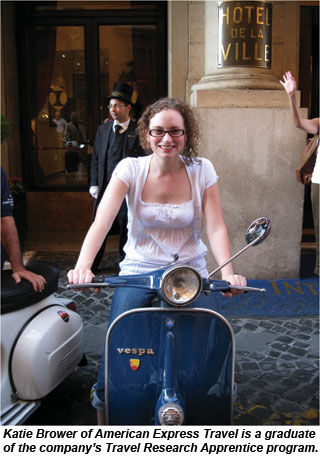
American Express Travel started its Travel Research Apprentice program in 2006 when it looked at its current agent base and realized that 40% were at retirement age.
So far, 80 people have participated in the program, with 90% having been promoted to travel counselor in American Express-owned Travel Service Offices.
The apprentices go through a 12-month curriculum that includes training on everything from customer experiences and destinations to airport city codes and using a GDS.
American Express has found that the program attracts people who have never used a travel agent, which enables them to tap a new generation.
Katie Brower, 27, is one of those people. Her friends were surprised when she joined the program and became a travel agent five years ago.
"They think travel agents are a dying breed, or they picture an older person in a travel agency office waiting to book a cruise," Brower said. "But they also think it's kind of cool. There's a mystery to it because they are mostly doing business-related jobs. So whenever I say [I'm a travel agent] at a party or a family get-together, they think it's very interesting."
Brower was 22 when she entered the apprentice program after completing an internship with another travel company and realizing she loved the work. She was promoted to a full-time agent within a year. At that time, she was the youngest in her office by about 15 years.
Because of her age, Brower was put on American Express programs such as Nexpedition, which targets young clients with its "high-tech, cool mystery travel program." But she mostly works selling travel to the company's platinum cardholders.
"When I meet clients, they are extremely surprised by my age," she said, adding that while she doesn't advertise her age, it can be an advantage when people find out. "It's different, and people enjoy coming back to me."
 Brower has watched the program grow since she joined and commends American Express for bringing more people into the business, especially since there are no longer the travel schools that once ushered people into the industry.
"There wasn't an avenue for people to get into travel," she said. "It's nice to have more young people in the office, and it seems we are growing."
Kristi Jones, president of Virtuoso, said the consortium recognized in 2000 that for the industry to remain viable and attract new talent, it would have to concentrate on making it an attractive profession by increasing the compensation of frontline travel agents.
Jones said that as the role of an agent shifted from one of an order-taker making money from selling airline tickets to what Virtuoso calls a travel adviser, it opened a door for young, new talent.
"The [agents] who survived the airlines pulling back were the ones who realized that who they represented wasn't the airline or the supplier, it was the client," Jones said. For the new generation of agents, she said, "that's an easier concept for them to embrace. They don't come from a model where they see 100% of their value set by the supplier. ... They are a new type of adviser who recognizes that the value they offer is to the client as well as to the supplier, and they try to represent a balance."
Jones said that in recent years, Virtuoso has successfully recruited people who were going to be lawyers, accountants or stockbrokers. While she, too, believes the economy plays a role, she also said young people are looking for more than just money.
"Of course they want a good wage, but they also want to feel they are participating in something that's important and can provide fulfillment on many levels," she said.
The young agents are different, she said, and their clients are different, as well: Beyond just the various new methods of virtual communications, they might meet their clients at a coffee shop or go mountain biking together.
Their use of the Internet and social media, Jones said, is accelerating awareness of the industry.
"As they are getting their own personal message out to their peer set, we are getting more interest," Jones said. "As they get the word out on social media, they do more than we can to say this is a great industry."
Follow Johanna Jainchill on Twitter @jjainchilltw.