From the Window Seat
In his column this week, Arnie Weissmann writes that visa facilitation could be a first step toward cooperation between governments and technology development, with the endgame being increased tourism. Read More
MERIDA, Mexico — Will the fourth time be a charm?
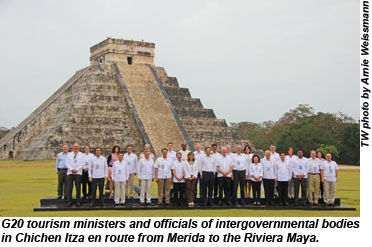
Tourism ministers from the countries with the 20 largest economies, collectively known as the G20 nations, met for the fourth time in as many years last week and fashioned an appeal to their heads of state to promote visa facilitation as a means of spurring economic growth and creating jobs.
The ministers, comprising a subset of the G20 known as the T20, gathered this year with the firm knowledge that their work will be presented to the G20 heads of state.
Although they had convened annually three times before, there was barely a hope, let alone an explicit promise, that their declarations would be considered when G20 leaders gathered for their annual summit.
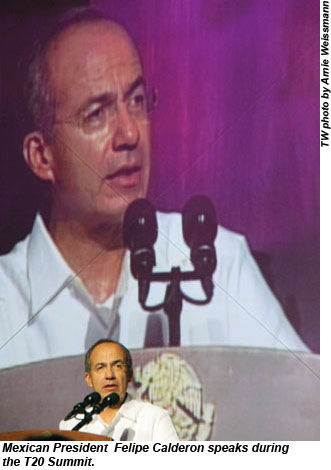
But in 2012, the stars seem to be aligning for the ministers and for travel and tourism in general, following strong shows of support for the industry by President Barack Obama and Mexico President Felipe Calderon. 
By virtue of hosting the G20 Summit in Cabo San Lucas next month, Calderon has the right to put visa facilitation on the agenda, and he has pledged to do just that.
The T20 Summit was chaired by Mexico’s secretary of tourism, Gloria Guevara, and facilitated by the general secretary of the United Nations World Tourism Organization, Talib Rafai.
All G20 nations were represented, as were regional ministers from the Caribbean and Central and South America, as well as representatives from IATA, the World Travel and Tourism Council (WTTC), the Organization for Economic Cooperation and Development, the International Labor Organization, the International Civil Aviation Organization and the International Trade Center.
Although travel does not enjoy Cabinet-level status in the U.S., Thomas Nides, deputy secretary of state, and Earl Anthony Wayne, the U.S. ambassador to Mexico, were present when the T20 ministers reviewed the Merida Declaration in preparation for presenting it to Calderon later that day.
Nides had been instrumental in pushing the Obama administration to seriously consider the potential for travel and tourism to assist in economic recovery. The result was the development of the country’s first national tourism strategy, announced by the White House on May 10.
The U.S. already participates in the reciprocal Visa Waiver Program with 36 other countries, including seven of the G20: Australia, France, Germany, Italy, Japan, the U.K. and South Korea.
 Although it was the ministers who reviewed the document and presented it, it was their senior technical staff who labored behind closed doors May 15 and hammered out the final wording of the declaration.
According to multiple sources in attendance, the draft that was first reviewed raised concerns from some of the Western representatives who felt it went too far in suggesting that “the doors are open” as regards the issuance of visas.
It was clear that some countries had security concerns, and others felt it simply could not be sold to their foreign affairs departments because it went too far in easing visa regulations, according to a person who participated in the debate.
The role of the U.S. team, which was led by John Brennan, minister counselor for consular affairs in the U.S. Embassy in Mexico City, was described by attendees as being “very helpful” and “constructive.”
“There was a good spirit,” said one negotiator, who requested anonymity. “We all agreed we want to ease movement across borders, but you have to be very careful. You can’t end up making a statement that the intelligence communities and immigration officials won’t support. You can’t leave the impression that the process is too easy.”
In an interview following the adoption of the declaration, Brennan said, “Everyone was clear on the goals. [But] it is important that we recognize current realities and not build in road blocks [to adoption by G20 heads of state]. We had to move up to more comprehensive language. In the end, there was broad consensus.”
A copy of the declaration that was obtained by Travel Weekly reveals that the document outlines statistical evidence of tourism’s economic importance, growth rates, positive impact on economic expansion and job creation.
It suggests that if its recommendations are adopted by G20 nations, 112 million additional international arrivals could be generated by 2015, increasing tourism receipts by $206 billion and creating up to 5.1 million jobs.
The G20 leaders are urged to leverage new technology, including electronic visa processes and delivery, and to “make travel more accessible, convenient and more efficient.”
The document asks that bilateral, regional and international cooperation on visa and other travel facilitation be explored with the goal of enabling international visitors to move more freely and efficiently.
The “ask” of the document is that the G20 communique, which is issued at the conclusion of the leaders summit, include an explicit recognition of “the role of travel and tourism as a vehicle for job creation, economic growth and development, and a [commitment] to travel facilitation as a conduit for job creation, decent work, poverty alleviation and global growth.”
 If such a statement were to actually be included, it would be a significant achievement. The communique’s language is viewed as a blueprint for the G20 countries’ agreed-upon agenda for the next 12 months, so its inclusion would give the tourism ministers a stronger position when pushing for visa facilitation policies in Cabinet-level discussions.
While the Merida Declaration is direct in its appeal to the G20, it also contains language that accepts individual nations’ discretion as to how far they would want to take visa reform. It recognizes the importance of maintaining national security and the authority and the sovereign right of states to control the entry of foreign nationals into their territories.
It also acknowledges that the recommendations will be reviewed in the light of preexisting international commitments. Even so, it asks that “visa and other travel facilitation arrangements ... be explored.”
During the review of the document, a few ministers expressed concern that the declaration’s focus on visa facilitation was too narrow and that words should be added acknowledging that there are other important travel-related concerns that must be address going forward.
But the consensus of the ministers was that the document’s wording should not be reopened at the 11th hour and that any additional suggestions could be made in 2013 when the T20 (and G20) meet in Russia next year.
The draft was approved without change.
Guevara confirmed that Calderon is pleased with the Declaration and will present it as is.
Follow Arnie Weissmann on Twitter @awtravelweekly.