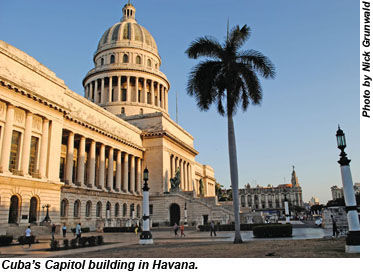
 The people-to-people educational and cultural programs in Cuba, so highly touted since they resumed last year, seem to have hit brick walls on both sides of the Straits of Florida.
The larger problem is on the U.S. side, where dozens of license-renewal applications, which are required by the U.S. Treasury Department’s Office of Foreign Assets Control (OFAC) each year of organizations running these programs, are backlogged in OFAC offices, waiting to be reviewed by a small staff made even smaller because of recent cutbacks.
On the Cuba side, there is no longer a means in place to obtain the visitor cards required by the Cuban government.
OFAC, which is charged with overseeing, implementing, licensing and regulating all categories of travel to Cuba by U.S. citizens, “is working to turn around the license applications we have received as quickly as possible,” according to John Sullivan, OFAC spokesman for terrorism and financial intelligence.
“The people-to-people program remains robust,” Sullivan said.
What had been a fairly simple renewal process abruptly changed when OFAC issued new guidelines on May 10 that called for more specific and detailed information regarding activities on each itinerary, both for programs already sold as well as for those going forward.
OFAC claims that some organizations had violated stipulations that program activities have to be of a cultural or educational nature in which participants interact with Cuban people.
In other words, no lounging on the beach at the Varadero resorts or salsa dancing in Havana clubs allowed.
“We revised the license application criteria to stress to applicants the seriousness of the requirements of the people-to-people licensing program, in part because of reports we received concerning travel under the licenses,” said Jeff Braunger, OFAC program manager for Cuba travel licensing.
He said the revised criteria would help address what OFAC views as deficiencies regarding license applications.
“These changes will provide clarity to applicants and licensees seeking renewals, facilitate our reviews of license applications and help to deter abuses by licensees,” Braunger said.
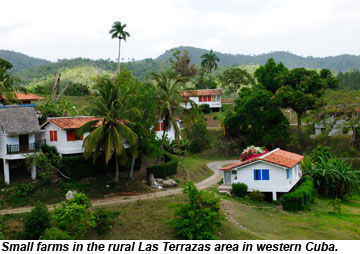 OFAC has issued approximately 140 people-to-people licenses since the program resumed in 2011. The list of the licensees is confidential, according to OFAC.
Companies and organizations offering the people-to-people programs already had been required to wade through a legal minefield of federal regulations to obtain their licenses.
Tour operators, including Insight Cuba, Friendly Planet and Austin-Lehman, had to partner with or be associated with nonprofit organizations, some of which already held a license to offer other categories of travel to Cuba, such as educational, religious or cultural tours.
Tour operators cannot obtain such a license themselves, under OFAC regulations.
Once companies or organizations obtained a license to operate people-to-people programs, they had to turn to U.S.-licensed Travel Service Providers (TSP) to handle the travel arrangements, including booking hotels, air, tours and activities in Cuba.
One requirement of the new guidelines stipulated that renewal applications could not be submitted until 60 days before the expiration of the current license.
Given the delay in OFAC’s processing of renewals, many companies are now in a “gap period,” according to one operator. “We don’t know if we will receive the license renewal in time to run the programs already on the books or if we have to tell our clients that the departures are delayed.”
That puts a lot of programs with September departures and beyond in limbo, since the programs cannot operate without a valid license.
That also puts in question the hotel inventory in Cuba booked by the operators as well as local Cuban suppliers, such as guides and bus drivers.
It also means staff layoffs for employees, who are specifically trained to handle the details of the people-to-people programs.
The Obama administration reversed the policy and restrictions begun under President George W. Bush in 2004 and posted new travel regulations on Jan. 28, 2011, allowing the resumption of people-to-people educational programs for the first time since 2003.
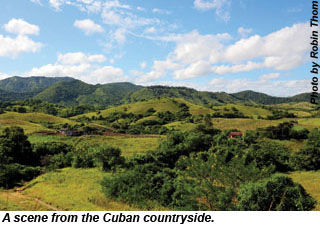 The move was highly touted because it opened a travel portal, albeit with U.S. government rules and conditions.
The newest measure did not lift the economic embargo, which has been in place since 1960; tourist travel to Cuba remains illegal.
Under the people-to-people regulations, travelers still had to go in groups and be accompanied by authorized, U.S.-government licensed operators.
What was different was that the policy change broadened the definition of group travel to Cuba from strictly religious, academic and cultural travel to include U.S. travelers who wanted to mix, mingle, meet and share experiences with Cubans under the people-to-people category of travel.
‘Lifetime memories’
“Often it is the people you meet while traveling who create lifetime memories,” Tom Popper, director of Insight Cuba, said last year. “A sharing of experiences is what these programs are all about. We can maximize opportunities for our travelers to do just that.”
Popper was the first to jump back into the fray, having run these programs from 2000 to 2003.
After a five-month wait, Insight Cuba received its license from OFAC on June 28, 2011, and launched its first program on Aug. 11, 2011.
“Response exceeded expectations,” Popper said. “We added more departures and programs this year based on our 2011 year-end bookings.”
Marazul Charters, a Miami-based travel agency licensed by OFAC both as a Carrier Service Provider (CSP) to sell charter flights to authorized groups traveling to Cuba and as a TSP to handle the travel arrangements, carried 5,000 travelers in the first six months of the programs, according to Bob Guild, vice president.
“From our standpoint, the people-to-people programs have been overwhelmingly successful,” Guild said. “The current slowdown in the license application and renewal procedures and the tightening up of criteria has frozen the programs right now.”
Change to tourist cards
Beyond the problems being encountered in this country, there is also a holdup on the other end, in the form of tourist cards, which are required by the government of Cuba for every U.S. traveler entering or leaving Cuba.
In the past, Marazul and other TSPs could fill out travelers’ cards, provided the traveler had been vetted as an authorized people-to-people participant or was traveling under a legitimate license with a religious, educational or cultural group.
The cards, which ranged from $10 to $50 each, were then stapled to a traveler’s airline ticket and presented upon arrival at the airport in Havana.
The cards now have to be obtained from the Cuban Interests Section, housed in the Swiss embassy in Washington.
“The U.S. has determined that Cuba has to be the issuing agent for these cards, so the cards and data have to be filled out by the Cubans before the passengers can be issued their tickets, which will further delay the entire process,” Guild said.
There is no procedure in place at the Havana airport for travelers to pick up and fill out an entry card upon arrival.
Follow Gay Nagle Myers on Twitter @gnmtravelweekly.