In the final hectic days before Hurricane Irma hit the
northeastern Caribbean on Sept. 6, hotels in the storm's projected path
struggled frantically to get visitors out as residents boarded up windows and
stockpiled supplies.
Then, 12 days later, Hurricane Maria finished off the job,
hitting Puerto Rico, which had been grazed but not flattened by Irma, and
dumping torrents of rain and further heartache on islands where homes and
businesses were already dotted with blue tarp roof coverings.
The storms affected everyone in their paths. Photos of the
damage and destruction wrought by the hurricanes reveal apocalyptic scenes of
stripped landscapes, buckled roofs, flooded roadways blocked by power lines and
toppled poles, and people struggling to comprehend where and how to start
rebuilding not only their homes, hotels, hospitals, schools, airports and
businesses, but also their lives.
Here are three stories out of the many that have emerged
from the recent chaos:
Protecting 120 guests in St. Thomas
Before Hurricane Irma arrived on St. Thomas, "the
flights filled up too quickly," said David Krech. "We couldn't get
all our guests out in time. So we had 120 guests, including about 20 kids, and
60 staff to ride out the storm."
Krech is the director of sales and marketing for Sugar Bay
Resort & Spa in St. Thomas, an island that the hurricanes left in ruins.
The resort rushed to secure the property and updated guests
constantly before Irma hit.
"Our last message directed guests to the Manor House,
where we gave them a box dinner and brought them to the lower level of the
resort, which had fewer windows," Krech said. "We boarded the windows
with double sheets of plywood and foam-sprayed all the cracks closed. We
drilled big holes in the floor so water could drain in case it flooded from
above."
The staff put sheets on beach-chair cushions for makeshift
beds, improvised a kids' playroom, had a DJ play music to drown out the sounds
of the howling wind and rain and set up a first-aid station with two emergency
medics on hand.
"I'd gone to Kmart before the storm and bought every
board game there was, plus a lot of
markers," Krech said. "Someone started writing a message on
the plywood, which soon became what we called the Wall of Fame. Everyone wrote
something."
Heavy winds rocked them for hours; the eye passed over at
about midnight, and the winds picked up again until 7 a.m., when all power was
lost.
"We checked outside at 10 a.m., moved the guests to
what was left of the restaurant -- half was blown away. Out of the 300 rooms,
about 50 were in decent shape, so we got them in and told them to stay there
since there were downed power lines all over the place."
Krech said he and the staff worked for the next six days to
get their guests out, a mission complicated by the fact that the airport was
damaged and the port was closed until damage assessments could be completed.
When a Norwegian Cruise Line ship was allowed in as a relief
vessel days later, the guests were finally evacuated.
Maria's 20 inches of rain and 110 mph hour winds "were
the finishing blow to what Irma began," Krech said.
He's still there, with a staff of four and 30 rooms housing
relief workers.
"The mold grows by inches each day, but we're not alone
in our misery," he said. "There are people on other islands a lot
worse off than here."
A life-changing event on St. Martin
As Irma approached the French island, "life as we knew
it was about to change," recalled John Berglund, owner and founder of the
Tijon Parfumerie & Boutique, a popular family business in Grand Case where
visitors could concoct their own perfumes.
"If St. Martin were one car, it would be ruled a total
loss," he said, after weathering the storm with his wife in a shelter.
During the early morning hours of Sept. 6, the men in the
shelter had to hold back the double door as the wind and pressure were
threatening to blow it out.
"We waited until noon and walked back home through
knee-deep water," he said. "What we witnessed was a war zone.
Armageddon. Stores, restaurants were gone. No vegetation. Cars were mashed.
Roofs, trees, zinc and other debris clogged the streets."
His house had no roof. Shutters were ripped off and
furniture lay piled in a corner.
Only the four walls of the home remained. Irma had taken
everything else.
The Tijon building miraculously was almost intact, although
a 40-foot container with hundreds of broken glass perfume bottles was tipped on
its side.
He checked on the nearby Grand Case resort to find that the
reception building was gone, as was the restaurant. Half the units had no roof.
General manager Steve Wright and his wife, Marga, spent the
worst of the storm in an open stairwell holding wood over their heads for
protection.
"Our administrative offices simply blew away, leaving a
clear concrete slab where they once were," Wright said.
Somehow he managed to maintain a sense of humor, adding, "My
office has never been so tidy in 20 years!"
Berglund and his wife evacuated on a relief flight to
Guadeloupe, another flight to Santo Domingo and then to Portugal, after their
flight to Miami was canceled.
He is back now rebuilding in Grand Case and plans to reopen
Tijon in mid-December, hoping there will again be tourists by then.
Birds, fish among victims in Anguilla
As Irma approached, the main concerns for Jackie Cestero,
owner and operator of Nature Explorers Anguilla, were for the fish in her
aquaponic garden and the birds on the island.
"Because we lost power for so long [her power was
restored on Day 46], there was no way for water to circulate in the fish tank,"
she said. "We ran a generator sparingly but lost about 90 of the larger
fish.
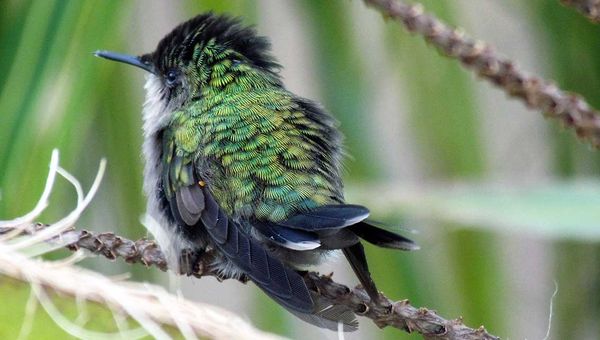
An Antillean crested hummingbird spotted in Anguilla post-Irma. Photo Credit: Jackie Cestero
"The shorebirds are beginning to return and on Oct. 9,
almost a month after Irma, I spotted a lone American flamingo."
Cestero will do a bird count on Nov. 5 and 6 to compare
numbers with prior years.
She's also involved in Anguilla Jammin', a jam and jelly
business with her niece Molly Nutting. Irma mangled the fruit trees, destroyed
the seedling beds and wiped out the pepper crop, a key ingredient in the jams.
"The farm imploded on itself," Cestero said.
The jam business is on hold for now, as are the farm tours
and tastings. She'll run her nature tours, she said, "but the real
question for both businesses is: Will there be enough guests to purchase our
products and services?"
That's a question being asked by many residents of all the
islands that are dealing with the aftermath of Irma and Maria.
More than 70% of the Caribbean was not touched by these
storms and is open for business.
The other 30% are hoping that the industry will not forget
to support them as they rebuild and reopen.