Following Travel Weekly's Hawaii Leadership Forum on April 21, Travel Weekly editor in chief Johanna Jainchill moderated a 90-minute roundtable with 10 Hawaii tourism stakeholders. Highlights include the state's inconsistent marketing budget, the impact of recent floods and what's new on the Islands.
Johanna Jainchill: How was Hawaii business going prior to the floods?
Sean Dee, chief commercial officer, Outrigger Hospitality Group: Taking a step back, the market has fundamentally changed since Covid. Hawaii's international business is still down about 50%. We had about 9.6 million total arrivals in 2025, and that's down from a peak rate of about 10.4 million back in 2019. Heading into 2026, we were starting to see some improvement. There was a little bit of cautious optimism for a strong spring and summer, and then the storms very unexpectedly crashed pretty hard.

Outrigger Hospitality Group chief commercial officer Sean Dee says Hawaii residents "feel better about tourism for the first time in years." Photo Credit: Paula Ota
David Hu, CEO of A|T Collective: The hope coming into 2026 was, given all the geopolitical events, there was going to be some consolidation of demand for all the islands. The consistent coverage of the storms is feeding the idea of, "Don't come. It's a danger zone." It's exaggerated.
Sandy Narvaez, senior director, sales and marketing, Hawaii and French Polynesia, Marriott International: We had customers calling us from Texas who were receiving news alerts about the storms. That's how the media portrayed the extent of the damage. But this is the short term. It looks like it's regulating moving forward.
Alisa Onishi, managing director for Hawaii marketing, Hawaiian Airlines: With anything that happens to Hawaii, it gets blown up over the mainstream media.
Hu: The ask right now is, "Hey, we need a concerted effort to make sure that we control the narrative for the Islands rather than let the press control the narrative for us." And since the 2019 period and the reduction of funding [for the Hawaii Tourism Authority], there is no way to combat that.

Talking about Hawaii's tourism marketing, A|T Collective CEO David Hu said, "It's a $63 million budget, and Mexico is spending multiples of that." Photo Credit: Paula Ota
Caroline Anderson, interim president, Hawaii Tourism Authority (HTA): In 2021, we lost our dedicated source of funding through the transient accommodations tax. So we're competing with all the other state government agencies. At HTA, we're doing all that we can to rebuild trust with the legislators. It's just proving to certain legislators why having consistent funding is important to make our destination competitive. Industry partners going to the legislature, sharing their stories, I think that is needed.
Ray Snisky, group president, ALG Vacations: Thank you for the authenticity about trust. The world is gaining on Hawaii. You had a tremendous advantage over Mexico for decades. They're building five-star resorts now. They're much more competitive than they have been in the past. The other challenge is the conflicting constituents they're trying to serve. When I hear residents are worried about overtourism, I think, 70% of the residents have to be tied to tourism. So who's the vote saying overtourism, and why does that small group of constituents have so much power? And where are the organized tourism lobbies that are sharing and educating the people?
Tom Mullen, COO of the Hawaii Visitors & Convention Bureau (HVCB): When we hit our peak in 2019, it was very different because of Airbnb. You have 9,000 vacation rental units here [on Oahu], 8,000 of which are illegal. That's like having 16 500-room hotels: the entire beachfront of Waikiki. So, tourism grew. It did come into the hotels but also went out to the residents. And that's what got everybody angry. We're trying to fix that.

Hawaii Visitors & Convention Bureau COO Tom Mullen said Airbnb helped Hawaii tourism hit a peak in 2019. The state has since cracked down on short-term rentals in residential areas. Photo Credit: Paula Ota
Hu: It's a $63 million budget, and Mexico is spending multiples of that. Little islands in the Caribbean are offering more in certain elements of support.
Snisky: As Caroline said, there's a trust issue. It's not about, "Is there money?" It's what do I want to spend this money on and could we spend it on other things that have a more heightened need than tourism, because we'll live on our name. There's a real risk to that.
Dee: I served on the HTA board back when we had dedicated funding of $82 million a year, which allows for long-term planning. I think on the trust side, we're rebuilding. There's a destination-management program that falls under HTA. Resident sentiment is actually increasing; for the first time in years, residents feel better about tourism. Aaron Sala [CEO of the HVCB] doesn't get enough credit for the work he's doing in the community. I have not seen an article or social media post about overtourism in almost a year.

Alisa Onishi, Hawaiian Airlines' managing director for Hawaii marketing, said the Alaska Airlines merger "has helped us broaden the offering for Hawaii." Photo Credit: Paula Ota
Narvaez: It's up to our legislators, and it's important for us to communicate that to them. Why are they in office? Because of our votes. What is truly impacted by tourism? Local businesses. Small mom-and-pop stores that have to shut down because we don't have enough tourists. Funding will provide us with the tools we need to manage the narrative, to communicate the benefits of tourism.
Anderson: Right now, we would be happy with level funding. Looking at next year, we'll fight for increased budget.
Snisky: I think that's a great plan, because you can't grow if you don't keep what you have.
Melissa Krueger, CEO, Classic Vacations: It's about consistency. Once you dip, it gets more expensive to dust off the brand.
Jainchill: What positives are you seeing in the market?
Rachel Bird, vice president, North America market management, Expedia Group: The top destinations searched in 2025 for 2026 travel -- Hawaii is not back yet, unfortunately -- but when we look at searches for spring break travel, Hawaii makes the list again. When you look at [Asia-Pacific] overall, Hawaii's not on the list like it was previously. However, when you narrow that down to Japan, it is again. The Japan piece was a lot of work we did with Hawaii Tourism and Visa in Japan. We saw pretty good exposure that helped us pull back that Japanese traveler.

"What is truly impacted by tourism? Local businesses. Small mom-and-pop stores that have to shut down because we don't have enough tourists." -- Sandy Narvaez, Marriott International's senior director, sales and marketing, Hawaii and French Polynesia Photo Credit: Paula Ota
Tony Logan, global director for advisor success, Virtuoso: I used to sell Hawaii as an advisor. I am impressed with the level of upgrades and the feeling of luxury at a variety of touch points. I have experienced firsthand that it feels a bit fresher here and there is a better story to tell. You have the layered nuances of each island, and the more we can sell multiple islands, that's key -- especially for the younger market.
Bird: There are opportunities to say, "What are the best-in-class destinations doing from a marketing perspective?" We heard yesterday that repeat travelers come from older generations, and the new generation wants newer experiences. That's prime for Hawaii. You have multiple islands that are all unique with different experiences to offer. I would be playing that up. And I would be telling that repeat traveler, you've been to Hawaii, but you haven't seen Hawaii Island.
Onishi: The merger with Alaska Airlines has helped us broaden the offering for Hawaii. We are joining Oneworld, which will really help our international markets. A Qantas loyalist can now earn and burn miles on Hawaiian. We've seen Japan and Australia not rebound. But leveraging those partners will bring more connectivity through Hawaii.
Krueger: I was looking at airfares in May, economy from San Francisco. Paris was $1,600, Puerto Vallarta was $1,400, Maui was $468. Why are we not marketing the heck out of that?
Jainchill: What about the HVCB's new campaign, "Hawaii Stays With You"?
Dee: We think it works on all the islands, across a bunch of different geos. It's tested incredibly well. It's a platform that we can work with.
Logan: One thing we see at Virtuoso is that there's a new and younger and eager travel advisor out there who's looking for real on-demand tools that bring this place to life. How do we get that message to the people who can deliver a little bit quicker?
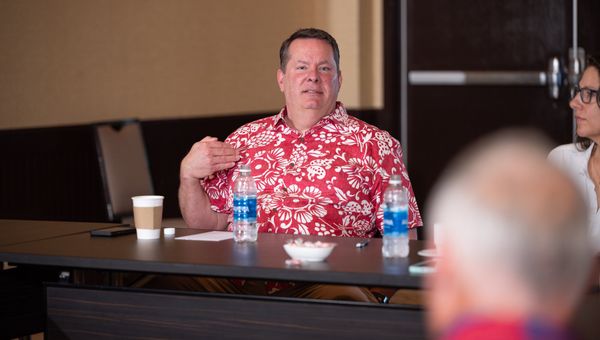
ALG Vacations group president Ray Snisky said there's "real risk" to reducing marketing budgets and trying to "live on your name." Photo Credit: Paula Ota
Hu: That's the frustration for all of us. We see how we could sell this. And yet, we're not able to fully take advantage of it because of things that are holding it back.
Krueger: I don't want to discount the travel advisor piece of this. They're really important. We're not talking about needing millions of dollars to go directly to them. What do we need to do to empower the advisors and create awareness? That's not costing any tax dollar money, that's leveraging our relationships.
Narvaez: Travel advisors are also influencers. Now we have travel influencers booking travel and they have a following, so they're like funnels of information that help us work the destination.
Dee: We should be talking about all the great things we've got happening. Every island has seen massive investment. The merger with Alaska is going to keep Hawaiian where it needs to be. I'm super proud of the destination.
___
The original transcript was edited for length and clarity, and the chronology was altered to keep dialogue about specific topics together.