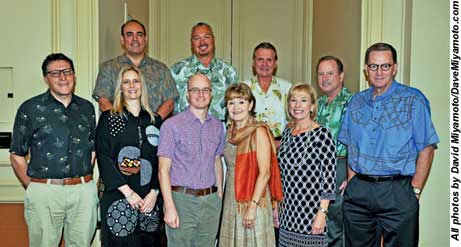
 Travel Weekly invited a group of travel executives to the Royal Hawaiian, a Luxury Collection Resort in Waikiki, in May to discuss the state of Hawaii's visitor industry. Participants in the roundtable, moderated by Travel Weekly Editor in Chief Arnie Weissmann and contributing editor Shane Nelson, delved into issues including capacity in busy Waikiki, the increasing impact of globalization, upcoming hotel renovations on Oahu and airlift to destinations across the state. The original transcript has been edited for length and flow.
Arnie Weissmann, editor in chief, Travel Weekly: Shall we start with Waikiki? You've got an enviable occupancy here, which leads to questions about capacity. Not just in terms of number of rooms, but in the sense that the sheer volume of people makes the Waikiki experience less pleasant and drives people to alternative islands or destinations other than Hawaii.
 Shari Chang, senior vice president of sales, marketing and revenue management, Aston Hotels & Resorts: That's something we're seeing on social media all the time, comments from people saying [they] had a great stay but "Waikiki was a little more congested than I expected it to be. Next time I might try a different area."
Without a doubt, the congestion is on people's minds. Even in shoulder season now, it's still pretty packed, so I think people are kind of shocked seeing it as full as it is. They expect it in the summer. They expect it in the holiday times and first quarter, but I think on the shoulder seasons they're not as used to it.
John Monahan, president and CEO, Hawaii Visitors and Convention Bureau: That's a great thing about Hawaii: We're so diverse. Some people love the entire Waikiki experience: the crowds, the upbeat atmosphere. People, including some at this table, as well as the city and county, have recently put a lot of money into Waikiki.
 We recently rebranded the Islands "The Hawaiian Islands" rather than "Hawaii, the Islands of Aloha" because we wanted to flesh out the individual island brands. Oahu has a great brand, centered in Waikiki. And there are phenomenal brands for travelers who want a different experience on the other islands.
Keith Vieira, senior vice president and director of operations, Starwood Hotels & Resorts Hawaii: It also depends on the visitor's cycle. If you're on your honeymoon, you go to Maui. You brought your kids and you want to go hiking or biking? You go to the Big Island. If you're a high school grad with a bunch of buddies, or the kids are 16 and you want to let them do their own thing -- and you want to be alone -- you love Waikiki Beach.
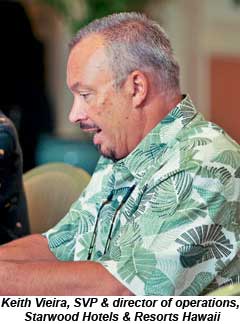 People also return to Waikiki because they love that urban resort experience. They love watching the street people at night. They love the options for food. So complaints about crowding are kind of like saying, "It's so busy, nobody goes there anymore."
Karen Hughes, vice president of Meet Hawaii and travel industry partnerships, Hawaii Visitors and Convention Bureau: What this says to agents is, book early if you want Waikiki. If you like that urban experience, book early because it is full.
Elliot Mills, vice president and general manager, Aulani, a Disney Resort & Spa: Or visitors can have the best of both worlds and go to Ko Olina [on Oahu's west coast]. There is a Neighbor Island type of feel when you go to Ko Olina and specifically to Aulani for family vacationing, but you can still go into Waikiki to get that dining, that entertainment experience and then comfortably move back to the Neighbor Island experience at Ko Olina pretty quickly. That's worked really well.
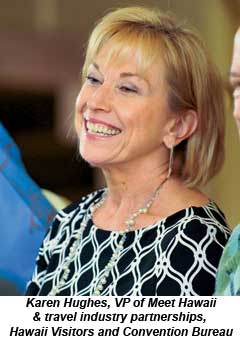 Chang: What's changing the mix now is a shift to more international visitors in Waikiki. We also tell agents, book early or go to the Neighbor Islands, because if you wait too late it is going to be more difficult to book Waikiki.
Weissmann: Regarding those international visitors, one effect of globalization is to create even more competition for available space in the most popular areas. How are you preparing for that, Jack?
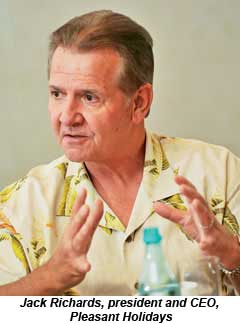
Jack Richards, president and CEO, Pleasant Holidays: It's been a problem. We're seeing the Chinese, the Russians, the Japanese, the Koreans, the Australians show up in every market, not just Hawaii.
It became a huge problem in 2008 when ATA and Aloha Airlines failed and the market lost a million air seats. Our business then was highly dependent upon Hawaii.
 But today, 30% less of our business is dependent upon Hawaii. We recognized in 2008, 2009 that if we didn't diversify our business and if Hawaii caught cold, we'd get the flu.
We ran out of hotel rooms on Oahu in August 2012. And for the first time that same month, we ran out of rental cars on Maui and Oahu, so it's not only hotels.
The infrastructure is not geared to support 90%-plus occupancy, [and] you're not going to convince the North American market to book early.
They are within 90 days today. We're just now starting to book June 2013 off the West Coast, and it's May, so what happens is the Asians book far out, and they build this huge base. The hotels raise the rates, which I would do, too, but it's shutting out the North American market.
Weissmann: John and Karen, I don't believe diversification is an option for you. How are you addressing this?
 Monahan: Jack paints a very gloomy picture, yet the North America market increased substantially last year, in the range of 6%.
And it's growing this year. We're picking up market share from both the Caribbean and Mexico, significant market share. There is room on the Neighbor Islands, there really is. Waikiki and Oahu are sold out at times, but that's why we market to vacation values, and we try to match up the experience a visitor wants to an island. We have plenty of capacity, particularly on Kauai and Hawaii Island but also on Maui.
So if you're talking strictly Waikiki, maybe I'd buy in a little bit more to what Jack is saying, but the Hawaiian Islands have so much more to offer, and they are still growing and gaining market share.
 Weissmann: Keith, could you give us an update about Starwood's expansion plans at the Moana Surfrider and elsewhere in Waikiki?
Vieira: At this point, we think that in July of next year the Princess Kaiulani [hotel] will come down. Two towers will be knocked out, and one tower, the newer tower, will be completely renovated, and our plan is to put in a 300-room St. Regis product.
So it will be a little higher-end product along with some residences there, [and] down the road, after that's complete, our hope is to replace the Diamond Head wing of the Moana Surfrider, which is an eight-story building built in 1954, with another St. Regis product -- at least that's the planning at this point.
That tower would be 26 stories on the same footprint but provide new product in Waikiki. We think, overall, the challenge is to get more new product into Waikiki, because over the last probably 15 years, Waikiki is down 3,500 to 4,000 rooms.
Weissmann: How many rooms will there be in the new 26-floor beachfront tower?
Vieira: There will probably be around 400 bays. We're not sure of the layout, whether they'll be one- or two-bedroom suites, but [the number] will be about double what there is now.
Weissmann: Is anyone else planning other projects?
 Barry Wallace, executive vice president of hospitality services, Outrigger Enterprises Group: We're doing some similar things to what Keith talked about. We're not anticipating new inventory, but we have a couple of assets that are being redeveloped, including the Ohana West, which is a 660-room hotel [in Waikiki]. The owner, Queen Emma Land Trust, is soliciting a redevelopment partner right now.
So what I see for the short term, being the next three to four years, is a constriction of inventory that will make it even harder to get a room in Waikiki and, hopefully, help us drive higher occupancy towards our Neighbor Islands.
Elizabeth Churchill, senior vice president of sales and marketing, Aqua Hotels & Resorts: We're thrilled the Volcano House is finally reopening [in Hawaii Volcanoes National Park] on the Big Island.
No one could stay in the national park for the last three years, so it's exciting to have a property in a Unesco World Heritage site, which attracts not only North American visitors but also international visitors, [and] we have been working very closely with the national park.
I don't think people realize we've got eight national parks in the state, five of which are on the Big Island. So we need to educate agents more about the rich natural and cultural heritage that we've got in the state.
Shane Nelson, contributing editor for Hawaii, Travel Weekly: John, you mentioned gaining market share this year, but given that Alaska, Hawaiian and United airlines announced service reductions, does that reflect a drop in demand for Hawaii from the U.S. in 2013? How would you characterize demand?
 Monahan: Huge so far. Looking at outbound U.S. travel, and we include Hawaii as part of that, in January and February we picked up 0.5% to 0.8% in market share. That's a huge move. We've gone from in the neighborhood of 12.4% to 13.2% market share leaving the U.S.
Basically, of every 100 people leaving the continental U.S. to go to international destinations, including Hawaii, 13 of them are coming to Hawaii. That's a big number.
So we are picking up, [but during this year's] August-to-December period, we had some airlines pull back from select markets. Those were primarily markets where they are making independent decisions, and they all went after San Jose. They all went after Oakland. They all went after San Diego, and it was too much, and now they're retrenching.
Bottom line, even with the reductions at the end of the year, we will still be up 2% this year in air seats. Jack mentioned we lost a million seats from North America in 2008. We've picked them all up, plus, since then.
 Nelson: How has the increase in nonstop flights from the U.S. West Coast directly to the Neighbor Islands affected business?
Monahan: It's a bit of a conundrum. It's great for the consumer, but it's put pressure on interisland air systems. There is less demand interisland, [and] multiple-island visits are down by 25% over the last 10 years.
People just don't travel to as many islands as they used to. That was also one of the reasons we went to the individual island marketing.
Again, we had to move people around because the interisland airfares went up, partially because of the cost of oil and partially because there was less demand because of the new nonstops.
Chang: It's also become more expensive to fly interisland because we don't have Aloha Airlines competing with Hawaiian anymore. It's going to be pretty hard for anyone [new] to come in that doesn't already have a sizeable investment here.
We'd like to see that, but I don't think it's going to happen.
Nelson: Has the increase in nonstop service to the Neighbor Islands from the West Coast been good for your business, Jack?
Richards: Absolutely. Tremendous. Once the marketing began, the airlift followed, [and] we've done extremely well with the nonstops.
Who would have envisioned nonstops to Kauai out of San Diego? I think you're going to see that continue because hubbing through Honolulu, given some of the caps we have on hotel rooms there, doesn't make a lot of sense during certain peak times of the year.
So it forces carriers to fly nonstop to the other islands, which I think is good for the overall business.
It helps us. When 80% of your business is in Honolulu and Maui, you need to spread your business out somewhere else, and I think [the nonstops have] helped, the marketing has helped.
I think going forward, even Hawaiian has recognized it has to do that. It is hubbing out of Maui, and 40% of our customers visit more than one island. It's remained constant over time.