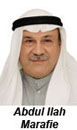
 Kuwait is experiencing a boom in high-end hotel and resort openings. Destinations Editor Kenneth Kiesnoski spoke with Abdul Ilah Marafie, CEO of the Kuwait-based Marafie Group and owner of the Radisson Blu Hotel Kuwait, about the challenges of running a hospitality business in, and promoting tourism to, a country better known for oil deals and regional diplomacy.
Q: What's your reaction to the push to make Kuwait a leisure travel destination?
A: First of all, Kuwait is not a tourism country; we don't have any attractions. What we have is pure business: Kuwait depends on foreign imports and has one export, oil, so we mostly attract businesspeople as visitors. But in the Kuwait Hotel Owners Association, we do try to make packages for the development of leisure tourism [as found] in the other Gulf Cooperation Council states. For example, for locals and people [residing] in GCC countries, we offer 50% discounts on rates over weekends, and Kuwait Airways gives them a subsidized air ticket.
Q: How, then, to explain the huge surge in Kuwait of not only hotel but high-end resort developments of late?
A: Some of our businesspeople think going into the hotel business is best. They see sometimes some of the hotels are fully booked, even if it's only for one day, five days. So they think that the hotel is fully booked all through the year, which means business.
Somebody comes to you as a landlord and says, "Why don't you establish a hotel? The name's not important. We can bring a three- to five-star [brand] in later." They then take advantage of the ... construction [allowances] for the hotels, which is higher than for other [developments] because there are a lot of services attached to hotel guestrooms. [Authorities] give you higher rates, higher volume and a higher number of floors.
Some developers take a hotel permit, put any hotel name on [the building] but then convert it to offices. This is cheating the law and trying to benefit from regulations designed for the hotel industry. In the last five years, more than 150 licenses were given for hotels. But how many of them are serious? Not exceeding 15 or 20.
Q: Does the Kuwaiti government respond to these violations? How responsive is the government to your concerns?
A: In the government, no one listens to us or gives us feedback. Nobody cares. They have their own agendas. For 25 years we've been fighting for [recognition]. We are intensifying our lobbying now. The director of tourism for the ministry of commerce [Majda Behbehani] said she appreciates our position. But she also said we need to find other members of parliament to support us. But we can't depend on them; at least 95% of them are corrupt. They don't do anything if there's no benefit for them.
That's why we're always out in the field alone. If we go abroad to market Kuwait, to ITB or World Travel Market, the stand cost is shared between Kuwait Airways, Kuwait Tourism Services and the hotels association. But nothing from the Kuwaiti government. Nothing!
Some 15 years ago we had to design for the Ministry of Interior a new visa system. We had to buy the computer equipment and software to produce the visas. Hotels now can issue the visitor visa for you, but we had to do this ourselves.
Q: Yet Kuwait does have a reputation as one of the most transparent, open and corruption-free countries in the Gulf, if not the entire Middle East.
A: Yes. Security-wise, Kuwait is open but safe, and you have the freedom to talk about anything. You can talk about politics all night until morning. That's not possible in all the Gulf states. Just look at our newspapers, our TV stations. Kuwait is also the only country in the GCC -- and most of the Arab world, unfortunately -- that's an institutional country with a real constitution and laws.
In the other GCC countries, if you have a legal case against the ruling family, for example, the courts won't hear you. Here in Kuwait, you can file cases against anyone you want, apart from the emir [Sheikh Sabah Al-Ahmad Al-Jaber Al-Sabah]. And you'll get a verdict, take it to the ministry and get the defendant to pay you. Still, the bureaucracy here is killing us.
Q: Has government red tape ever affected your own hotel business?
A: Four years ago, they passed a new law for the seaside where any hotel could build two more floors. The maximum, seaside, had been three floors. We submitted our papers to the municipality, and I worked with my nephew for two years on the design, preparation and lobbying. Two years later, after the lobbying was completed and we got the approval, the minister of the municipality said no. I went to him and asked why. He said because we had one mistake or penalty against us from when we built the hotel in 1980: There was an extra 40 square meters that we'd built.
I told him, "Today, my right is another 9,000 meters; now, take from that those 40 meters, or even 500 meters, and give me the rest." Finally I told him to forget it; I wouldn't add the new two floors but would just do a renovation, to establish a new presidential suite, sky lounge, new banquet hall and a renovation of the whole hotel.
Q: In light of these challenges in building and operating hotels in Kuwait, how's the quality of accommodations in general?
A: The hotel product in Kuwait is very high quality, unlike in some other Arab countries. The Ibis property in Kuwait City is at least three-star in quality, for example.
Q: And how about the welcome visitors get in Kuwait, in hotels and on the street?
A: In the streets, you can see many nationalities coming and going to work, to market, wherever. Here, we have this heritage; more than 200 years ago, Kuwaitis became travelers to the world, so we're happy to see foreigners in our country. In general, Kuwait is a place you can go to relax. We have cultured people who are willing to accept others. It's also a hot country, so this, too, makes us a warm people. [Laughs]
For destination news and updates worldwide, follow Ken Kiesnoski on Twitter @kktravelweekly.