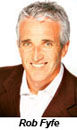
 Air New Zealand created a stir last week by unveiling a lie-flat economy seat prototype and a space-age design for its economy premier seating. CEO Rob Fyfe talked with aviation editor Michael Fabey about what the airline hopes to accomplish with its new seating and what other changes the carrier has in mind.
Q: Are you hoping to capture more of the transpacific market with the new seating concepts?
A: We only have 1% of U.S. southbound; we can certainly gain more even at this time.
Q: What's the biggest problem in creating or capturing that kind of market?
A: It's such a long way. Part of what this product is about is to make it less intimidating.
Q: Seats alone won't make the market more attractive.
A: The challenge is to sell a dream. Air New Zealand and the government will be working on this over the next few years. We can put New Zealand on the international map. We saw some of that already with publicity from "Lord of the Rings" and the America's Cup. We had one of our 747s painted with scenes from "Lord of the Rings."
Q: Is there any airline in the U.S. that you see as a kindred spirit?
A: Southwest. We're not alike in the markets we serve, but we have the same kind of culture. There's a connection.
Q: What is the New Zealand dream you can sell?
A: You have to remember why passengers come here. They want a holiday in an area that's natural, remote and beautiful. But we must be compatible.
Q: What do you mean by "compatible"?
A: As people become more environmentally sensitive, we have to position ourselves so we don't become an impediment. We accept we're a polluter. We're not in denial. We are the least polluting airline in the world, based on the number of passengers and how much we fly.
Q: What are some of the steps you are taking?
A: Look at the some of the changes we're making in the business premier class. We're making the seats lighter. By using beanbags instead of foot rests, we cut more weight. The footrests weigh over a ton, when all added up. The beanbags weigh just a few ounces each. We're looking at recycling, how we use materials, the designs of seats and carpets. Take water: We carry potable water and fill up the tanks. When we arrive at the other end, we've used only half of the water we carry. For us to carry one kilo of weight, it takes a half-kilo of fuel. Airlines have a practical motivation to reduce fuel; it's their biggest cost.
Q: What's your take on alternative fuel?
A: We're looking at using biofuels. It's technically challenging. The biggest issue is getting economies of scale.
Q: What can you do in the meantime?
A: We also consider the operation of aircraft: taxiing only with one engine, using ground power when we can and carrying less discretionary fuel. We've slowed own our aircraft significantly [during flight]. For us it has become a real mission.
Q: What about the rest of the industry?
A: I've spent a lot of time talking to CEOs about what we're doing, and I think that has helped to move a number of airlines in the right direction. We have to look at it as an opportunity and see how it can add value instead of as a cost issue. IATA has set industry goals, the first unified statement we've had as an industry.