 Doomsday theorists might want to move up their holiday plans for next December. The rest of us can relax.
Some hype holds that the end of the world could coincide with the winter solstice on Dec. 21, the end of the 5,125-year Mayan calendar that began in 3114 B.C., also called the Long Count calendar.
The Mayan calendar is based on a 20-day cycle in 394-year increments known as a baktun.
Dec. 21, 2012, marks the end of 13 baktun cycles and the conclusion of a key cycle of time, but it’s not the end of the world.
It’s more like flipping your kitchen calendar from one month to the next, although in this case the “pages” are heavy stone carvings inscribed with intricate symbols indecipherable to most everyone except scholars, astrologers and the Mayan people themselves.
In fact, Mayans who know what is going on are pretty excited about the “new beginning” and the “transition,” as they call it.
For the Mexican Tourism Board as well as a number of tour operators and hoteliers, the Mayan event is a broad opportunity to promote Mexico’s culture, traditions and archaeological sites through hundreds of Mayan-theme events, festivals and packages designed to lure tourists to the region.
The Riviera Maya, for example, plans to re-enact a popular Mayan ball game called pitz as well as re-create the Sacred Mayan Journey, a pilgrimage by canoe from Pole Port (now Xcaret, an eco-park in the Rivera Maya region) to Cozumel and back again to Xamanha (Playa del Carmen) to pay homage to the goddess Ixchel.
In fact, the region of Mexico that is home to the Mayan civilization (it spills over into neighboring Guatemala, Belize and Honduras) now is tagged as the Mundo Maya, or Mayan world, and figures prominently in advertising and marketing.
“We expect a lot of visitors, more than 50 million domestic and international visitors, in that region this year,” said Alfonso Sumano, regional director for the Americas.
The five southeastern states comprising the ancient world of the Maya include Quintana Roo, home to Cancun and the Riviera Maya; Campeche; Tabasco; Chiapas; and Yucatan.
Each of the five states is highlighting two archaeological sites this year, in addition to more than 20 more sites open to the public.
Of the $30 million budgeted for overall advertising and marketing in 2012, “an important portion” is earmarked to promote the Mayan region and the yearlong events surrounding the calendar change on Dec. 21, according to Sumano.
“We have identified the circuit of the Mayan route, one that visitors can follow on their own or on package tours,” he said.
The route represents a multiregion strategic partnership with Belize, Guatemala and Honduras, targeting long-term tourism development centered on the Mayan culture.
Actually, the celebrations already have begun. The countdown officially kicked off on Dec. 21, 2011, when indigenous people of the region gathered at various sites to dance around sacred fires in preparation for the end of one calendar cycle and the beginning of another.
Digital clocks have been erected in many sites in the region this year. Maya-related websites also measure the time remaining in days, hours and seconds with countdown clocks on their homepages.
There’s even an iPhone app that counts down to the date.
There will be no shortage of tours, for sure. What some call an apocalypse others see as a potential gold mine and tourism bonanza.
Hotels and tour companies have rolled out all manner of Mayan-theme packages and excursions.
Already, at least 30 programs are available from operators, ranging from Gogo Vacations, Abercrombie & Kent and Classic Vacations to Tia Stephanie Tours, Mexico Unlimited and Prime Travel.
Gogo’s eight-day Treasures of the Yucatan, priced from $1,779 per person, for example, begins and ends in Cancun and visits the ruins at Tulum, site of a pre-Columbian walled city; the Mayan city of Coba; and Chichen Itza, a Unesco World Heritage Site. It also includes the religious center at Izamal, the ruins at Uxmal, Merida’s museums and the pyramid in the Mayan city of Ek Balam.
The museum circuit
Visitors to the region will get their fill of museums as well as ancient ruins and carvings.
The Archaeological Museum in Cancun, which opens later this year, will house Mayan carvings, paintings, jewelry and pottery.
Also on the museum circuit will be the new Museo del Mundo Maya, which is set to debut this fall in Merida, capital of the Yucatan state.
Another project is the Palacio de la Civilizacion Maya in Yaxcaba, a few miles from Chichen Itza.
“Many in Mexico have been planning for this year for 10 years,” Sumano said.
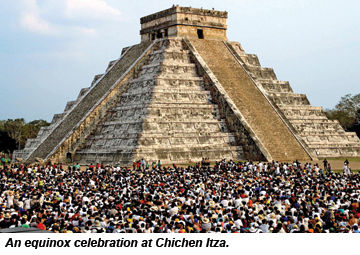
Most visitors will take in a full day at Chichen Itza, the most well-known and revered of the Maya sites, especially the signature El Castillo great pyramid.
Chichen Itza will host many events this year, including equinox and solstice celebrations in March, June and September, capped by the big one in December.
Paul McCartney will stage a concert on Chichen Itza’s sacred grounds late this spring as part of the celebrations, according to Sumano.
Despite the number of events leading up to and surrounding Dec. 21, the Mundo Maya celebrations, while they promise to be joyful and colorful, are authentic and meaningful.
“Visitors should seek out the opportunity to meet actual Maya, see their customs, traditions, form of life and learn about their mysticism and philosophy,” Sumano said.