
Gay Nagle Myers
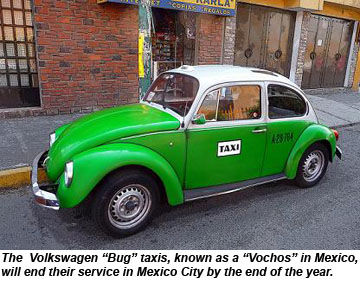
 One of Mexico City’s most recognizable icons, the Volkswagen “Bug” taxi, will be retired by the end of the year.
Six years ago, the rounded, two-door sedan nicknamed the Bug — in Mexico, it’s a “Vocho” — accounted for almost half of all taxis in Mexico City, with almost 50,000 in service. Today, the privately owned and operated Bugs number approximately 3,500 among 130,000 taxis.
 Transportation authorities enacted an ordinance in 2008 that mandated the retirement of public transport vehicles that are at least 10 years old. Also, for passenger safety and convenience, all taxis must now have four doors and a trunk.
The last Bug rolled off the assembly line in 2003 in the Mexican state of Puebla, but the cabs now are deemed impractical due to the difficulty in obtaining spare parts, although they were economical to operate.
The Bug taxis were once yellow but were painted green and white in the 1990s in an effort to project an environmentally friendly image, according to Victor Ramirez, Mexico City’s taxi services director.
Despite their role as icons, the Bugs were not high on creature comforts. Taxi drivers removed the passenger front seats so customers could get in and out more easily. The back seat was not large to begin with.
Taxi owners who turn in Bugs to be crushed will get a $1,120 credit toward the purchase of new cabs.
Mexico City received its first fleet of all-electric Nissan Leaf taxis last fall and opened its first quick-charge station as part of an effort to promote the use of electric vehicles.