 Three wily baboons scrambled up a nearby sausage tree as the Kwetsani Camp manager walked me to my treehouse tent the first day.
If you don't latch your door, she warned, the baboons will steal your underwear.
That seemed like a strange thing to say to a new guest, but the baboons were only the first of many animals I saw up close while staying in one of the most remote game lodges in Botswana's vast Okavango Delta. I photographed an elephant from my bathroom window, saw a python in the kitchen and watched half a dozen red lechwes graze within a few yards of the lodge.
Kwetsani was the final stop on a 10-day visit to southern Africa in December arranged by Goway Travel's Africa Experts, a division of the Toronto-based travel company that specializes in customized independent travel. The itinerary was designed to provide a sampling of the landscape, lodges, wildlife, food and adventures possible on a Goway safari to Botswana.
"No one wants to make the wrong choices on a safari," said Antony Saba, Goway's manager of product development and our tour leader. "People expect the trip of a lifetime."
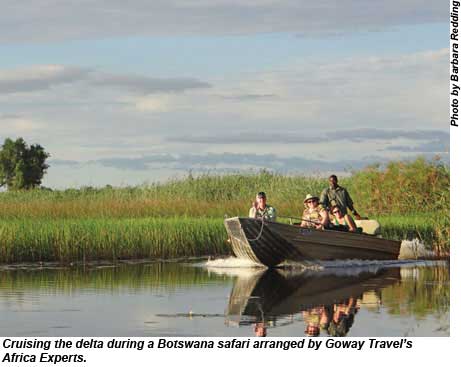
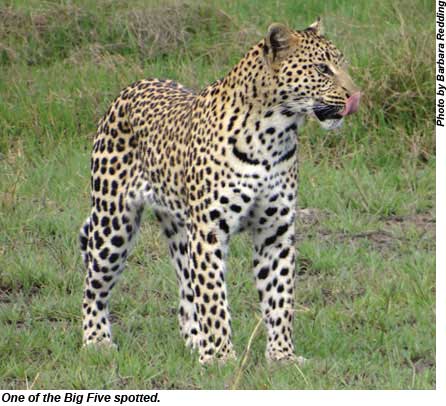
We got one: We saw the Big Five (Cape buffalo, elephant, leopard, lion, rhinoceros), the Ugly Five (hyena, Marabou stork, vulture, warthog, wildebeest) and dozens of other animals and birds of all sizes. We floated over the delta in bush planes and a helicopter. We sped along "hippo highways" in open-air boats and bounced along single-track roads in four-wheel-drive vehicles. We stayed in three luxurious, secluded lodges in Botswana and took a side trip to Victoria Falls in Zimbabwe.
 Goway, operating in Africa since the 1990s, has seen 20% growth in passengers traveling to Africa in recent years, with safaris to southern Africa, including Botswana, surpassing ones in East Africa.
Landlocked and the size of Texas, Botswana has fewer people than Houston (under 2 million). But the country is home to one of the continent's most unusual habitats: a huge inland flood plain created when water from Angola flows into the Okavango River and fans across the Kalahari Desert.
In late fall and winter (roughly May to August), this thin sheet of water gradually covers about 6,000 square miles in the country's northwest corner, before receding in the summer. The pristine and mostly uninhabited wetlands, reed beds and savannahs nourish an array of wildlife, including giraffes, zebras, hippos, rhinoceros and lions as well as dozens of species of rare, colorful birds and amphibians.
To preserve the delta, Botswana's government has wisely adopted a low-volume, low-impact and upscale approach to tourism. Private companies lease land to operate dozens of small lodges or camps like Kwetsani, which has six tented chalets built on wood platforms. They also must be ecologically sensitive and help support local communities.
Despite the lodges' remote locations, amenities include en-suite baths, luxury linens, gourmet meals, spas, gyms and plunge pools. As we experienced at Kwetsani, you can stay in close proximity to African wildlife in the Okavango without roughing it — or bumping into a lot of other people.
Visit www.goway.com.