My initial impression when I stepped out of the taxi in Salt River, a neighborhood that sits on the fringes of Cape Town's tourist circuit, wasn't exactly inspiring.
The place felt a little rough around the edges. Buildings, their paint peeling, looked like they had seen better days. Sidewalks demanded careful navigation. It's the kind of neighborhood I might have hurried through under any other circumstances.
But I was here to meet AWOL Tours' Winston Fani, South Africa's first blind tour guide. Winston was waiting for me with a broad smile. "Welcome to my office," he said with a laugh, extending a hand in my direction.
"Most people walk past these walls every day and see nothing," Winston said as we began our street art walk. "But there are stories everywhere; you just need to know how to listen to them."
With each step, Winston painted a picture with words. A colorful mural celebrating the rainbow nation caught my eye, or rather, Winston's description caught my ear. Another mural showed people from different races working side by side, complete with subtle details like a woman in a wheelchair holding a spade among her nondisabled peers. "Inclusivity," Winston reminded me gently. "That's real strength."
He shared anecdotes about each of the artists, many of whom he'd met during his time frequenting a now-closed art studio in the area, a hub that had drawn creative talent from around the globe.
"This one is my favorite," he said, gesturing toward the wall with a familiarity that suggested he could sense the mural's presence. The mural he described was "Man with Dreadlocks" -- a half-robot, half-human figure made of bushes.
"Nature is still the best technology. That's the message here. No matter what machines we create, we remain the masters," he said.
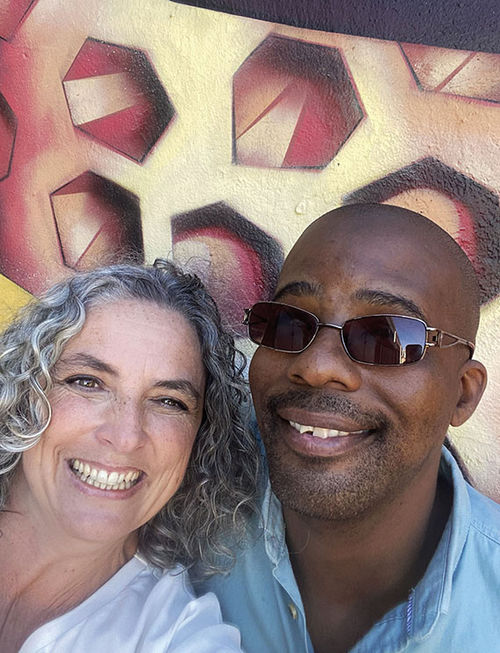
The writer with AWOL Tours guide Winston Fani. Photo Credit: Dorine Reinstein
At each of our stops, Winston reached toward a small plaque beside each mural, running his fingers over braille descriptions that he had created for blind visitors.
"I had to go to every artist, learn about their work and then translate it into something I could understand," he said. "Then I created both braille descriptions and audio recordings that blind people can access through these QR codes."
He demonstrated by scanning one of the codes with his phone, and suddenly his own voice filled the air, describing the mural in vivid detail -- not just its visual elements but the emotions it evoked, the history it represented and the artist's intentions.
"My aim is simple," Winston told me when asked why he went to such lengths. "I want everyone, blind or not, to feel part of this journey."
His passion is infectious and deeply genuine: "I don't feel like I'm working," he said at one point. "I'm having fun sharing my world. I'm probably the only blind person giving art tours anywhere in the world."
History hidden in plain sight
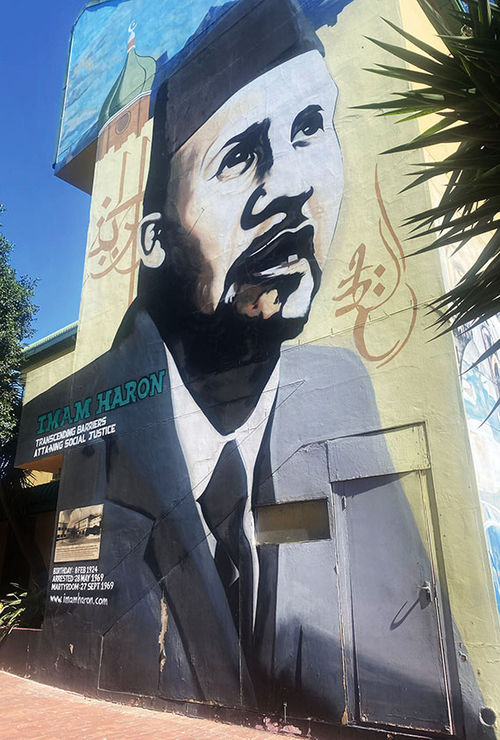
The mural of Imam Haron outside Community House honors the anti-apartheid activist, who died while in police custody in 1969. Photo Credit: Dorine Reinstein
As our tour continued, we turned a corner and entered what Winston described as Community House, a building that once housed white women who came from farms seeking work in Cape Town during the early 19th century. Later, it became headquarters for the Communist Party and trade unions during apartheid.
On the outside wall, Winston pointed out a painting depicting a miner wrapped in green blankets, an artistic remembrance of the 2012 Marikana massacre when dozens of striking mine workers were killed by police forces during South Africa's democratic era.
Another wall showed a striking mural of Imam Haron. "He was an anti-apartheid activist," said Winston, his tone growing somber as he described how Haron had died in police custody in 1969, his body bearing 27 bruises and two broken ribs. "They claimed he fell down stairs," Winston said, "but we know that was propaganda."
Inside the building, portraits of other heroes of the struggle lined the walls. Winston paused at an artwork celebrating Jeanette Schoon. "She was also an anti-apartheid activist," he said quietly. "Killed by a parcel bomb while she was having tea in 1984."
A little farther down the street, a striking mural depicted a newspaper front page showing Nelson Mandela's release from prison. "Look closely," he instructed. "Do you see how there's a figure in a suit with a red tie but no face? That's because during apartheid, it was illegal to show the faces of political prisoners in newspapers. Everyone knew who it was by the outline alone."
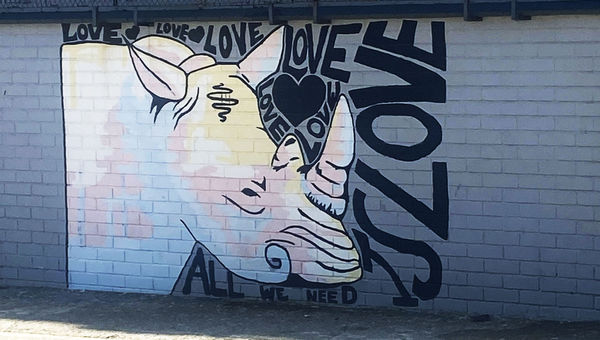
A rhino mural in Salt River carries a simple but powerful message: "All we need is love." Photo Credit: Dorine Reinstein
A personal journey
Between stops, Winston shared pieces of his own story: how he met his wife (who is also blind and works as a content writer), how he became a tour guide and the challenges he faced getting certified by the Tourist Guide Institute in South Africa (the first visually impaired guide ever certified by that organization).
"Most tourism institutions wouldn't take me because I'm blind," he said, without any bitterness. "But I found a mentor who said, 'You're going to help me do it. You're going to show me how to do it.' And we did."
It was really by chance that Winston began leading tours. As Wendy Purdon of AWOL tells it, she and her best friend, Tania, were on their way to visit Winston and his wife, Busi; Tania had raised Busi's guide dog and wanted to see how everyone was doing. But along the way, Wendy and Tania got lost.
"We called Winston, who gave us amazing directions to the house," Purdon said. "I jokingly said to him, 'You should be a tour guide.' Winston replied, 'I have always wanted to work in tourism,' to which I said, 'Well then, why don't you?' ... So it started as a dream that we manifested into a reality."
Purdon and her friend actually put together the tour that Winston leads, walking it over and over again with him and coaching him until he had it memorized.
"From the beginning, I had no hesitation working with Winston," Purdon said. "Winston is smart, funny, likeable, responsible, forward-thinking and brave -- all the attributes that we look for in a tour guide."
As we approached the end of our tour, Winston led me to a mural depicting a rhino with the words "All we need is love" emblazoned around its head.
"We used to have three different species of rhinos," Winston said solemnly. "Now we only have one left. I'm afraid the next generation won't have the luxury of witnessing these beautiful creatures."
The irony wasn't lost on me: a man who had never seen a rhino expressing concern that future generations might not see one either. It was a powerful reminder that appreciation and conservation transcend sight itself.
Throughout our walk, Winston never once seemed uncertain of his route. The neighborhood was clearly mapped in his mind with a precision that put my own spatial awareness to shame. Every uneven paving stone, every car parked partially on the sidewalk, Winston navigated them all with the casual confidence of someone who has transformed potential obstacles into familiar landmarks.
Unfortunately, Winston admitted, the tour was much shorter than when he first set up the experience. A lot of the original wall art has disappeared as buildings were repainted and walls were repurposed. But Winston isn't giving up. Instead, he's planning to expand his tours to include a gin tasting experience. "Same concept as my wine tours," he said, referring to his other specialty as a wine taster.
This addition will undoubtedly create a more rounded experience, complementing the visual and historical elements with sensory dimensions of taste and smell. As we parted ways, Winston promised, "Next time you're in Cape Town, I'll have the gin tasting ready."
As I walked back to my taxi at the end of the tour, I realized how differently I was seeing Salt River compared to when I arrived. What had first seemed run-down now felt full of life and meaning. Thanks to Winston Fani, I'd seen a side of Cape Town most visitors miss.