 The 2011-12 North American ski season appears to have been both the warmest and driest on record, but for many resorts disaster might have been staved off by one stiff tailwind.
Collectively, North American ski resorts likely matched the revenue generated during the 2010-11 season despite brutally mild weather throughout most of the continent.
The season saver was a combination of advanced reservations generated by year-earlier record snowfall and an improving economy that made prospective travelers more confident about booking trips, according to the Mountain Travel Research Program, also known as MTRiP.
For resorts across Western U.S. states like California, Colorado, Oregon and Utah, revenue through the end of March was up about 2% from a year earlier, as a 4.8% increase in room rates more than offset the effect of a 2.3 percentage-point drop in occupancy, MTRiP reported.
While East Coast resorts’ numbers haven’t been tallied, and revenue there will likely fall substantially because of an unseasonably warm winter, total North American ski-resort spending will likely be on par with year-earlier figures.
“The weather combination was really two gut punches to the ski industry,” said Ralf Garrison, director of MTRiP. “Natural snow can be augmented by man-made snow, but not if it’s 80 degrees. But the pure-destination skiers had already made reservations and were locked into a vacation, so when they came, they ended up shopping, cross-country skiing and spa-ing.”
The positive momentum heading into the ski season was generated largely by record snowfall during the 2010-11 season. Because of such storms, U.S. ski resorts generated a record 60.5 million visits for the year-ago ski season, with some of the largest percentage gains occurring in the Pacific Northwest, according to the National Ski Areas Association (NSAA).
With fresh memories of last year’s powder, advance U.S. bookings throughout the Western U.S. were up about 15% in November and helped resorts such as Wyoming’s Jackson Hole Mountain Resort attract more visitors for this ski season than last.
In fact, Jackson Hole had its second-best season on record, trailing only a 2007-08 season when the resort received about 60% more snow.
Still, while the NSAA hasn’t released this season’s numbers, Garrison estimates that this year’s visits will have fallen about 15%, into the 50-million range. That would be the lowest figure since the 1990-91 ski season, when resorts were hit by the twin challenges of mild weather and a stumbling economy.
And much of that decline likely occurred in the Northeast, which accounts for about one-fifth of U.S. ski-area visits. Northeast resorts are more likely to be hurt by warm and dry weather conditions because much of their clientele are drive-market, shorter-stay visitors who don’t tend to book in advance and will be swayed by reports of no snow.
Sarah Neith, spokeswoman for Ski Vermont, said the shortened season could be attributed to “lower snowfall and a record-warm March. ... Lack of snow in metro regions also had an impact on the ski season, as many tourists view a dry season at home to be a benchmark of what they might find in the mountains.”
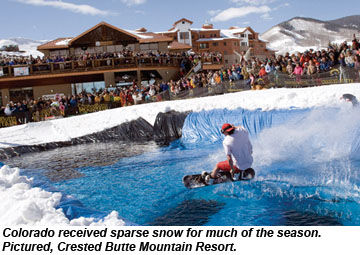
Farther west, Colorado received scarce snow for much of the season, forcing resort operators such as Vail Resorts to kick up snow-making efforts. Vail, Beaver Creek and Keystone resorts all closed their seasons at the scheduled time.
But in a March 6 statement announcing the company’s earnings for the quarter ended Feb. 26, Vail Resorts CEO Rob Katz called the 2011-12 season “one of the most, if not the most, challenging winters for the U.S. ski industry.”
Meanwhile, in Utah, snowfall was “a bit below” average and substantially less than a year earlier, when Snowbird stayed open until the Fourth of July, according to Ski Utah spokeswoman Jessica Kunzer.
One exception to the warm, dry season was the Pacific Northwest, which accounted for about 7% of 2010-11 visits but which will likely pull a bigger share this season.
In British Columbia, Whistler Blackcomb’s snowfall is about 30% ahead of average levels, and the 15 feet of new snow the resort received last month was a March record, according to Whistler Blackcomb spokesman Peter Lonegran.
In Alaska, Alyeska Resort reported last month that it was “within reach” of its seasonal snowfall record of 939 inches.
Also falling into the better-late-than-never category were the California and Nevada resorts such as Mammoth Mountain Ski Area and those near Lake Tahoe, which were fairly dry until January.
While Tahoe snowfall levels were still about 20% below average as of last week, the area had received 17 feet of new snow since the beginning of March, enabling some resorts to extend their seasons into May, according to Ski Lake Tahoe spokesman Eric Doyne.
Meanwhile, Mammoth Mountain snowfall was about 30% less than average, but the resort received more than eight feet of new snow since the beginning of last month, pushing the season through Memorial Day, according to spokeswoman Joani Lynch.
Between such late-season storms, early-season reservation numbers and an improving economy, some industry stalwarts tried to take a positive view of what by all accounts was a most challenging season.
“There may have been a few less waist-deep powder days this season,” said Ski Utah’s Kunzer. “But goggle tans were at an all-time high.”
Follow Danny King on Twitter @dktravelweekly.