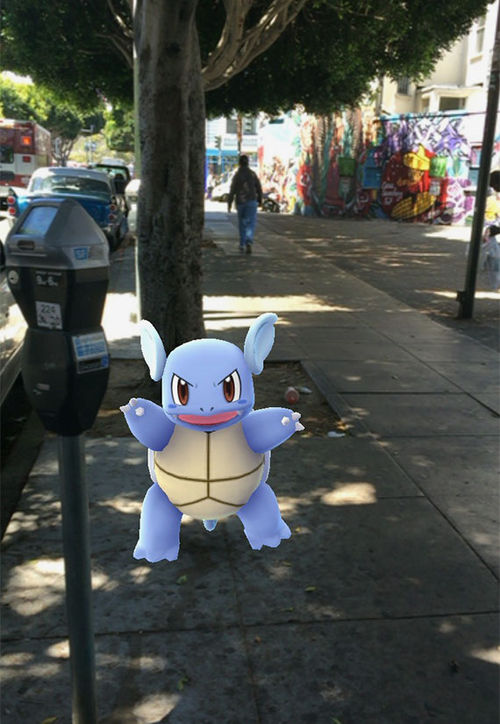
A Wartortle found on the streets of San Francisco. Photo Credit: Sarah Feldberg
The explosion in popularity of the mobile video game Pokemon
Go since it was released on July 6 presented both opportunities and challenges
for travel destinations last week.
The game sends phone-clutching players into the
streets to catch virtual monsters in the real world. According to the app-focused research firm SensorTower, Pokemon Go
had surpassed 15 million installs as of late last week, at a time when it was
only available to smartphone users in the U.S., Australia and New Zealand.
One measure of its popularity is that users are spending
more time playing it (33 minutes daily on average) than they are spending
reading statuses on Facebook (22 minutes) or posting photos on Snapchat (18
minutes).
But the very fact that Pokemon Go forces players to actually
get off the couch and leave their homes also posed challenges and opportunities
for attractions and destinations.
“It came out last Wednesday, and come Monday it was a big
conversation at our marketing meeting,” said Legoland rep Brittany Williams.
Inside the park, she said, “We are definitely seeing a lot more phones out. You
can tell what they’re doing. They’re definitely following their phones around.”
In Manhattan last week, some stores and attractions had
started enthusiastically seeding their properties with Pokemon characters and
“lure modules” as a means of drawing in potential new customers.
On the other hand, Pokemon players were beginning to pose a
problem for attractions like the 9/11 Museum in New York and the Holocaust
Museum in Washington, both of which complained that the game was inappropriate
given the solemnity of their missions.
For the uninitiated in the world of Zubats and Spearows,
Pokemon Go is built around the hunt for cute, cartoonish monsters that populate
streets and other environs. In fact, the name Pokemon is a shortening of
“pocket monsters.”
Players follow GPS maps to designated Pokestops, often
landmarks such as murals or historical buildings, where they collect Pokeballs
used to trap the creatures. The goal of the game is to “catch ’em all” and to
use the resulting menagerie of monsters in battles against other players in “gyms.”
While Pokemon has been around since 1996, Pokemon Go has
taken the game’s virtual universe and incorporated it into the real world using
augmented reality. The game overlays animated characters onto the live,
first-person view on a player’s smartphone, so a Caterpie worm can show up on
your dog’s head or a poison bat can flap above your front door.
“Augmented reality has been around for a while,” said Norm
Rose, an analyst with Phocuswright. “Both virtual reality and augmented reality
can be huge for the travel industry because they allow a user to look at a
destination through their own lens.”
In Amsterdam, for example, Rose pointed to an augmented
reality app that enables visitors to see inside the homes they’re passing as
they float down a canal.
“Pokemon Go is an example of how you can drive engagement
with game-ification,” Rose said.
With so many people playing the game in public, so many
Pokestops set at real-world landmarks and so many monsters showing up virtually
anywhere, Pokemon Go is having a noticeable impact on some attractions.
“Yesterday, there were five teenagers who were looking for a
Pokemon outside my office,” said Cincinnati Zoo communications coordinator
Angela Hatke. She asked the group if they’d come to the zoo, which houses
giraffes, black rhinoceros and polar bears, just to catch virtual animals.
“The only reason they came to the zoo was just for that,”
she said. “They were here just to play.”
Hatke doesn’t necessarily see that as a problem, though it
might seem ironic to chase virtual monsters in a place full of real wild
creatures. She said the zoo is a Pokemon Go hot spot with dozens of Pokestops
located at exhibits like the Reptile House and landmarks like the cheetah
sculpture. As long as visitors stick to public areas and glance up from their
devices enough to not crash into barriers or each other, the zoo is welcoming
Pokemon Go players.
“If people want to come here and play, we’re definitely
encouraging it, but we want them to look up and look around,” Hatke said.
“We’re hoping that they’re absorbing some information and wildlife.”
The zoo has also been exploring the potential benefits of
Pokemon Go. Some employees purchased an in-app “lure,” which increases the rate
of creatures, for a Pokestop near an ice cream stand. The idea is simple: If
you draw players to the area with make-believe monsters, maybe they’ll purchase
a cone to go with that Pikachu.
Likewise, the zoo is actively trying to increase the number
of Pokestops in some of its less popular areas.
“Some exhibits off the beaten path don’t have Pokestops,”
Hatke said. “We’re reaching out to the game to see if we can add them.”
Legoland’s Williams said she had noticed a similar benefit
inside the park.
“The positive for us is that maybe [guests are] exploring
new areas of the park that they don’t normally visit,” she said.
There are 25 Pokestops within Legoland, and so far players
have brought the game inside without incident.
On rides, however, the park is emphasizing its no-devices
policy. No cameras out. No phones out. No trying to catch Pokemon while zooming
past Lego dragons and castles.
SeaWorld Orlando on Saturday promoted a Pokemon Go event, informing guests that it was “activating dozens of Pokemon lure modules,” guaranteeing that players would find “the rarest of the rare Pokemon” inside the park. SeaWorld Orlando has 25 Pokestops and two Pokemon gyms in the park.
Other destinations and attractions have been frustrated with
their unauthorized appearance within the viral app. The Holocaust Museum is the
site of three Pokestops, according to the Washington Post. To the museum’s
dismay, players have begun catching creatures and collecting balls within its
walls.
“Playing the game is not appropriate in the museum, which is
a memorial to the victims of Nazism,” communications director Andrew Hollinger
told the Post. “We are trying to find out if we can get the museum excluded
from the game.”
The Auschwitz Memorial in Poland and Arlington National
Cemetery in Virginia have also lodged online protests regarding their
inclusion. A tweet posted by Arlington reads: “We do not consider playing
Pokemon Go to be appropriate decorum on the grounds of ANC. We ask all visitors
to refrain from such activity.”
At least one property is responding to the Pokemon Go frenzy
by promoting outright abstinence, at least for a limited time.
“To combat this mania and the overall addictive nature of
the digital world,” Mandarin Oriental Las Vegas is hosting a digital detox
weekend retreat Sept. 9 to 11. The itinerary includes yoga, guided meditation,
spa services and zero or restricted access to mobile phones.
“Pikachu, Squirtle and Charizard will be nowhere in sight,”
the hotel’s marketing promises. Because unlike the real world, when you want to
escape Pokemon Go, you can always just turn off your phone.