For the last couple of years, affluent Americans have been shopping more frequently at dollar stores, Costco and Wal-Mart. That’s a strong indicator that the much-touted resilience of the upscale consumer is wearing thin, according to Pam Danziger, president of Unity Marketing, a consulting firm focusing on the buying behavior and motivation of luxury consumers.
Danziger maintains that the spending patterns of today’s affluent consumers — particularly those at the extreme high end of the wealth scale — have changed significantly in the last three years following a short-lived, post-recession rebound in luxury buying in 2010. In fact, even those earning $250,000 and more in annual income  are feeling decidedly middle class, says Danziger, who is also the author of two books on the upscale consumer, including Putting the Luxe Back in Luxury. How New Consumer Values Are Redefining the Way We Market Luxury (Paramount Market Publishing, 2011).
She attributes current press coverage purporting a strong luxury market to superficial reporting by the media and a focus on the wrong data, namely the exceptional growth of giant multinational luxury brand conglomerates with exposure in developing markets including China, India, and Brazil where luxury is a red-hot commodity.
“These companies don't get to be the biggest in the world because they are dummies. They got to be the biggest in the world because they are very, very shrewd,” Danziger said. “Just because they're doing well doesn't necessarily mean that the market is booming. Their revenue growth says more about their success at managing their businesses than it does about the affluent consumer market.”
Danziger spoke with Diane Merlino, editor in chief of Travel Weekly PLUS, about the new realities of today’s upscale consumer and how they will impact the luxury travel market. This is the first of three installments from their dialogue, edited for clarity and length.
Merlino: Some recent press reports paint a very rosy picture of a rebounding luxury consumer, but you say a lot of that information is misleading.
Danziger: One of the key indicators I look at is the monthly retail data that come out of the Department of Commerce Bureau of the U.S. Census Department. I look at the store classification that includes general merchandisers and home furnishings — pretty much any type store that you're going to find in a mall — and also the big boxes like Costco, Wal-Mart, Kmart and Target.
These are the most important retailers, and their numbers in the first three months of this year are down almost 1% from last year. That’s a really huge indicator that consumer spending across the entire economy is off and very weak.
Merlino: But how is that relevant to the affluent market? Those consumers aren’t necessarily shopping in the type of stores you described.
Danziger: There’s that terrible misconception about the affluent consumer market. They're shopping everywhere. They’re shopping at dollar stores, they're shopping at Costco, and they're shopping much less at Neiman Marcus and Saks.
Merlino: How do you know where they’re shopping, Pam?
Danziger: We do a survey every three months with 1,200-plus affluent luxury consumers, which we define as those people in the top 20% of U.S. households in terms of income. So every quarter we're out there taking the pulse of the affluent consumer market, measuring where they're shopping, what they're buying, and their inclinations for future spending. We look at backward indicators as well as forward indicators in terms of their purchase plans and subsequent purchase behavior. And we’re seeing that they are shopping across a wide range of stores.
What’s important to understand about this consumer when it comes to shopping at mass-merchant types of stores is that they don’t have to shop every week at Wal-Mart because they need to stretch their pocketbook. They choose to shop there because they've learned that that's where you can get smart bargains and you can make your money go further.
Affluent consumers are the smartest in the bunch. They're the ones who really know how to stretch a dollar, how to find value, and how to get the most out of the money that they have — and they generally have a lot more than anybody else.
Merlino: There are a lot of different ways to slice and dice the affluent demographic. You include the top 20% of household income earners in your definition of the affluent consumer.
Danziger: We use that figure as the best indicator of affluence based on how the Bureau of Labor Statistics calculates what they call the top quintile. That way I can key right back to government statistics. Annual income for the top 20% of households starts at just about $100,000; about 24 million households fall into that quintile. 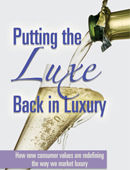
Of that 20%, the top 18% of households earn $100,000 to $250,000 annually. These are the HENRYs — “High Earners, Not Rich Yet.” About 2% of the top 20% have incomes of $250,000 and above. These are the Ultra Affluents. HENRYs are the working affluent, people in upper middle management kinds of positions within corporations. The Ultra Affluents tend to be business owners or very senior executives inside corporations.
Merlino: I think the group you call Ultra Affluents are the top-choice target market for a lot of brands.
Danziger: For many companies in the travel industry, particularly in the luxury travel sector, Ultra Affluents are the most important consumers. But they represent only 2% of U.S. households so they are only a very narrow slice of a much bigger affluent market.
Whereas the Ultra Affluents might travel three, five, seven, or even 10 times a year for personal travel, the HENRYs might travel four or five times a year and spend less. But there are many more of those households, and they represent a significant potential market for luxury companies. HENRYs have a lot of cash, a lot of disposable income. They’re not rich yet, but they're very successful in their careers and in their lifestyles, and they represent a much larger potential market than the very high-flying Ultra Affluents that we find in the top 2%.
Merlino: Pam, you say that the buying behavior of the Ultra Affluents has changed dramatically in the last couple of years. How so?
Danziger: As a result of the recession, Ultra Affluents are starting to behave, spend, and purchase more like HENRYs. We saw this very distinctly in our annual and quarterly tracking surveys over the last few years.
2010 was a banner year for luxury, when Ultra Affluents were buying based on a release of pent-up demand caused by the recession in 2008 and 2009. If we look back to our surveys from 2010, and to the years prior to the recession, Ultra Affluents were spending three or four times more than HENRY households on luxury goods and services. In 2012 they were spending only two times more than HENRY households.
That’s a significant decline in terms of their inclination to spend. So whereas a couple of years ago the top 2% were the primary market for luxury brands, going forward that will become the top 1% or less.
Merlino: What’s behind that drop in spending inclination among the Ultra Affluents?
Danziger: People at the level of $250,000 in household income are without a doubt feeling decidedly middle class in this economy — not affluent, not wealthy, not rich. I think that’s a measure of how bad this economy is for the affluent and how badly they have been hit by changes in taxation and the threats of Obamacare and all the other things we're seeing. Their confidence has really eroded.
It doesn't mean that they can't spend that much any more. It means they are not inclined to do so because they don't feel confident about the direction of the country.
NEXT ISSUE: Pam Danziger on how the aging baby boomer affluents and the emerging Millennial affluents will redefine the market.